
Backed by market attractiveness analysis, total addressable market sizing, company benchmarking matrices, interactive Excel dashboards, wider supply chain intelligence, emerging startup coverage, and detailed product-level insights, The Business Research Company’s 2026 market reports are designed to offer research that is more actionable and strategically valuable than ever.
Methanol Market Revenue Outlook: What CAGR Lies Ahead Through 2030?
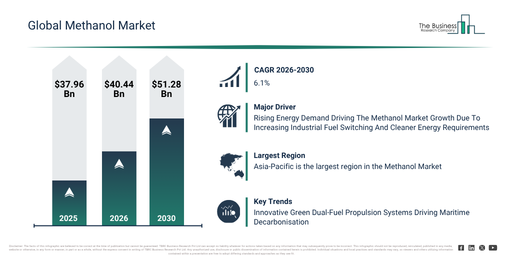
The methanol market has experienced significant expansion in recent years. It is projected to increase from $37.96 billion in 2025 to $40.44 billion in 2026, representing a compound annual growth rate (CAGR) of 6.5%. This historical growth can be attributed to the rising demand for chemical intermediates, increased consumption of methanol in formaldehyde production, growing adoption of methanol as an industrial solvent, expanding automotive fuel blending activities, and its increasing utilization in the construction and manufacturing industries.
The methanol market is anticipated to experience substantial expansion over the upcoming years. Its valuation is projected to reach $51.28 billion by 2030, demonstrating a compound annual growth rate (CAGR) of 6.1%. This growth during the forecast period is driven by several factors, including the escalating demand for green methanol production, the increasing acceptance of methanol as an alternative marine fuel, rising investments in methanol synthesis derived from carbon dioxide, a heightened emphasis on incorporating renewable energy into methanol production, and the expanding need for chemical solutions with low emissions. Key trends anticipated for the forecast period encompass a rising demand for low-carbon and renewable methanol production, its growing adoption as a clean alternative fuel, increased utilization of methanol as a fundamental chemical building block, the expanding development of technologies for methanol derived from biomass and waste, and an increasing need for methanol-based fuel blending applications.
Get A Free Sample Report With In-Depth Market Insights:
Methanol Market Growth Backed By Core Demand Fundamentals
The future expansion of the methanol market is expected to be propelled by the increasing energy demand. Energy demand signifies the overall energy volume required by households, industries, transportation, and other sectors for daily activities and supporting economic growth. This demand is escalating due to population growth, as more individuals necessitate greater energy amounts for basic needs such as electricity, transportation, housing, and industrial production. The growing global energy demand boosts methanol by intensifying the need for efficient, versatile, and cleaner alternative fuels applicable across power generation, transportation, and industrial uses to sustainably meet rising energy consumption. For instance, in February 2025, the International Energy Agency, a France-based government organization, stated that global electricity demand climbed by 4.3% in 2024 and is projected to keep growing at close to 4% annually through 2027. Therefore, the escalating energy demand is stimulating the growth of the methanol market.
Methanol Market Segment Analysis Spotlighting Growth Areas
The methanol market covered in this report is segmented –
1) By Feedstock: Natural Gas, Coal, Biomass, Other Feedstocks
2) By Derivative: Formaldehyde, Acetic Acid, Methyl Tertiary Butyl Ether, Dimethyl Ether, Gasoline Blending, Biodiesel, Solvents, Other Derivatives
3) By Application: Chemical Feedstock, Fuel, Solvent, Antifreeze, Other Applications
4) By End Use Industry: Chemicals, Construction, Automotive, Energy And Power, Electronics, Marine And Shipping, Pharmaceuticals
Subsegments:
1) By Natural Gas: Steam Methane Reforming Based Methanol Production, Combined Reforming Natural Gas Methanol Production, Low Carbon Natural Gas Derived Methanol, Gas To Methanol Processes
2) By Coal: Coal Gasification Based Methanol Production, Coal To Methanol Processes, High Pressure Coal Gasification Methanol Production, Integrated Coal Chemical Methanol Production
3) By Biomass: Biomass Gasification Based Methanol Production, Bio Methanol From Agricultural Waste, Bio Methanol From Forestry Residues, Renewable Bio Methanol Via Synthesis Gas Conversion
4) By Other Feedstocks: Carbon Dioxide Based Methanol Production, Municipal Solid Waste Derived Methanol, Industrial Waste Gas Based Methanol Production, Power To Methanol Green Hydrogen Based Production
Methanol Market Growth Trends Reshaping The Competitive Landscape
Major companies in the methanol market are concentrating on developing innovative solutions, such as green methanol dual-fuel propulsion systems, to advance maritime decarbonisation, improve fuel flexibility, and reduce lifecycle greenhouse gas emissions. These green methanol dual-fuel propulsion systems are marine engine technologies that allow ships to operate on both conventional fossil fuels and green methanol, thereby helping to diminish greenhouse gas emissions, enhance fuel flexibility and energy security, and support a gradual shift to low-carbon shipping without requiring a full replacement of existing engine infrastructure. For example, in January 2026, Cargill Incorporated, a US-based agribusiness commodity trading company, launched the Brave Pioneer, a green methanol dual-fuel dry bulk vessel introduced as part of its broader maritime decarbonisation strategy. The vessel is equipped with advanced propulsion technology that permits switching between conventional fuel and green methanol, which can decrease CO2 emissions by up to 70% compared to traditional fuels, and is being deployed for operational trials across key shipping routes, including Singapore bunkering operations, to evaluate fuel logistics, carbon accounting, and market readiness for low-carbon freight solutions. This initiative highlights the expanding industry adoption of scalable alternative fuel technologies aimed at improving sustainability across global shipping supply chains.
Methanol Market Leading Companies: Who Holds The Strongest Market Presence?
Major companies operating in the methanol market are Methanex Corporation, Zagros Petrochemical Company, Saudi Basic Industries Corporation, BASF SE, Mitsubishi Gas Chemical Company Inc., Proman AG, China Coal Energy Company Limited, Yankuang Energy Group, OCI Global, Celanese Corporation, PETRONAS Chemicals Group Berhad, Deepak Fertilisers and Petrochemicals Corporation Ltd., Gujarat Narmada Valley Fertilizers & Chemicals Ltd., Bushehr Petrochemical Company, Marjan Petrochemical Company, Assam Petro-Chemicals Limited, Sabalan Petrochemical Company, Caribbean Gas Chemical Limited, Fanavaran Petrochemical Company, Shiraz Petrochemical Company
View The Full Methanol Market Report:
Methanol Market Regional Analysis And Top Geography
Asia-Pacific was the largest region in the methanol market in 2025. Asia-Pacific is expected to be the fastest-growing region in the forecast period. The regions covered in the methanol market report are Asia-Pacific, South East Asia, Western Europe, Eastern Europe, North America, South America, Middle East, Africa.
Reach Out To Our Team:
The Business Research Company: https://www.thebusinessresearchcompany.com/
Americas: +1 310-496-7795
Asia: +44 7882 955267 & +91 8897263534
Europe: +44 7882 955267
Email us at: marketing@tbrc.info
Follow us on:
LinkedIn: https://in.linkedin.com/company/the-business-research-company
YouTube: https://www.youtube.com/channel/UC24_fI0rV8cR5DxlCpgmyFQ
Global Market Model: https://www.thebusinessresearchcompany.com/global-market-model

Wasay has over a decade of experience in market research, data modelling, and analytics, with prior experience at GlobalData and Decision Tree Consulting Services. At The Business Research Company , he leads research operations across syndicated studies, customized consulting engagements, and the Global Market Model platform. His professional experience includes supporting organizations such as Boston Consulting Group, KPMG, and Ernst & Young. Wasay holds a degree in Electronics and Communications Engineering, postgraduate management qualifications from International Management Institute Belgium and Indian School of Business and Entrepreneurship, and completed the Integrated Program in Business Analytics from Indian Institute of Management Indore.