Backed by market attractiveness analysis, total addressable market sizing, company benchmarking matrices, interactive Excel dashboards, wider supply chain intelligence, emerging startup coverage, and detailed product-level insights, The Business Research Company’s 2026 market reports are designed to offer research that is more actionable and strategically valuable than ever.
N-(n-propyl) Thiophosphoric Triamide (NTTP) Urease Inhibitor Market Size, Value And Growth Trajectory Through 2030
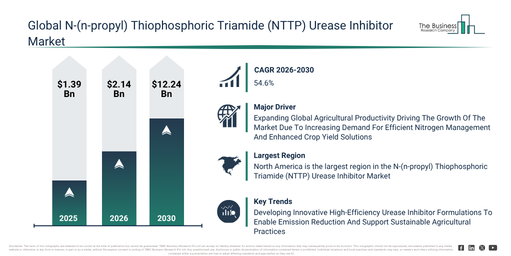
The n-(n-propyl) thiophosphoric triamide (NTTP) urease inhibitor market has experienced significant recent growth. This market is projected to expand from $1.39 billion in 2025 to $2.14 billion in 2026, achieving a compound annual growth rate (CAGR) of 54.4%. Historically, this expansion has been driven by several factors, including the increasing worldwide use of fertilizers in intensive farming practices, a heightened understanding of nitrogen depletion in soil, wider application of urea-based fertilizers, the growing uptake of traditional nitrogen stabilizers in developed regions, and initial regulatory efforts to control agricultural emissions.
The n-(n-propyl) thiophosphoric triamide (NTTP) urease inhibitor market is projected to experience substantial growth over the next few years, reaching $12.24 billion in 2030 at a compound annual growth rate (CAGR) of 54.6%. This anticipated expansion throughout the forecast period is primarily driven by factors such as increasingly stringent environmental regulations concerning nitrogen emissions and ammonia volatilization, a growing demand for fertilizers that enhance nitrogen use efficiency, advancements in precision agriculture and soil health optimization techniques, the greater integration of advanced urease inhibitor technologies in developing economies, and an expanding need for sustainable and climate-smart agricultural inputs. Key developments expected during this period involve the rising acceptance of nitrogen stabilizers to improve fertilizer effectiveness and reduce environmental nitrogen losses, a surging demand for urease inhibitor-augmented fertilizers to support sustainable farming practices, the evolution of precise nutrient management solutions for superior crop yields and soil health, wider application of controlled-release and stabilized nitrogen fertilizer formulations in extensive agricultural operations, and a heightened emphasis on minimizing emissions and ensuring regulatory compliance in the deployment of nitrogen fertilizers.
Get A Free Sample Report With In-Depth Market Insights:
N-(n-propyl) Thiophosphoric Triamide (NTTP) Urease Inhibitor Market Opportunity Drivers: What’s Unlocking New Revenue Potential?
The global increase in agricultural output is projected to fuel the expansion of the N-(n-propyl) thiophosphoric triamide (NPPT) urease inhibitor market in the future. Agricultural productivity refers to the volume of crops or livestock generated per unit of land, labor, or other farming resources utilized. This rise in agricultural output stems from the increasing adoption of advanced farming technologies, which boost efficiency and elevate yields per land unit. N-(n-propyl) thiophosphoric triamide (NPPT) urease inhibitors play a crucial role in fertilizer applications by minimizing nitrogen loss through ammonia volatilization, thus enhancing nitrogen use efficiency and guaranteeing improved nutrient availability for crops, ultimately boosting overall farm productivity. For instance, as reported in April 2024 by the State Council of the People’s Republic of China, a leading administrative body based in China, the country’s grain production reached 695 million tonnes in 2023, marking a 1.3% year-on-year growth. Consequently, the growing global agricultural productivity acts as a key driver for the N-(n-propyl) thiophosphoric triamide (NPPT) urease inhibitor market’s expansion.
N-(n-propyl) Thiophosphoric Triamide (NTTP) Urease Inhibitor Market Segment Trends And Revenue Contributors
The N-(n-propyl) thiophosphoric triamide (NTTP) urease inhibitor market covered in this report is segmented –
1) By Product Type: Granular, Liquid, Powder
2) By Crop Type: Cereals And Grains, Oilseeds And Pulses, Fruits And Vegetables, Other Crop Types
3) By Distribution Channel: Direct Sales, Distributors, Online Retail, Other Distribution Channels
4) By Application: Agriculture, Horticulture, Turf And Ornamental, Other Applications
5) By End User: Farmers, Agrochemical Companies, Fertilizer Manufacturers
Subsegments:
1) By Granular: Coated Granular NPPT Urease Inhibitor, Slow Release Granular NPPT Urease Inhibitor, Blended Granular Fertilizer Formulations, Controlled Release Granular Fertilizer Products
2) By Liquid: Emulsifiable Liquid NPPT Urease Inhibitor, Suspension Concentrate Liquid Formulation, Aqueous Solution Based Inhibitor, Liquid Fertilizer Additive Blends
3) By Powder: Dry Powder NPPT Urease Inhibitor, Water Soluble Powder Formulation, Blended Powder Fertilizer Additives, Micro Fine Powder Stabilizer Formulation
N-(n-propyl) Thiophosphoric Triamide (NTTP) Urease Inhibitor Market Innovation Trends Shaping Future Development
Major companies within the N-(n-propyl) thiophosphoric triamide (NPPT) urease inhibitor market are prioritizing the development of novel, advanced effectiveness urease inhibitor formulations, such as climate-smart inhibitor-integrated fertilizers, to facilitate quantifiable reductions in emissions and contribute to sustainability objectives. These climate-smart inhibitor-integrated fertilizers represent formulations that incorporate monitoring mechanisms designed to measure the decrease in greenhouse gas emissions and enhance the efficiency of nitrogen utilization during fertilizer application. For instance, in October 2023, BASF SE, a Germany-based chemical company, launched a climate-smart fertilizer program using Limus urease inhibitor technology in collaboration with Yuntianhua. This particular fertilizer solution aims to mitigate ammonia and nitrous oxide emissions during application, simultaneously optimizing nitrogen access for crops under field conditions. Furthermore, it enables third-party validation of emission reductions, ensuring agricultural methods conform to sustainability criteria and carbon accountability benchmarks. This introduction marks a notable technological stride by combining urease suppression with emissions tracking, thereby connecting conventional fertilizer application with environmentally intelligent farming techniques. It provides a versatile and effective approach for mitigating ecological effects, boosting nutrient uptake, and contributing to worldwide sustainability and carbon abatement efforts in agriculture.
N-(n-propyl) Thiophosphoric Triamide (NTTP) Urease Inhibitor Market Competitive Landscape: Which Companies Lead The Industry?
Major companies operating in the n-(n-propyl) thiophosphoric triamide (nttp) urease inhibitor market are BASF SE, Nutrien Ltd., Corteva Agriscience, EuroChem Group AG, ICL Group Ltd., CF Industries Holdings Inc., Incitec Pivot Fertilisers, UPL Limited, Nufarm Limited, Timac Agro International, Coromandel International Limited, Yara International ASA, Gujarat State Fertilizers & Chemicals Limited (GSFC), Helm AG, Uralchem JSC, Haifa Group, Loveland Products Inc., Luxi Group Co. Ltd., Koch Fertilizer LLC, Jiangsu Jinma Chemical Co. Ltd.
View The Full N-(n-propyl) Thiophosphoric Triamide (NTTP) Urease Inhibitor Market Report:
N-(n-propyl) Thiophosphoric Triamide (NTTP) Urease Inhibitor Market Regional Outlook: Where Is Opportunity Concentrated?
North America was the largest region in the N-(n-propyl) thiophosphoric triamide (NPPT) urease inhibitor market in 2025. Asia-Pacific is expected to be the fastest-growing region in the forecast period. The regions covered in the N-(n-propyl) thiophosphoric triamide (NTTP) urease inhibitor market report are Asia-Pacific, South East Asia, Western Europe, Eastern Europe, North America, South America, Middle East, Africa.
Reach Out To Our Team:
The Business Research Company: https://www.thebusinessresearchcompany.com/
Americas: +1 310-496-7795
Asia: +44 7882 955267 & +91 8897263534
Europe: +44 7882 955267
Email us at: marketing@tbrc.info
Follow us on:
LinkedIn: https://in.linkedin.com/company/the-business-research-company
YouTube: https://www.youtube.com/channel/UC24_fI0rV8cR5DxlCpgmyFQ
Global Market Model: https://www.thebusinessresearchcompany.com/global-market-model

Wasay has over a decade of experience in market research, data modelling, and analytics, with prior experience at GlobalData and Decision Tree Consulting Services. At The Business Research Company , he leads research operations across syndicated studies, customized consulting engagements, and the Global Market Model platform. His professional experience includes supporting organizations such as Boston Consulting Group, KPMG, and Ernst & Young. Wasay holds a degree in Electronics and Communications Engineering, postgraduate management qualifications from International Management Institute Belgium and Indian School of Business and Entrepreneurship, and completed the Integrated Program in Business Analytics from Indian Institute of Management Indore.