
Backed by market attractiveness analysis, total addressable market sizing, company benchmarking matrices, interactive Excel dashboards, wider supply chain intelligence, emerging startup coverage, and detailed product-level insights, The Business Research Company’s 2026 market reports are designed to offer research that is more actionable and strategically valuable than ever.
Para-Xylene Market Poised To Hit $77.41 Billion By 2030 With A 6.93% CAGR
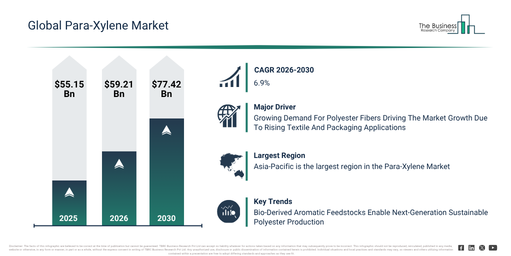
The para-xylene market has demonstrated robust expansion recently. It is forecast to advance from $55.15 billion in 2025 to $59.21 billion in 2026, achieving a compound annual growth rate (CAGR) of 7.4%. This historical growth stemmed from factors such as increasing demand for polyester fibers, higher PET packaging consumption, the enlargement of global petrochemical production capacity, escalating textile manufacturing activities, and increased uptake of purified terephthalic acid.
The para-xylene market is projected to experience robust expansion over the coming years, reaching a valuation of $77.42 billion by 2030, driven by a compound annual growth rate (CAGR) of 6.9%. This anticipated growth during the forecast period is primarily fueled by factors such as the increasing need for sustainable PET packaging, greater investments in bio based para xylene manufacturing, rising polyester consumption in automotive sectors, an uptick in capacity enhancements within integrated refinery complexes, and a growing requirement for high-performance packaging solutions. Key trends shaping the market during this period encompass the expanding production capacity of purified terephthalic acid, a rising demand for high purity para xylene feedstock, increased capital allocation towards integrated aromatics production facilities, the broadening of petrochemical refinery capacities in developing nations, and the growing embrace of bio based para xylene production methods.
Get A Free Sample Report With In-Depth Market Insights:
Para-Xylene Market Growth Backed By Core Demand Fundamentals
The increasing need for polyester fibers is anticipated to drive the expansion of the para-xylene market in the future. These synthetic fibers find extensive application in sectors like textiles, clothing, home decor, and industrial uses, owing to their lasting nature, cost-effectiveness, and resilience against shrinkage and creasing. The fast-fashion sector is fueling the rise in polyester fiber demand, as companies create vast quantities of inexpensive, frequently updated clothing lines. Polyester is favored for its low cost, durability, ease of large-scale production, and suitability for quick mass manufacturing. Crucially, para-xylene acts as a primary raw material for purified terephthalic acid (PTA), which facilitates the creation of strong, light, and robust polyester fibers utilized throughout textile applications. As an illustration, the Textile Exchange, a US-based non-profit, reported in September 2025 that the volume of polyester fiber production rose from around 71 million tonnes in 2023 to approximately 78 million tonnes in 2024. Consequently, the expanding demand for polyester fibers is propelling the growth of the para-xylene market.
Para-Xylene Market Segment Landscape And Growth Outlook
The para-xylene market covered in this report is segmented –
1) By Production Process: Catalytic Reforming, Toluene Disproportionation, Steam Cracking, Other Production Processes
2) By Distribution Channel: Direct Sales, Distributors And Traders, Online Procurement Platforms
3) By Application: Purified Terephthalic Acid, Dimethyl Terephthalate, Solvents, Other Applications
4) By End Use Industry: Textiles, Packaging, Plastics, Automotive, Other End Use Industries
Subsegments:
1) By Catalytic Reforming: Continuous Catalytic Reforming Processes, Semi Regenerative Catalytic Reforming Processes, Platinum Based Catalytic Reforming Processes, Naphtha Feed Catalytic Reforming Processes
2) By Toluene Disproportionation: Catalytic Toluene Disproportionation Processes, Hydrogen Assisted Toluene Disproportionation Processes, High Selectivity Toluene Disproportionation Processes, Integrated Aromatics Conversion Processes
3) By Steam Cracking: Naphtha Steam Cracking Processes, Ethane Steam Cracking Processes, Propane Steam Cracking Processes, Mixed Feed Steam Cracking Processes
4) By Other Production Processes: Xylene Isomerization Processes, Methanol To Aromatics Processes, Coal Based Aromatics Production Processes, Bio Based Para Xylene Production Processes
Para-Xylene Market Innovation Trends: What Developments Are Reshaping The Industry?
Leading enterprises within the para-xylene market are dedicating efforts to creating environmentally friendly bio-based para-xylene alternatives, with the aim of lowering carbon footprints, diminishing reliance on new petroleum raw materials, and promoting circular packaging endeavors. Bio-paraxylene signifies para-xylene derived from renewable organic sources like used cooking oil, capable of being transformed into terephthalic acid (TPA) essential for manufacturing PET resin. As an illustration, in October 2024, Suntory Group, a beverage producer based in Japan, unveiled the globe’s inaugural commercial PET bottles employing bio-paraxylene sourced from used cooking oil. This undertaking forms part of an extensive collaborative effort involving entities like ENEOS Corporation, Mitsubishi Corporation, Neste, Mitsui Chemicals, Indorama Ventures, and Iwatani Corporation, aiming to forge a completely integrated bio-based supply chain. Within this framework, used cooking oil undergoes conversion into bio-naphtha, subsequently processed into bio-paraxylene, and ultimately utilized for crafting PET resin for beverage containers. The resultant PET bottles achieve a notable reduction in CO2 emissions when contrasted with traditional petroleum-derived PET bottles, all while preserving complete compatibility with current recycling and bottle-to-bottle closed-loop systems.
Para-Xylene Market Competitive Landscape: Who Leads The Industry?
Major companies operating in the para-xylene market are ExxonMobil Corporation, Saudi Basic Industries Corporation, PetroChina Company Limited, Reliance Industries Limited, China Petroleum & Chemical Corporation, SK Innovation Co. Ltd., Hengli Petrochemical Co. Ltd., Formosa Chemicals & Fibre Corporation, Indian Oil Corporation Limited, Mitsubishi Chemical Group Corporation, Idemitsu Kosan Co. Ltd., Lotte Chemical Corporation, Indorama Ventures Public Company Limited, GS Caltex Corporation, Alpek S.A.B. de C.V., Hanwha TotalEnergies Petrochemical Co. Ltd., Zhejiang Petrochemical Co. Ltd., Petroliam Nasional Berhad, CPC Corporation Taiwan, Chevron Phillips Chemical Company LLC, Rongsheng Petrochemical Co. Ltd.
View The Full Para-Xylene Market Report:
Para-Xylene Market Geographic Spread And Regional Opportunities
Asia-Pacific was the largest region in the para-xylene market in 2025. Asia-Pacific is expected to be the fastest-growing region in the forecast period. The regions covered in the para-xylene market report are Asia-Pacific, South East Asia, Western Europe, Eastern Europe, North America, South America, Middle East, Africa.
Reach Out To Our Team:
The Business Research Company: https://www.thebusinessresearchcompany.com/
Americas: +1 310-496-7795
Asia: +44 7882 955267 & +91 8897263534
Europe: +44 7882 955267
Email us at: marketing@tbrc.info
Follow us on:
LinkedIn: https://in.linkedin.com/company/the-business-research-company
YouTube: https://www.youtube.com/channel/UC24_fI0rV8cR5DxlCpgmyFQ
Global Market Model: https://www.thebusinessresearchcompany.com/global-market-model

Wasay has over a decade of experience in market research, data modelling, and analytics, with prior experience at GlobalData and Decision Tree Consulting Services. At The Business Research Company , he leads research operations across syndicated studies, customized consulting engagements, and the Global Market Model platform. His professional experience includes supporting organizations such as Boston Consulting Group, KPMG, and Ernst & Young. Wasay holds a degree in Electronics and Communications Engineering, postgraduate management qualifications from International Management Institute Belgium and Indian School of Business and Entrepreneurship, and completed the Integrated Program in Business Analytics from Indian Institute of Management Indore.