Backed by market attractiveness analysis, total addressable market sizing, company benchmarking matrices, interactive Excel dashboards, wider supply chain intelligence, emerging startup coverage, and detailed product-level insights, The Business Research Company’s 2026 market reports are designed to offer research that is more actionable and strategically valuable than ever.
Perfumes Market Size Outlook: How Quickly Will Revenue Expand Through 2030?
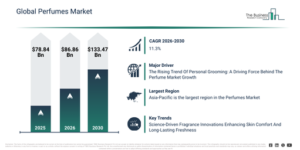
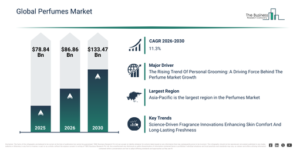
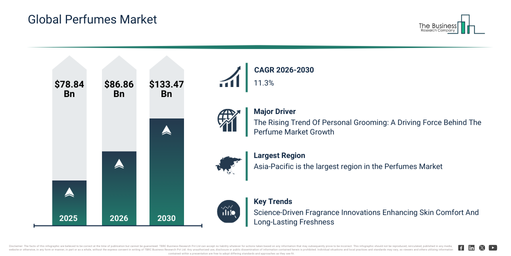
The perfumes market has experienced substantial growth in recent years. It is projected to expand from $78.84 billion in 2025 to $86.86 billion in 2026, demonstrating a compound annual growth rate (CAGR) of 10.2%. This historical growth can be attributed to the rise of personal grooming culture, the proliferation of fashion and luxury brands, increasing disposable income levels, the significant influence of celebrity endorsements, and the longstanding cultural use of fragrances.
The perfumes market is set for significant expansion in the coming years. It is forecast to grow to $133.47 billion by 2030, demonstrating a compound annual growth rate (CAGR) of 11.3%. This anticipated growth during the forecast period stems from factors such as increasing consumer interest in unisex fragrances, the expansion of e-commerce platforms for fragrance sales, a heightened focus on sustainable perfumes, the broadening of premiumization trends, and the rising influence of digital marketing. Prominent trends for this period encompass a growing demand for premium and luxury fragrances, the increasing appeal of niche and artisan perfumes, a stronger preference for long-lasting scents, the proliferation of online perfume sales channels, and an escalating consumer interest in natural fragrance ingredients.
Get A Free Sample Report With In-Depth Market Insights:
Perfumes Market Growth Momentum: What Factors Are Shaping Demand?
The increasing popularity of personal grooming is anticipated to fuel the expansion of the perfume market. Personal grooming encompasses practices focused on maintaining one’s appearance and hygiene, involving various routines to ensure a clean, well-kept, and presentable look. Perfumes frequently serve as a component of these personal grooming habits, helping individuals enhance their fragrance, convey their unique style, and make a favorable impression. For example, Cosmetica Italia, an Italy-based national trade association, reported in September 2024 that Italy’s cosmetics market demonstrated continued strength at the close of 2023, achieving a value of $14.5 billion (€12,530 million), which signifies a 9.4% increase over 2022. Furthermore, the overall turnover for the cosmetics industry reached $17.5 billion (€15.1 billion). Consequently, the rising trend of personal grooming is acting as a key driver for the growth of the perfume market.
Perfumes Market Segmentation: How Does The Market Break Down By Category?
The perfumes market covered in this report is segmented –
1) By Product: Mass, Premium
2) By Distribution Channel: Offline, Online
3) By End-User Sex: Women, Men, Unisex
Subsegments:
1) By Mass: Designer Mass Fragrances, Celebrity-Endorsed Mass Fragrances, Drugstore and Value Brand Fragrances
2) By Premium: Luxury Fragrances, Niche and Artisan Fragrances, High-End Designer Fragrances
Perfumes Market Trends Redefining Industry Growth
Major companies operating in the perfume market are developing advanced, science-backed fragrance ingredients and formulations, such as natural actives, that enhance skin comfort, regulate odor-causing bacteria, and deliver longer-lasting freshness to meet rising consumer demand for multifunctional, skin-friendly scent solutions. For instance, in March 2024, Silab, a France-based cosmetic company, launched Deolya, a natural deodorant active ingredient derived from Spiraea ulmaria L., designed to combine underarm hygiene with skin care. It soothes irritation, strengthens the skin barrier, and reduces inflammation, showing notable improvement in discomfort after shaving or epilation after 28 days. Deolya also targets malodor-causing bacteria, particularly Staphylococcus hominis, by regulating its abundance and enzymatic activity. Clinical studies show a 58% reduction in body odor from the first application and a 76.3% drop in malodorous 3M3SH thiol, even with continued effects after a week of daily use.
Perfumes Market Competitive Overview And Top Companies
Major companies operating in the perfumes market are LVMH, L’Oréal S.A., PUIG, Hermès International, Shiseido Company, Limited, Coty Inc., Estée Lauder Companies Inc., Chanel Limited, Interparfums, Inc., Natura & Co, Avon Products, Inc., Revlon, Inc., Ajmal Perfumes, Rasasi Perfumes, Arabian Oud, Abdul Samad Al Qurashi, The Fragrance Kitchen (TFK), Amouage, Creed Fragrances, Zoologist Perfumes, Libertine Fragrance, Givaudan
View The Full Perfumes Market Report:
Perfumes Market Global Footprint: Which Region Leads The Industry?
Asia-Pacific was the largest region in the perfumes market in 2025. Western Europe was the second-largest region in the global perfumes market. The regions covered in the perfumes market report are Asia-Pacific, South East Asia, Western Europe, Eastern Europe, North America, South America, Middle East, Africa
Reach Out To Our Team:
The Business Research Company: https://www.thebusinessresearchcompany.com/
Americas: +1 310-496-7795
Asia: +44 7882 955267 & +91 8897263534
Europe: +44 7882 955267
Email us at: marketing@tbrc.info
Follow us on:
LinkedIn: https://in.linkedin.com/company/the-business-research-company
YouTube: https://www.youtube.com/channel/UC24_fI0rV8cR5DxlCpgmyFQ
Global Market Model: https://www.thebusinessresearchcompany.com/global-market-model

Wasay has over a decade of experience in market research, data modelling, and analytics, with prior experience at GlobalData and Decision Tree Consulting Services. At The Business Research Company , he leads research operations across syndicated studies, customized consulting engagements, and the Global Market Model platform. His professional experience includes supporting organizations such as Boston Consulting Group, KPMG, and Ernst & Young. Wasay holds a degree in Electronics and Communications Engineering, postgraduate management qualifications from International Management Institute Belgium and Indian School of Business and Entrepreneurship, and completed the Integrated Program in Business Analytics from Indian Institute of Management Indore.