Delivering more actionable and strategically valuable research, The Business Research Company’s 2026 market reports feature market attractiveness analysis, total addressable market evaluation, company benchmarking matrices, interactive Excel dashboards, expanded supply chain intelligence, emerging startup coverage, and detailed product insights.
Polymeric Biomaterials Market Value Expansion And Long-Term Growth Outlook
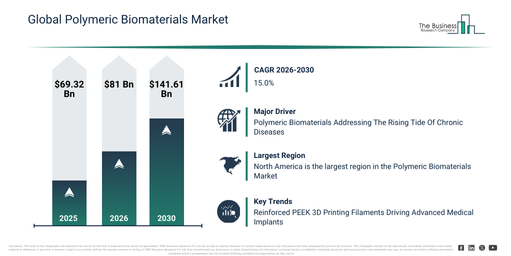
The polymeric biomaterials market has shown substantial growth in recent years. This market is projected to expand from $69.32 billion in 2025 to $81 billion in 2026, demonstrating a compound annual growth rate (CAGR) of 16.8%. Previously, this growth was primarily influenced by factors including the demand for medical implants, an increase in surgical procedures, innovations in polymer science, the enlargement of hospital infrastructure, and the integration of healthcare technology.
The polymeric biomaterials market is anticipated to experience considerable growth in the near future. Its valuation is projected to hit $141.61 billion by 2030, supported by a vigorous compound annual growth rate (CAGR) of 15.0%. This projected expansion is primarily fueled by factors such as the healthcare demands of an aging population, advancements in regenerative medicine, an increase in minimally invasive surgical procedures, developments in personalized medicine, and new breakthroughs in biodegradable polymers.
Key trends identified for the upcoming period include the greater integration of these substances into tissue engineering, their wider application in drug delivery systems, the broad development of biodegradable implant materials, a heightened demand for advanced surgical polymers, and a deliberate concentration on personalized medical biomaterials.
Download A Free Sample Report For Comprehensive Market Insights:
Polymeric Biomaterials Market Development Factors: Which Trends Are Supporting Demand?
The polymer nanocomposites market is expected to grow, driven by heightened demand in the automotive sector. This industry encompasses all businesses and efforts involved in manufacturing motor vehicles, including the production of key components such as engines, bodywork, tires, batteries, and gasoline. Within the automobile industry, polymer nanocomposites are primarily utilized for interior and exterior vehicle applications. They are applied across diverse systems, including engines and powertrains, suspensions, and braking systems, aimed at reducing vehicle weight and improving engine economy, while simultaneously enhancing comfort and drivability. Consequently, the polymer nanocomposites market is experiencing expansion. For example, in March 2024, the European Automobile Manufacturers Association, a Belgium-based organization of leading automobile manufacturers, reported that the EU car market saw a robust expansion of 13.9% in 2023 compared to 2022, reaching a volume of 10.5 million units. Furthermore, according to Take-Profit.org, a US-based financial and analytical information provider, US car production increased to 1.87 million units (1870 K units) in March 2023. The total volume ranged from 0.01 million units to 9.92 million units, and in Brazil, production grew by 221.835k units from 161.518k units. Therefore, the rising demand within the automotive sector is propelling the growth of the polymer nanocomposites market.
Polymeric Biomaterials Market Segments: Where Are The Largest Growth Opportunities?
The polymeric biomaterials market covered in this report is segmented –
1) By Product: Polylactic Acid, Polyglycolic Acid, Polyurethanes, Polytetrafluoroethylene, Polyaryletherketone, Polydioxanone, Other Products
2) By Application: Cardiovascular, Dental, Orthopedic, Plastic Surgery, Other Applications
3) By End-User: Hospitals, Clinics, Other End-users
Subsegments:
1) By Polylactic Acid (PLA): PLA-Based Scaffolds, PLA-Based Sutures And Stents
2) By Polyglycolic Acid (PGA): PGA-Based Sutures, PGA-Based Scaffolds
3) By Polyurethanes: Polyurethane-Based Wound Dressings, Polyurethane-Based Implants
4) By Polytetrafluoroethylene (PTFE): PTFE-Based Vascular Grafts, PTFE-Based Membranes
5) By Polyaryletherketone (PAEK): PAEK-Based Implants, PAEK-Based Prosthetics
6) By Polydioxanone (PDO): PDO-Based Sutures, PDO-Based Drug Delivery Systems
7) By Other Products: Biodegradable Polymers, Natural Polymers
Polymeric Biomaterials Market Transformation Trends: Which Innovations Are Driving Change?
Top companies within the polymeric biomaterials market are focusing on developing sophisticated innovations, such as reinforced PEEK 3D printing filaments, to gain a competitive edge. These reinforced PEEK 3D printing filaments are high-performance polymer biomaterials enriched with carbon fiber, enabling the extrusion-based 3D printing of customized medical implants that offer superior strength, excellent biocompatibility, and a metal-free design. For instance, in October 2023, Evonik Industries AG, a Germany-based specialty chemicals company, unveiled VESTAKEEP iC4620 3DF (and its 12% carbon fiber equivalent, VESTAKEEP iC4612 3DF). These filaments provide a high strength-to-weight ratio, allow for control over fiber alignment during printing to enhance mechanical properties, and possess full biocompatibility for medical implants intended for long-term body contact. Such material innovations facilitate the shift towards patient-specific, 3D-printed implants capable of competing with traditional metal devices, though manufacturers must navigate process complexity and uphold stringent quality control for consistent mechanical properties.
Polymeric Biomaterials Market Major Participants And Competitive Dynamics
Major companies operating in the polymeric biomaterials market are BASF SE, 3M Company, Medtronic plc, Toray Industries Inc., Evonik Industries AG, Covestro AG, Stryker Corporation, Solvay SA, DuPont Biomaterials, Arkema Group, Mitsubishi Chemical Holdings Inc., Celanese Corporation, Royal DSM, TEIJIN Limited, Zimmer Biomet Holdings Inc., Dentsply Sirona Inc., W. L. Gore & Associates Inc., Corbion NV, Integra LifeSciences Holdings Corporation, Victrex plc, Collagen Matrix, Berkeley Advanced Biomaterials, Bezwada Biomedical LLC, Covation Biomaterials, Starch Medical Inc.
Access The Complete Polymeric Biomaterials Market Report:
Polymeric Biomaterials Market Geographic Landscape: Which Region Dominates Industry Growth?
North America was the largest region in the polymeric biomaterials market in 2025. Asia-Pacific is expected to be the fastest-growing region in the forecast period. The regions covered in the polymeric biomaterials market report are Asia-Pacific, South East Asia, Western Europe, Eastern Europe, North America, South America, Middle East, Africa
Get in touch with us:
The Business Research Company: https://www.thebusinessresearchcompany.com/
Americas: +1 310-496-7795
Asia: +44 7882 955267 & +91 8897263534
Europe: +44 7882 955267
Email us at: marketing@tbrc.info
Follow us on:
LinkedIn: https://in.linkedin.com/company/the-business-research-company
YouTube: https://www.youtube.com/channel/UC24_fI0rV8cR5DxlCpgmyFQ
Global Market Model: https://www.thebusinessresearchcompany.com/global-market-model

Wasay has over a decade of experience in market research, data modelling, and analytics, with prior experience at GlobalData and Decision Tree Consulting Services. At The Business Research Company , he leads research operations across syndicated studies, customized consulting engagements, and the Global Market Model platform. His professional experience includes supporting organizations such as Boston Consulting Group, KPMG, and Ernst & Young. Wasay holds a degree in Electronics and Communications Engineering, postgraduate management qualifications from International Management Institute Belgium and Indian School of Business and Entrepreneurship, and completed the Integrated Program in Business Analytics from Indian Institute of Management Indore.