Featuring market attractiveness scoring, total addressable market sizing, company benchmarking matrices, interactive Excel dashboards, deeper supply chain intelligence, emerging startup tracking, and granular product-level insights, The Business Research Company’s 2026 market reports are built to deliver research that is both more actionable and more strategically valuable.
Renewable Naphtha Market Revenue Outlook: What CAGR Lies Ahead Through 2030?
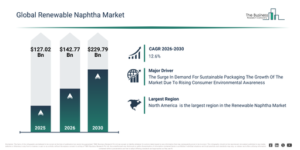
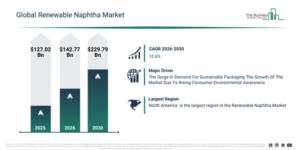
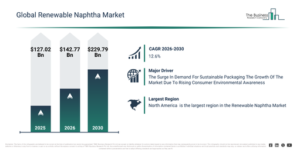
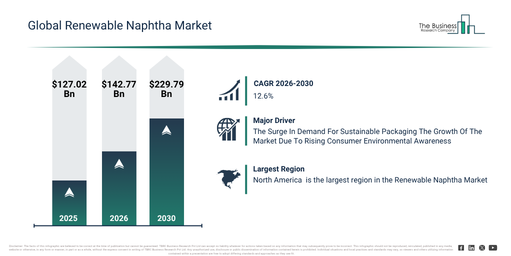
The market size for renewable naphtha has demonstrated significant growth over the past few years. Projections indicate it will expand from $127.02 billion in 2025 to $142.77 billion in 2026, registering a compound annual growth rate (CAGR) of 12.4%. Historically, this expansion was driven by factors such as a strong reliance on fossil-based naphtha feedstocks that restricted renewable adoption, insufficient scalable infrastructure for biomass processing, the elevated expenses associated with producing renewable hydrocarbon alternatives, minimal regulatory impetus for reducing carbon intensity within the petrochemical sector, and the nascent stage of waste-to-fuel conversion technologies.
The renewable naphtha market size is anticipated to undergo rapid growth over the next few years. It is projected to expand to $229.79 billion in 2030, achieving a compound annual growth rate (CAGR) of 12.6%. The expansion during the forecast period is attributable to several factors, such as more stringent global carbon emission regulations fueling renewable naphtha demand, increased investments in bio-refineries and circular feedstock supply chains, the rising adoption of sustainable aviation fuel and green plastics boosting feedstock demand, advancements in catalytic and pyrolysis technologies improving yield efficiency, and corporate net-zero commitments prompting greater procurement of low-carbon feedstocks. Prominent trends expected during this period include the expansion of waste-to-chemicals based renewable naphtha production, increasing adoption of bio-based feedstock diversification strategies, a growing integration of circular economy models within petrochemical value chains, the development of low-carbon fuel certification and traceability systems, and the broader application of advanced catalytic conversion technologies for biomass upgrading.
Get A Free Sample Report With In-Depth Market Insights:
Renewable Naphtha Market Growth Factors: What’s Supporting Expansion?
The increasing demand for sustainable packaging is expected to stimulate the growth of the renewable naphtha market in the coming years. Sustainable packaging involves the design and utilization of packaging materials and systems that reduce environmental harm by minimizing waste, employing renewable or recyclable resources, and improving efficiency across the product’s entire lifecycle. This surge in demand for sustainable packaging primarily stems from heightened environmental awareness among both consumers and businesses, which is prompting a shift towards eco-friendly materials to lessen pollution and reduce plastic waste. Renewable naphtha facilitates sustainable packaging by serving as a low-carbon feedstock for the creation of bio-based plastics and polymers, thereby decreasing reliance on fossil resources and lowering overall packaging-related emissions. For instance, in April 2023, the 2023 Buying Green Report by Trivium Packaging, a Netherlands-based sustainable packaging company, indicated that 82% of consumers were willing to pay more for sustainable packaging, marking a 4% increase from 2022. Consequently, the rising demand for sustainable packaging is driving the expansion of the renewable naphtha market. The escalating investments in net-zero initiatives are projected to fuel the growth of the renewable naphtha market in the future. Investments in net-zero refer to financial commitments made by governments, corporations, or investors towards projects, technologies, and efforts aimed at reducing greenhouse gas emissions to as close to zero as possible by balancing emitted and removed carbon. These increasing investments in net-zero are mainly driven by tightening climate regulations that compel governments and businesses to cut greenhouse gas emissions, meet legally binding targets, and accelerate the transition toward low-carbon and sustainable energy systems. Such investments lead to greater funding for low-carbon fuel technologies and circular carbon solutions, thereby accelerating the production and adoption of renewable naphtha as a sustainable alternative to fossil-based feedstocks. For example, in September 2023, according to Allen Overy Shearman Sterling LLP, a UK-based law firm, climate finance investment needs to be rapidly and substantially increased, with the estimated cumulative funding required to achieve Net Zero by 2050 rising to USD 226 trillion, up from USD 200 trillion last year. Therefore, the growing investments in net-zero are driving the growth of the renewable naphtha market.
Renewable Naphtha Market Segment Analysis: What Are The Core Market Categories?
The renewable naphtha market covered in this report is segmented –
1) By Product Type: Light Naphtha, Heavy Naphtha
2) By Source: Biomass, Vegetable Oils, Animal Fats, Municipal Solid Waste, Other Sources
3) By Distribution Channel: Direct, Indirect
4) By Application: Petrochemicals, Gasoline Blending, Plastics, Other Applications
5) By End-Use Industry: Automotive, Chemicals, Energy, Other End-Users
Subsegments:
1) By Light Naphtha: Paraffinic Light Naphtha, Isomerized Light Naphtha, Reformulated Light Naphtha, Straight Run Light Naphtha
2) By Heavy Naphtha: Paraffinic Heavy Naphtha, Aromatic Rich Heavy Naphtha, Catalytically Reformed Heavy Naphtha, Cracked Heavy Naphtha
Renewable Naphtha Market Competitive Landscape: Which Companies Lead The Industry?
Major companies operating in the renewable naphtha market are Shell plc, TotalEnergies SE, BP p.l.c., Chevron Corporation, Valero Energy Corporation, Phillips 66 Co., Eni S.p.A., Petroliam Nasional Berhad, ENEOS Corporation, Indian Oil Corporation Limited, Repsol S.A., SK Innovation Co. Ltd., OMV Aktiengesellschaft, Neste Oyj, Galp Energia SGPS S.A., INEOS Group, Emirates National Oil Company Limited, UPM-Kymmene Corporation, World Energy LLC, Diamond Green Diesel LLC.
View The Full Renewable Naphtha Market Report:
Renewable Naphtha Market Regional Breakdown: Where Is Demand Concentrated?
North America was the largest region in the renewable naphtha market in 2025. Asia-Pacific is expected to be the fastest-growing region in the forecast period. The regions covered in the renewable naphtha market report are Asia-Pacific, South East Asia, Western Europe, Eastern Europe, North America, South America, Middle East, Africa.
Reach Out To Our Team:
The Business Research Company: https://www.thebusinessresearchcompany.com/
Americas: +1 310-496-7795
Asia: +44 7882 955267 & +91 8897263534
Europe: +44 7882 955267
Email us at: marketing@tbrc.info
Follow us on:
LinkedIn: https://in.linkedin.com/company/the-business-research-company
YouTube: https://www.youtube.com/channel/UC24_fI0rV8cR5DxlCpgmyFQ
Global Market Model: https://www.thebusinessresearchcompany.com/global-market-model

Wasay has over a decade of experience in market research, data modelling, and analytics, with prior experience at GlobalData and Decision Tree Consulting Services. At The Business Research Company , he leads research operations across syndicated studies, customized consulting engagements, and the Global Market Model platform. His professional experience includes supporting organizations such as Boston Consulting Group, KPMG, and Ernst & Young. Wasay holds a degree in Electronics and Communications Engineering, postgraduate management qualifications from International Management Institute Belgium and Indian School of Business and Entrepreneurship, and completed the Integrated Program in Business Analytics from Indian Institute of Management Indore.