
Featuring market attractiveness scoring, total addressable market sizing, company benchmarking matrices, interactive Excel dashboards, deeper supply chain intelligence, emerging startup tracking, and granular product-level insights, The Business Research Company’s 2026 market reports are built to deliver research that is both more actionable and more strategically valuable.
Reverse Osmosis (RO) Antiscalant Market Value Analysis: What Growth Lies Ahead Over The Forecast Period?
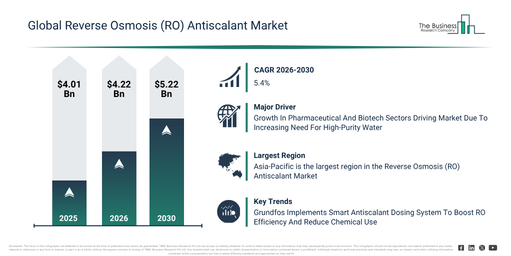
The reverse osmosis (RO) antiscalant market size has seen substantial growth over recent years. It is anticipated to expand from $4.01 billion in 2025 to $4.22 billion in 2026, achieving a compound annual growth rate (CAGR) of 5.2%. The expansion observed in the past can be attributed to factors like the increasing utilization of RO systems, the rising prevalence of scaling issues in water treatment processes, the adoption of phosphorus-based antiscalants, the development of municipal and industrial water infrastructure, and the demand for extended membrane lifespan.
The reverse osmosis (RO) antiscalant market is projected to experience substantial expansion over the upcoming years. This market is forecasted to reach $5.22 billion by 2030, exhibiting a compound annual growth rate (CAGR) of 5.4%. Factors contributing to this growth during the forecast period include the increasing uptake of both synthetic polymeric and natural green antiscalants, the proliferation of seawater desalination initiatives, the rising number of industrial water treatment uses, a heightened emphasis on environmental regulations, and the creation of sophisticated antiscalant formulations tailored for diverse water chemistries. Key trends anticipated during this period involve the greater acceptance of green and biodegradable antiscalants, a surge in demand for liquid antiscalant products, the expanding incorporation of RO antiscalants within industrial water treatment processes, wider application of antiscalants in seawater desalination facilities, and an intensified focus on inhibiting scale in water systems utilized by the pharmaceutical and food & beverage sectors.
Get A Free Sample Report With In-Depth Market Insights:
Reverse Osmosis (RO) Antiscalant Market Growth Catalysts And Demand Drivers
The anticipated expansion of the pharmaceutical and biotech sectors is set to boost the reverse osmosis (RO) antiscalant market. These sectors encompass businesses engaged in drug discovery, development, production, and biologics manufacturing, with their growth primarily driven by escalating R&D investments aimed at creating innovative drugs and biologics. Within these industries, RO antiscalants are crucial for preventing scaling in reverse osmosis systems, which produce ultra-pure water essential for formulation, equipment cleaning, and processing. This application ensures consistent water quality, protects membrane integrity, and maintains operational efficiency. Supporting this trend, official UK government statistics from October 2025 indicated that life sciences manufacturing turnover reached $61.57 billion (£46.5 billion) in 2023–2024, representing 32% of the total sector turnover. Consequently, the rising activity in the pharmaceutical and biotech sectors is a key driver for the reverse osmosis (RO) antiscalant market.
Reverse Osmosis (RO) Antiscalant Market Segment Performance And Emerging Opportunities
The reverse osmosis (ro) antiscalant market covered in this report is segmented –
1) By Type: Phosphorus Antiscalants, Synthetic Polymeric Antiscalants, Natural Green Antiscalants
2) By Formulation: Liquid Antiscalants, Powder Or Solid Antiscalants
3) By Application: Seawater Desalination, Brackish Water Treatment, Municipal Water Treatment, Industrial Water Treatment, Wastewater Treatment And Reuse, Food And Beverage Processing, Pharmaceutical And Healthcare Water Purification, Power Generation, Other Applications
4) By End-User: Industrial, Power Plants, Petrochemicals, Chemical Manufacturing, Electronics And Semiconductors, Mining, Municipal, Commercial, Residential, Other End-Users
Subsegments:
1) By Phosphorus Antiscalants: Amino Phosphonates, Phosphonic Acid Derivatives, Phosphate-based Antiscalants
2) By Synthetic Polymeric Antiscalants: Polyacrylic Acid (PAA), Polycarboxylates, Copolymers
3) By Natural Green Antiscalants: Biodegradable Plant-based Antiscalants, Organic Acid-based Antiscalants, Environmentally Friendly Chelating Agents
Reverse Osmosis (RO) Antiscalant Market Trends Shaping Long-Term Demand
Prominent companies within the reverse osmosis (RO) antiscalant market are prioritizing the creation of advanced solutions, such as smart antiscalant dosing systems, to boost efficiency and decrease both chemical and energy consumption. These intelligent dosing systems employ real-time data analytics and automated controls to adjust chemical dosages based on water quality and operating conditions, thereby minimizing waste and optimizing overall system performance. For instance, in 2025, Grundfos, a Denmark-based company, deployed its Smart Filtration Suite, which features the SmartRO algorithm, at a desalination plant in Vadodara, India. This system independently determines optimal dosing levels via integrated data analytics, an antiscalant controller, and an optimization module operating in automated mode. The implementation of this solution resulted in a 7% reduction in energy consumption and a 68% decrease in chemical usage, while also lowering pump energy requirements, clearly demonstrating considerable improvements in operational efficiency.
Reverse Osmosis (RO) Antiscalant Market Leading Companies And Competitive Benchmarking
Major companies operating in the reverse osmosis (RO) antiscalant market are BASF SE, Dow Chemicals, Ecolab Inc., Veolia, SNF Floerger, Gradiant, DuPont, Kurita Water Industries Ltd., Univar Solutions LLC, Kemira Oyg, Genoasis, Genesys International Ltd., Avista Membrane Solutions, Solenis, Shandong IRO Water Treatment Co., Ltd., ACURO ORGANICS LIMITED, Jayem Engineers, GreenFission Chemicals Private Limited, Radik Chemicals, BioKrishi Technologies Pvt. Ltd., Candour Water Solutions’
View The Full Reverse Osmosis (RO) Antiscalant Market Report:
Reverse Osmosis (RO) Antiscalant Market Top Region By Revenue And Market Share
Asia-Pacific was the largest region in the reverse osmosis (RO) antiscalant market in 2025. North America is expected to be the fastest-growing region in the forecast period. The regions covered in the reverse osmosis (RO) antiscalant market report are Asia-Pacific, South East Asia, Western Europe, Eastern Europe, North America, South America, Middle East, Africa.
Reach Out To Our Team:
The Business Research Company: https://www.thebusinessresearchcompany.com/
Americas: +1 310-496-7795
Asia: +44 7882 955267 & +91 8897263534
Europe: +44 7882 955267
Email us at: marketing@tbrc.info
Follow us on:
LinkedIn: https://in.linkedin.com/company/the-business-research-company
YouTube: https://www.youtube.com/channel/UC24_fI0rV8cR5DxlCpgmyFQ
Global Market Model: https://www.thebusinessresearchcompany.com/global-market-model

Wasay has over a decade of experience in market research, data modelling, and analytics, with prior experience at GlobalData and Decision Tree Consulting Services. At The Business Research Company , he leads research operations across syndicated studies, customized consulting engagements, and the Global Market Model platform. His professional experience includes supporting organizations such as Boston Consulting Group, KPMG, and Ernst & Young. Wasay holds a degree in Electronics and Communications Engineering, postgraduate management qualifications from International Management Institute Belgium and Indian School of Business and Entrepreneurship, and completed the Integrated Program in Business Analytics from Indian Institute of Management Indore.