Featuring market attractiveness scoring, total addressable market sizing, company benchmarking matrices, interactive Excel dashboards, deeper supply chain intelligence, emerging startup tracking, and granular product-level insights, The Business Research Company’s 2026 market reports are built to deliver research that is both more actionable and more strategically valuable.
Smart Materials Market Growth Analysis: How Will Revenue Trend Over The Forecast Period?
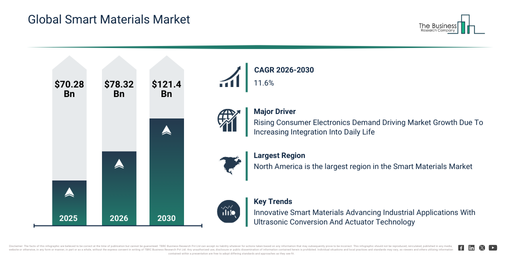
The smart materials market has seen substantial growth over recent years. It is anticipated to expand from $70.28 billion in 2025 to $78.32 billion in 2026, demonstrating a compound annual growth rate (CAGR) of 11.4%. This historical growth can be linked to factors such as defense research investments, advancements in aerospace innovation, the increasing demand for adaptive systems, initial applications of piezoelectric technology, and financial support for academic research.
The smart materials market is projected to experience substantial growth over the next few years. It is forecast to reach $121.4 billion by 2030, exhibiting a compound annual growth rate (CAGR) of 11.6%. This anticipated growth during the forecast period is driven by factors such as smart infrastructure development, the expansion of wearable electronics, the demand for electric vehicle sensors, innovations in healthcare devices, and AI enabled material systems. Significant developments anticipated include the increasing adoption of self healing materials, their growing application in sensors and actuators, broader use in adaptive aerospace structures, a heightened demand for shape memory materials, and their integration into smart consumer electronics.
Get A Free Sample Report With In-Depth Market Insights:
Smart Materials Market Expansion Drivers: What’s Shaping Future Growth?
The rising need for consumer electronics is anticipated to boost the smart materials market’s expansion in the future. These include electronic items for daily personal or domestic applications, such as smartphones, laptops, televisions, gaming systems, and intelligent home devices. The heightened consumption of consumer electronics stems from their deeper integration into daily routines, which improves communication, efficiency, leisure, and ease, alongside their ability to adapt to changing user preferences and living patterns. Smart materials augment consumer electronics by facilitating advanced features like self-repairing screens, pliable displays, energy-saving components, and responsive adjustments to environmental shifts, thereby enhancing resilience, functionality, and user satisfaction. An illustrative example is from May 2023, where total consumer electronic equipment output in Japan, as reported by the Japan Electronics and Information Technology Industries Association, a trade group located in Japan, hit $209.16 million (¥32,099 million), an increase from $164.65 million (¥25,268 million) recorded in May 2022. Consequently, the rising requirement for consumer electronics fuels the smart materials market.
Smart Materials Market Segment Trends And Revenue Contributors
The smart materials market covered in this report is segmented –
1) By Product Type: Piezoelectric Materials, Electro-Rheostatic, Magneto-Rheostatic, Shape Memory Materials, Smart Hydrogels, Electrochromic Materials, Other Product Types
2) By Application Type: Transducers, Actuators And Motors, Sensors, Structural Materials, Coating, Other Applications
3) By End User: Industrial, Defense And Aerospace, Automotive, Consumer Electronics, Healthcare, Other End User
Subsegments:
1) By Piezoelectric Materials: Piezoelectric Ceramics, Piezoelectric Polymers, Piezoelectric Composites, Piezoelectric Crystals
2) By Electro-Rheostatic: ER Fluids with Liquid Crystals, ER Fluids with Polymers, ER Fluids with Suspended Particles
3) By Magneto-Rheostatic: MR Fluids with Iron Particles, MR Fluids with Cobalt Particles, MR Fluids with Nickel Particles
4) By Shape Memory Materials: Shape Memory Alloys, Shape Memory Polymers, Shape Memory Ceramics, Shape Memory Hydrogels
5) By Smart Hydrogels: pH-Responsive Hydrogels, Temperature-Responsive Hydrogels, Light-Responsive Hydrogels, Electric-Responsive Hydrogels
6) By Electrochromic Materials: Organic Electrochromic Materials, Inorganic Electrochromic Materials, Hybrid Electrochromic Materials
7) By Other Product Types: Self-Healing Materials, Conductive Polymers, Photomechanical Materials, Thermochromic Materials
Smart Materials Market Strategic Trends: What Defines The Next Growth Phase?
Leading companies in the smart materials market are focusing on developing advanced smart materials by integrating ultrasonic conversion and actuator technology with filling polymers. This strategy aims to enhance their adaptability and performance across diverse industrial and medical applications. Ultrasonic conversion refers to the process of transforming electrical energy into high-frequency mechanical vibrations, while actuator technology enables precise motion control through these vibrations, offering benefits such as high efficiency, precision, fast response, and low maintenance, with applications spanning medical, industrial, and automation fields. For example, in May 2024, PI Ceramic GmbH, a Germany-based advanced materials company, introduced piezoceramic composites created by embedding piezoelectric ceramics within filling polymers, leveraging ultrasonic conversion and actuator technology. This method improves adaptability for applications in medical technology, such as high-intensity focused ultrasound and diagnostic imaging, as well as industrial uses like flow rate metering and non-destructive measurement, by enhancing acoustic impedance matching, precision, sensitivity, and resolution.
Smart Materials Market Competitive Landscape: Which Companies Lead The Industry?
Major companies operating in the smart materials market are Honeywell International Inc., 3M Company, Toray Industries Inc., Evonik Industries AG, TDK Corporation, DuPont de Nemours Inc., Arkema S.A., AMETEK Inc., Schott AG, CeramTec AG, CTS Corporation, SAES Getters S.p.A, Piezo Kinetics Inc., PI Ceramic GmbH, Kyocera Corporation, APC International, LORD Corporation, Smart Material Corp., Murata Manufacturing Co., Ltd., Solvay S.A., Covestro AG, Eastman Chemical Company, Gentex Corporation
View The Full Smart Materials Market Report:
Smart Materials Market Geographic Analysis: Where Is Demand Accelerating Fastest?
North America was the largest region in the smart materials market in 2025. Asia-Pacific is expected to be the fastest-growing region in the forecast period. The regions covered in the smart materials market report are Asia-Pacific, South East Asia, Western Europe, Eastern Europe, North America, South America, Middle East, Africa
Reach Out To Our Team:
The Business Research Company: https://www.thebusinessresearchcompany.com/
Americas: +1 310-496-7795
Asia: +44 7882 955267 & +91 8897263534
Europe: +44 7882 955267
Email us at: marketing@tbrc.info
Follow us on:
LinkedIn: https://in.linkedin.com/company/the-business-research-company
YouTube: https://www.youtube.com/channel/UC24_fI0rV8cR5DxlCpgmyFQ
Global Market Model: https://www.thebusinessresearchcompany.com/global-market-model

Wasay has over a decade of experience in market research, data modelling, and analytics, with prior experience at GlobalData and Decision Tree Consulting Services. At The Business Research Company , he leads research operations across syndicated studies, customized consulting engagements, and the Global Market Model platform. His professional experience includes supporting organizations such as Boston Consulting Group, KPMG, and Ernst & Young. Wasay holds a degree in Electronics and Communications Engineering, postgraduate management qualifications from International Management Institute Belgium and Indian School of Business and Entrepreneurship, and completed the Integrated Program in Business Analytics from Indian Institute of Management Indore.