Built to provide research that’s more actionable and strategically valuable, The Business Research Company’s 2026 market reports include market attractiveness analysis, total addressable market sizing, company benchmarking matrices, interactive Excel dashboards, broader supply chain intelligence, emerging startup tracking, and in-depth product insights.
Stem Cell Beauty Product Market Growth From $3.37 Billion In 2026 To $5.26 Billion By 2030 At A CAGR Of 11.7%
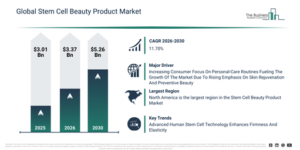
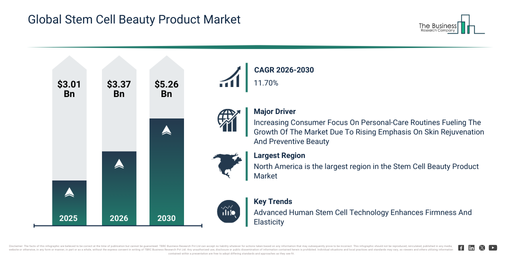
The stem cell beauty product market has observed substantial expansion in recent years. This market is expected to increase from $3.01 billion in 2025 to $3.37 billion in 2026, achieving a compound annual growth rate (CAGR) of 12.0%. The growth witnessed in earlier periods can be ascribed to a number of elements such as increasing consumer focus on anti-aging remedies, enhanced knowledge of regenerative skincare, a greater preference for luxury beauty products, wider distribution via specialty retailers, and the growing effect of celebrity-driven skincare fads.
The stem cell beauty product market is projected to experience substantial expansion in the coming years. This market is forecast to reach $5.26 billion by 2030, exhibiting a compound annual growth rate (CAGR) of 11.7%. This anticipated growth during the forecast period is primarily driven by factors such as a heightened demand for beauty solutions that are clinically proven, a greater embrace of bioactive and regenerative ingredients, increased investment in sophisticated cosmetic biotechnology, a noticeable shift in consumer preferences towards personalized skincare, and a stronger emphasis on formulations that are both natural and highly effective. Significant trends during this period are expected to encompass innovations in formulation propelled by technology, enhancements in methods for extracting plant and human stem cells, progress in developing active ingredients cultivated in laboratories, an uptick in research and development concerning skin rejuvenation biology, and novel advancements in delivery systems designed for deeper skin penetration.
Get A Free Sample Report With In-Depth Market Insights:
Stem Cell Beauty Product Market Growth Backed By Core Demand Fundamentals
The heightened consumer interest in personal-care regimens is projected to stimulate the growth of the stem cell beauty product market moving forward. Personal-care routines involve consistent activities individuals undertake to uphold or improve their physical, emotional, and aesthetic well-being through practices such as skincare, wellness rituals, and proactive beauty measures. The surge in consumer attention to personal-care routines arises from an increasing awareness of preventative health and mental well-being, as individuals strive to proactively maintain their appearance and overall wellness. Stem cell beauty products are instrumental in meeting these evolving personal-care demands by facilitating skin regeneration, improving elasticity, reducing the visible indicators of aging, and boosting overall skin vitality through advanced cellular repair mechanisms. For instance, in December 2024, data from the United States Bureau of Labor Statistics, a US-based federal statistical agency, showed that average annual expenditures on personal care products and services increased from $866,000 in 2022 to $950,000 in 2023, reflecting a 9.7% growth. Thus, the escalating consumer focus on personal-care routines is a key driver for the stem cell beauty product market’s expansion.
Stem Cell Beauty Product Market Breakdown By Product Type And Application
The stem cell beauty product market covered in this report is segmented –
1) By Product Type: Serums, Creams And Moisturizers, Face Masks, Injectables And Fillers, Oils And Essences
2) By Consumer Demographics: Age Groups, Gender, Income Levels
3) By Ingredient Source: Allogenic Stem Cells, Autologous Stem Cells, Placental Stem Cells, Umbilical Cord-Derived Stem Cells, Induced Pluripotent Stem Cells (iPSCs)
4) By Target Skin Concerns: Aging Skin, Hyperpigmentation, Acne And Scarring, Dryness And Dehydration, Sensitivity And Redness
5) By Distribution Channels: Online Retail, Offline Retail, Direct Sales
Subsegments:
1) By Serums: Anti Aging Stem Cell Serums, Skin Brightening Stem Cell Serums, Hydration Boost Stem Cell Serums
2) By Creams And Moisturizers: Regenerative Stem Cell Creams, Deep Moisture Stem Cell Creams, Rejuvenating Stem Cell Night Creams
3) By Face Masks: Hydrating Stem Cell Sheet Masks, Regenerating Stem Cell Gel Masks, Brightening Stem Cell Clay Masks
4) By Injectables And Fillers: Stem Cell Infused Dermal Fillers, Regenerative Stem Cell Injectable Solutions, Anti Aging Stem Cell Facial Injectables
5) By Oils And Essences: Nourishing Stem Cell Facial Oils, Rejuvenating Stem Cell Essences, Hydrating Stem Cell Beauty Oils
Stem Cell Beauty Product Market Growth Trends Reshaping The Competitive Landscape
Leading companies within the stem cell beauty product market are concentrating on developing sophisticated items, such as patented human stem cell technology, to enhance effectiveness, improve skin health, and minimize visible signs of aging. Patented human stem cell technology refers to advanced formulations that utilize crucial biological elements derived from human stem cells to support the skin’s natural repair and renewal processes. For instance, in September 2024, Angela Caglia Skincare, a United States-based luxury skin care brand, introduced the Cell Forté Serum. This premium, concentrated serum features a patented plant-based bioreactor technology for human stem cell-derived ingredients, ensuring ethical procurement and high potency. It comprises a proprietary blend of growth factors, exosomes, and signaling molecules, which allows for targeted interaction with skin cells to boost firmness, elasticity, and overall complexion without irritation. Furthermore, it incorporates antioxidant-rich adaptogens and a sustainable, refillable packaging system, thereby extending product durability and reducing environmental impact for discerning consumers.
Stem Cell Beauty Product Market Competitive Landscape: Who Leads The Industry?
Major companies operating in the stem cell beauty product market are Christian Dior SE, Unilever plc, L’Oréal S.A., Oriflame Holding AG, Juice Beauty Inc., Eminence Organic Skin Care, Chantecaille Beauté Inc., SkinMedica Inc., Andalou Naturals, Mibelle Biochemistry, Stempeutics Research Pvt. Ltd., Mychelle Dermaceuticals LLC, Intelligent Nutrients LLC, Cellular Health MD, U.S Stem Cell Inc., Celprogen Inc., Vytrus Biotech S.A., AnteAGE, Stemology, Aveda Corporation, BioRestorative Therapies Inc.
View The Full Stem Cell Beauty Product Market Report:
Stem Cell Beauty Product Market Geographic Landscape: Which Region Dominates Industry Growth?
North America was the largest region in the stem cell beauty product market in 2025.Asia – Pacific is expected to be the fastest-growing region in the forecast period. The regions covered in the stem cell beauty product market report are Asia-Pacific, South East Asia, Western Europe, Eastern Europe, North America, South America, Middle East, Africa.
Reach Out To Our Team:
The Business Research Company: https://www.thebusinessresearchcompany.com/
Americas: +1 310-496-7795
Asia: +44 7882 955267 & +91 8897263534
Europe: +44 7882 955267
Email us at: marketing@tbrc.info
Follow us on:
LinkedIn: https://in.linkedin.com/company/the-business-research-company
YouTube: https://www.youtube.com/channel/UC24_fI0rV8cR5DxlCpgmyFQ
Global Market Model: https://www.thebusinessresearchcompany.com/global-market-model

Wasay has over a decade of experience in market research, data modelling, and analytics, with prior experience at GlobalData and Decision Tree Consulting Services. At The Business Research Company , he leads research operations across syndicated studies, customized consulting engagements, and the Global Market Model platform. His professional experience includes supporting organizations such as Boston Consulting Group, KPMG, and Ernst & Young. Wasay holds a degree in Electronics and Communications Engineering, postgraduate management qualifications from International Management Institute Belgium and Indian School of Business and Entrepreneurship, and completed the Integrated Program in Business Analytics from Indian Institute of Management Indore.