The Business Research Company’s 2026 market reports combine market attractiveness scoring, total addressable market sizing, company benchmarking matrices, interactive Excel dashboards, deeper supply chain intelligence, emerging startup tracking, and granular product-level insights to deliver research that is more actionable and strategically valuable.
What Is The Tannin Market Growth Rate? A 7.6% CAGR Outlook Through 2030
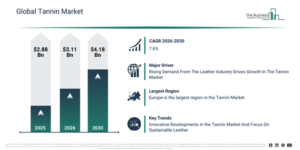
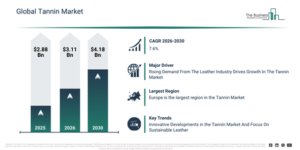
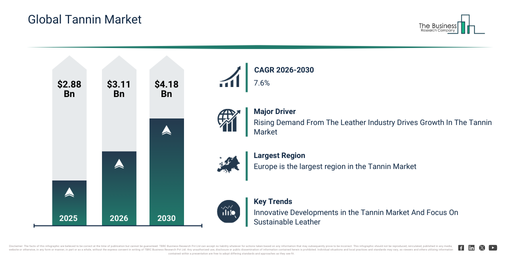
The tannin market has shown substantial expansion in recent years. It is anticipated to increase from $2.88 billion in 2025 to $3.11 billion in 2026, exhibiting a compound annual growth rate (CAGR) of 8.0%. This historical growth can be linked to traditional leather tanning techniques, its utilization in beverage processing, the accessibility of plant sources, the proliferation of wood adhesives, and the escalating demand for natural preservatives.
The tannin market is anticipated to experience substantial expansion over the coming years. Its valuation is projected to reach $4.18 billion by 2030, driven by a compound annual growth rate (CAGR) of 7.6%. This projected growth stems from several factors, including a shift towards environmentally friendly materials, an increase in plant-based chemicals, advancements in extraction technologies, a greater need for natural additives, and evolving sustainability regulations. Key developments expected during this forecast period encompass an increasing need for natural tanning agents, expanded application in clarifying wine and beverages, the proliferation of bio-based adhesives, greater utilization in corrosion prevention, and an emphasis on functional compounds sourced from plants.
Access A Free Sample Of The Latest Tannin Market Analysis:
Why Is The Tannin Market Growing? The Key Demand Driver Explained
The rising demand from the leather industry is anticipated to fuel the growth of the tannin market moving forward. This leather industry segment focuses on transforming animal hides and skins into leather and producing various leather goods such as garments, footwear, and accessories. The impetus for this demand from the leather industry stems from evolving fashion trends, the expanding automotive sector, the heightened popularity of premium home furnishings, and advancements in sustainable leather manufacturing techniques. Tannin plays a crucial role in the leather industry’s tanning process, where it helps convert raw animal hides into durable, flexible leather by binding with the proteins in the hides to prevent decomposition and enhance the material’s strength and quality. For example, in January 2025, figures from the Centre for the Brazilian Tanning Industry (CICB), a Brazil-based industry association, revealed that Brazil’s exports of hides and skins reached USD 1.26 billion in 2024, indicating a 12.5% growth in value, 22.3% growth in square-meter volume, and 38.8% growth in tonnage compared to 2023. Therefore, the increasing demand from the leather industry is serving as a key driver for the growth of the tannin market.
What Are The Main Segments Of The Tannin Market?
The tannin market covered in this report is segmented –
1) By Type: Hydrolysable, Non-Hydrolysable
2) By Source: Plant-Based, Synthetic
3) By Application: Leather Tanning, Wine Production, Wood Adhesives, Other Applications
Subsegments:
1) By Hydrolysable: Gallotannins, Ellagitannins
2) By Non-Hydrolysable: Condensed Tannins, Proanthocyanidins
Tannin Market Trend Analysis: Where Leading Companies Are Focusing
Leading companies within the tannin market are focusing on developing innovative products that incorporate sustainable tan leather, ensuring they are both environmentally friendly and safe for consumers. Sustainable tan leather refers to material produced using ecologically sound and ethically responsible methods, particularly during the tanning process. For example, in August 2023, Bentley Motors Limited, a UK-based manufacturer and marketer of luxury cars and SUVs, unveiled Olive Tan Leather as part of its commitment to sustainability. The tanning agent for this leather is derived from an organic by-product of olive oil pressing, specifically from wastewater collected during the olive pressing process. This method is free from harmful metals, minerals, and aldehydes, and also requires less water compared to traditional tanning processes.
Which Companies Are Major Players In The Tannin Market?
Major companies operating in the tannin market are Indena S.p.A., Mimosa S.A., Silvateam S.p.A., Polson Ltd., W. Ulrich GmbH, Laffort SA, Ever S.R.L., TANAC Inc., Tanin Sevnica d.d., Tannin Corporation, UCL Company (Pty) Ltd., Forestal Mimosa Ltda., CIMV S.A., Indunor S.A., Monteloeder S.L., Agrovin S.A., Prisco – Industrie dei Derivati Tannici S.r.l., AEB Group S.p.A., Gelerlioglu Tannin (Gelerlioglu Deri Kimya A.S.), Seta S.A., Unitán S.A.I.C.
Get The Complete Tannin Market Analysis Here:
Which Region Held The Largest Share Of The Tannin Market In 2025?
Europe was the largest region in the tannin market in 2025. Asia-Pacific is expected to be the fastest-growing region in the forecast period. The regions covered in the tannin market report are Asia-Pacific, South East Asia, Western Europe, Eastern Europe, North America, South America, Middle East, Africa
Reach Out To Our Team:
The Business Research Company: https://www.thebusinessresearchcompany.com/
Americas: +1 310-496-7795
Asia: +44 7882 955267 & +91 8897263534
Europe: +44 7882 955267
Email us at: marketing@tbrc.info
Follow us on:
LinkedIn: https://in.linkedin.com/company/the-business-research-company
YouTube: https://www.youtube.com/channel/UC24_fI0rV8cR5DxlCpgmyFQ
Global Market Model: https://www.thebusinessresearchcompany.com/global-market-model

Wasay has over a decade of experience in market research, data modelling, and analytics, with prior experience at GlobalData and Decision Tree Consulting Services. At The Business Research Company , he leads research operations across syndicated studies, customized consulting engagements, and the Global Market Model platform. His professional experience includes supporting organizations such as Boston Consulting Group, KPMG, and Ernst & Young. Wasay holds a degree in Electronics and Communications Engineering, postgraduate management qualifications from International Management Institute Belgium and Indian School of Business and Entrepreneurship, and completed the Integrated Program in Business Analytics from Indian Institute of Management Indore.