
Enhanced with market attractiveness analysis, total addressable market evaluation, company benchmarking matrices, interactive Excel dashboards, expanded supply chain intelligence, emerging startup coverage, and detailed product insights, The Business Research Company’s 2026 market reports deliver more actionable and strategically valuable research.
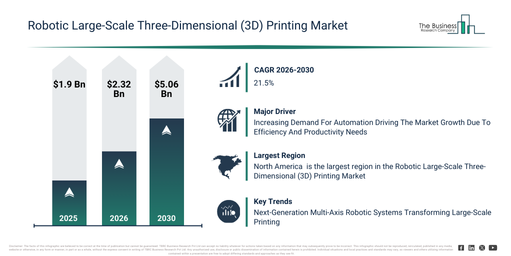
Robotic Large-Scale Three-Dimensional (3D) Printing Market Growth From $2.32 Billion In 2026 To $5.06 Billion By 2030 At A CAGR Of 21.5%
The robotic large-scale three-dimensional (3D) printing market size has witnessed substantial growth in recent years. It is projected to increase from $1.9 billion in 2025 to $2.32 billion in 2026, demonstrating a compound annual growth rate (CAGR) of 22.1%. The expansion observed in the past can be attributed to the rising adoption of large-scale 3D printing, its increased application in construction and industrial manufacturing, the development of multi-material printing solutions, the integration of automated inspection systems, and the broadening of academic research applications.
The robotic large-scale three-dimensional (3D) printing market size is projected to experience significant expansion in the coming years. This market is expected to reach $5.06 billion by 2030, exhibiting a compound annual growth rate (CAGR) of 21.5%. The projected growth is primarily driven by the increasing deployment of AI-driven 3D printers, the development of scalable robotic printing platforms, rising adoption across the aerospace and automotive sectors, innovations in material handling automation, and the expansion of integrated factory automation solutions. Key trends during this forecast period include the adoption of multi-material robotic 3D printing systems, the integration of smart material handling units, the deployment of AI-based printing control systems, the expansion of automated inspection and scanning solutions, and the development of connected robotic 3D printing ecosystems.
Download A Free Sample Report For Comprehensive Market Insights:
Robotic Large-Scale Three-Dimensional (3D) Printing Market Growth Momentum: Which Factors Are Influencing Demand?
The rising need for automation is projected to drive expansion in the robotic large-scale three-dimensional (3D) printing market. Automation involves employing control systems to operate manufacturing equipment, thereby minimizing human involvement. This increasing preference for automation stems from the desire for greater productivity, allowing quicker task completion, fewer human errors, and improved overall operational efficiency. The surge in automation demand propels innovations in robotic large-scale three-dimensional (3D) printing, facilitating production processes that are faster, more accurate, and scalable. This leads to reduced labor expenses, fewer human mistakes, the creation of intricate and personalized designs, and ultimately greater efficiency and uniformity in various industrial uses. As an illustration, data from April 2024 released by the International Federation of Robotics, a professional non-profit organization based in Germany, indicated a 12% rise in total industrial robot installations, totaling 44,303 units in 2023. Within the automotive sector, sales saw a 1% increase, with a record 14,678 robots installed. This occurred after a substantial 47% jump in installations in 2022, amounting to 14,472 units. Consequently, the rising need for automation is a key factor propelling the expansion of the robotic large-scale three-dimensional (3D) printing market.
Robotic Large-Scale Three-Dimensional (3D) Printing Market Categorization By Product Type And Application
The robotic large-scale three-dimensional (3d) printing market covered in this report is segmented –
1) By Component: Hardware, Software, Services
2) By Material Type: Polymers, Metals, Concrete, Composites, Other Material Types
3) By Application: Construction, Aerospace And Defense, Automotive, Industrial Manufacturing, Art And Design, Other Applications
4) By End-User: Commercial, Industrial, Academic And Research Institutes, Other End-Users
Subsegments:
1) By Hardware: Robotic Arms, Controllers, Sensors, Printers, Materials Handling Systems, Power Supply Units
2) By Software: Design Software, Simulation Software, Process Control Software, Monitoring And Analytics Software, Workflow Management Software
3) By Services: Installation Services, Maintenance Services, Training Services, Consulting Services, Support Services
Robotic Large-Scale Three-Dimensional (3D) Printing Market Trends Reshaping Industry Growth
Leading companies active in the robotic large-scale three dimensional (3D) printing market are concentrating on advanced solutions, specifically multi-axis robotic systems, to enable faster, more precise, and cost-effective manufacturing of large, complex parts. Multi-axis robotic systems are defined as robots with multiple degrees of movement, going beyond the standard 3 axes, and they contribute by allowing greater flexibility, precision, and efficiency in building complex 3D-printed parts from various angles without needing repositioning. For example, in August 2023, MX3D BV, a Netherlands-based manufacturing company, launched the MX Metal AM System, which is a turnkey robotic wire-based directed energy deposition (DED) platform equipped with an 8-axis heavy-duty industrial robot. This system supports the production of very large, certified metal parts weighing up to five tons, with deposition rates surpassing 10 kg per hour. It combines its proprietary MetalXL software with sophisticated sensors and closed-loop controls, facilitating 24/7 automated manufacturing and providing sectors such as energy, maritime, and heavy manufacturing with a quicker, more accurate, and economical alternative to traditional casting and forging processes.
Robotic Large-Scale Three-Dimensional (3D) Printing Market Company Landscape And Strategic Competition
Major companies operating in the robotic large-scale three-dimensional (3D) printing market are ABB Limited, Sika AG, Alquist 3D LLC, Caracol S.r.l., Contour Crafting Corporation, Branch Technology Inc., MX3D B.V., SQ4D Inc., Apis Cor Inc., Vertico B.V., Mighty Buildings Inc., CyBe Construction B.V., Constructions-3D SAS, CEAD Group B.V., WAAM3D Limited, WASP S.r.l., Luyten 3D Pty Ltd, Hyperion Robotics Oy, BetAbram d.o.o., Cazza Construction Technologies LLC
Access The Complete Robotic Large-Scale Three-Dimensional (3D) Printing Market Report:
Robotic Large-Scale Three-Dimensional (3D) Printing Market Geographic Distribution And Regional Opportunities
North America was the largest region in the robotic large-scale three-dimensional (3D) printing market in 2025. Asia-Pacific is expected to be the fastest-growing region in the forecast period. The regions covered in the robotic large-scale three-dimensional (3D) printing market report are Asia-Pacific, South East Asia, Western Europe, Eastern Europe, North America, South America, Middle East, Africa.
Get in touch with us:
The Business Research Company: https://www.thebusinessresearchcompany.com/
Americas: +1 310-496-7795
Asia: +44 7882 955267 & +91 8897263534
Europe: +44 7882 955267
Email us at: marketing@tbrc.info
Follow us on:
LinkedIn: https://in.linkedin.com/company/the-business-research-company
YouTube: https://www.youtube.com/channel/UC24_fI0rV8cR5DxlCpgmyFQ
Global Market Model: https://www.thebusinessresearchcompany.com/global-market-model

Wasay has over a decade of experience in market research, data modelling, and analytics, with prior experience at GlobalData and Decision Tree Consulting Services. At The Business Research Company , he leads research operations across syndicated studies, customized consulting engagements, and the Global Market Model platform. His professional experience includes supporting organizations such as Boston Consulting Group, KPMG, and Ernst & Young. Wasay holds a degree in Electronics and Communications Engineering, postgraduate management qualifications from International Management Institute Belgium and Indian School of Business and Entrepreneurship, and completed the Integrated Program in Business Analytics from Indian Institute of Management Indore.
