Backed by market attractiveness analysis, total addressable market sizing, company benchmarking matrices, interactive Excel dashboards, wider supply chain intelligence, emerging startup coverage, and detailed product-level insights, The Business Research Company’s 2026 market reports are designed to offer research that is more actionable and strategically valuable than ever.
Building Envelope Retrofit Market Set To Climb From $47.81 Billion In 2026 To $68.96 Billion By 2030
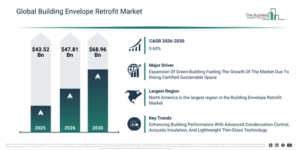
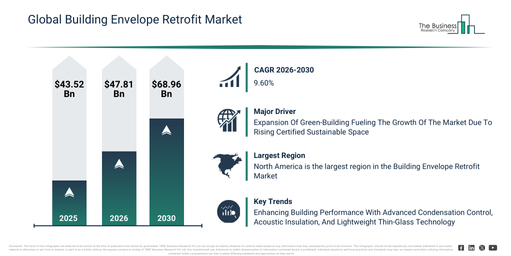
The building envelope retrofit market size has experienced significant expansion in recent years. It is anticipated to grow from $43.52 billion in 2025 to $47.81 billion in 2026, at a compound annual growth rate (CAGR) of 9.9%. The historical increase in this market can be ascribed to several factors, including an aging building stock, governmental regulatory initiatives in numerous areas, historically escalating energy prices which spurred retrofits, heightened consciousness regarding indoor air quality and comfort, and the initial implementation of energy audits and essential retrofit services.
The building envelope retrofit market is projected to experience substantial expansion in the coming years. Its size is anticipated to reach $68.96 billion by 2030, exhibiting a compound annual growth rate (CAGR) of 9.6%. This growth during the forecast period can be attributed to several factors, including the expansion of policy incentives and mandates, rising energy costs alongside new financial models boosting project feasibility, ongoing urban renewal and extensive public sector initiatives, advancements in material science and envelope technologies improving return on investment (ROI), and a growing focus on resilience and climate adaptation efforts. Key trends expected over the forecast period involve a greater embrace of smart envelopes and dynamic facades, increased integration of performance verification and post-occupancy monitoring, broader application of deep retrofit strategies aligned with greenhouse gas reduction targets, enhanced cross-sector collaboration between developers and energy service companies, and wider adoption of standardized retrofit protocols and digital twin technology.
Get A Free Sample Report With In-Depth Market Insights:
Building Envelope Retrofit Market Opportunity Drivers: What’s Unlocking New Revenue Potential?
The increasing adoption of green-building practices is anticipated to fuel the expansion of the building envelope retrofit market moving ahead. Green-building encompasses construction methods designed to lessen environmental harm by utilizing energy-efficient materials and architectural designs. The surge in green-building is attributable to sustainability requirements and objectives for carbon emission reduction, which advocate for upgrading current structures to achieve enhanced performance. Building envelope retrofits contribute to the realization of green-building projects through the enhancement of walls, roofs, and facades with insulation and weatherproofing, resulting in excellent energy efficiency. For instance, in December 2023, according to the Department of Energy Security and Net Zero, a UK-based government authority, the UK government aims to reduce direct emissions from public sector buildings by 50% by 2032 and 75% by 2037. Consequently, the growing prevalence of green-building is a significant catalyst for the expansion of the building envelope retrofit market.
Building Envelope Retrofit Market Segment Analysis: What Are The Core Market Categories?
The building envelope retrofit market covered in this report is segmented –
1) By Product Type: Insulation, Windows And Doors, Roofing, Wall Systems, Other Products
2) By Technology: Traditional, Advanced Or Smart
3) By Material: Glass, Metal, Plastic, Wood, Other Materials
4) By Application: Residential, Commercial, Industrial, Institutional
Subsegments:
1) By Insulation: Foam Insulation, Fiberglass Insulation, Mineral Wool Insulation, Cellulose Insulation, Reflective Insulation
2) By Windows And Doors: Single Pane Windows, Double Pane Windows, Triple Pane Windows, Wood Doors, Metal Doors, Glass Doors
3) By Roofing: Asphalt Shingles, Metal Roofing, Clay And Concrete Tiles, Slate Roofing, Synthetic Roofing
4) By Wall Systems: Curtain Wall Systems, Cladding Systems, Exterior Insulation And Finish Systems (EIFS), Precast Concrete Panels, Masonry Wall Systems
5) By Other Product: Sealants, Weather Stripping, Vapor Barriers, Air Barriers, Flashing
Building Envelope Retrofit Market Innovation Trends Shaping Future Development
Leading companies active in the building envelope retrofit market are prioritizing advanced features like sophisticated condensation management to enhance the energy efficiency, indoor comfort, and lasting durability of windows and facades. This advanced condensation control refers to a material’s capacity to minimize moisture accumulation on glass surfaces, thereby preventing mold, fogging, and structural damage while maintaining clarity and thermal performance. For instance, in May 2024, Alpen High Performance Products Inc., a US-based developer of cutting-edge window and door technologies, unveiled AlpenGlass insulated thin-glass units, crafted for both residential and commercial applications. These units incorporate custom thin-glass configurations measuring from 0.5 to 1.1 millimeters, providing thermal insulation up to R15 without increasing either weight or thickness. AlpenGlass additionally offers acoustic performance, UV protection, and diverse glazing options for safety, impact resistance, and bird-safe designs. This launch highlights the escalating focus on integrating high-performance, sustainable materials into building retrofits to improve energy efficiency, occupant comfort, and environmental stewardship. By utilizing AlpenGlass, architects and builders can upgrade existing windows or implement new designs featuring superior insulation, effective condensation control, and a low embodied carbon impact.
Building Envelope Retrofit Market Key Players Shaping Industry Direction
Major companies operating in the building envelope retrofit market are Saint-Gobain, Sika AG, Dow Inc., Johnson Controls International plc, WSP Global Inc., Owens Corning, Kingspan Group plc, Tremco International Ltd., Carlisle Companies Incorporated, ROCKWOOL Group, Andersen Corporation, Arup Group Limited, Pella Corporation, Soprema S.A., Schuco International KG, Marvin Companies Inc., Ameresco, GAF Materials, Knauf Insulation, AECOM, YKK AP Inc.
View The Full Building Envelope Retrofit Market Report:
Building Envelope Retrofit Market Regional Analysis: Which Region Leads By Revenue?
North America was the largest region in the building envelope retrofit market in 2025. Asia-Pacific is expected to be the fastest-growing region in the forecast period. The regions covered in the building envelope retrofit market report are Asia-Pacific, South East Asia, Western Europe, Eastern Europe, North America, South America, Middle East, Africa.
Reach Out To Our Team:
The Business Research Company: https://www.thebusinessresearchcompany.com/
Americas: +1 310-496-7795
Asia: +44 7882 955267 & +91 8897263534
Europe: +44 7882 955267
Email us at: marketing@tbrc.info
Follow us on:
LinkedIn: https://in.linkedin.com/company/the-business-research-company
YouTube: https://www.youtube.com/channel/UC24_fI0rV8cR5DxlCpgmyFQ
Global Market Model: https://www.thebusinessresearchcompany.com/global-market-model

Wasay has over a decade of experience in market research, data modelling, and analytics, with prior experience at GlobalData and Decision Tree Consulting Services. At The Business Research Company , he leads research operations across syndicated studies, customized consulting engagements, and the Global Market Model platform. His professional experience includes supporting organizations such as Boston Consulting Group, KPMG, and Ernst & Young. Wasay holds a degree in Electronics and Communications Engineering, postgraduate management qualifications from International Management Institute Belgium and Indian School of Business and Entrepreneurship, and completed the Integrated Program in Business Analytics from Indian Institute of Management Indore.