
Enhanced with market attractiveness analysis, total addressable market evaluation, company benchmarking matrices, interactive Excel dashboards, expanded supply chain intelligence, emerging startup coverage, and detailed product insights, The Business Research Company’s 2026 market reports deliver more actionable and strategically valuable research.
Building Vibration Isolation Market Revenue Growth Supported By A CAGR Of 3.65% Through 2030
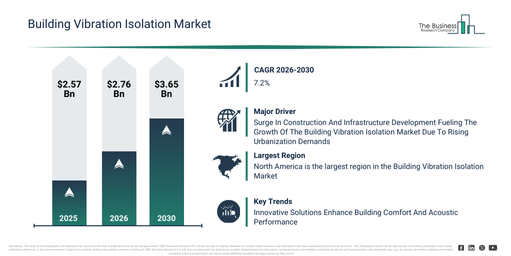
The building vibration isolation market has experienced significant growth in recent years. It is projected to expand from $2.57 billion in 2025 to $2.76 billion in 2026, at a compound annual growth rate (CAGR) of 7.5%. The market’s past growth can be attributed to factors such as the increasing requirement for vibration control in urban construction, the growing application of damping materials in sensitive facilities, the widespread adoption of isolation rails and mounts, the development of infrastructure in high-vibration areas, and the rising implementation of vibration reduction systems.
The building vibration isolation market is projected to experience substantial expansion over the upcoming years. This market is forecast to reach $3.65 billion by 2030, exhibiting a compound annual growth rate (CAGR) of 7.2%. This anticipated growth during the forecast timeframe is propelled by factors such as the increasing uptake of smart vibration monitoring technologies, an increase in the production of advanced damping materials, heightened investment in robust building designs, the creation of environmentally friendly isolation materials, and the greater incorporation of digital modeling for vibration reduction. Key developments expected within this period involve the proliferation of AI-driven vibration monitoring solutions, enhancements in sustainable isolation materials, the establishment of automated manufacturing processes for isolation components, the embedding of IoT-enabled sensors for building vibration, and the utilization of digital simulation alongside performance analytics.
Download A Free Sample Report For Comprehensive Market Insights:
Building Vibration Isolation Market Industry Drivers: What Is Driving Revenue Growth?
The increasing construction and infrastructure development is expected to propel the growth of the building vibration isolation market going forward. This refers to the planning, building, and upgrading of physical structures and systems like buildings, roads, bridges, and utilities that underpin economic and social activities. The rise in such development is driven by urbanization, as growing city populations necessitate improved housing, transportation, and utility networks. Building vibration isolation supports these efforts by enhancing structural integrity and occupant comfort, effectively minimizing the impact of ground-borne vibrations from sources such as traffic, railways, or industrial machinery. For instance, in February 2024, the Infrastructure and Projects Authority, a UK-based government agency, reported that planned investment of £164 ($214.18) billion in major infrastructure and construction projects for 2024/25 surpasses that of 2023/24. Over the next decade, total projected investments are estimated to reach between £700 ($914.16) billion and £775 ($1012.11) billion. Therefore, the increasing construction and infrastructure development is driving the building vibration isolation market.
Building Vibration Isolation Market Segment Analysis Highlighting Growth Areas
The building vibration isolation market covered in this report is segmented –
1) By Product: Elastomeric Isolators, Air Isolators, Mechanical Isolators, Compact Pneumatic Isolators, Other Products
2) By Material: Natural And Recycled Rubber, Cork And Resin Bonded Cork, Virgin Polyurethane, Other Materials
3) By Form: Mats Or Pads, Blocks, Module
4) By Application: Transportation, Architecture, Electronics, Aerospace, Defense, Manufacturing, Medical, Other Applications
5) By End-Use: Residential, Commercial, Industrial
Subsegments:
1) By Elastomeric Isolators: Neoprene Isolators, Natural Rubber Isolators, Silicone Isolators, Polyurethane Isolators, Other Elastomeric Materials
2) By Air Isolators: Passive Air Isolators, Active Air Isolators, Pneumatic Air Isolators
3) By Mechanical Isolators: Spring Isolators, Wire Rope Isolators, Friction Isolators, Viscous Dampers
4) By Compact Pneumatic Isolators: Single-Stage Pneumatic Isolators, Multi-Stage Pneumatic Isolators
5) By Other Products: Tuned Mass Dampers, Base Isolators, Vibration Pads, Floor Isolation Systems
#Building Vibration Isolation Market Growth Trends: What Is Influencing The Future Outlook?
Leading companies operating within the building vibration isolation market are concentrating on developing innovative products, such as sound reduction and vibration isolation solutions, to improve building comfort, structural stability, and acoustic performance. These sound reduction and vibration isolation products represent materials and systems engineered to minimize the transmission of noise and vibrations through building structures, thereby enhancing acoustic comfort and structural integrity. For example, in June 2025, The Pate Company, a US-based manufacturing company, introduced a pate sound shield (PSS) specifically designed to reduce structural noise and elevate building acoustic performance. This product is engineered to diminish rooftop equipment noise by up to 75 decibels while simultaneously offering vibration isolation and improved thermal insulation with an R-value of 8.0. Its adaptable acoustic barrier efficiently absorbs sound waves, thus enhancing occupant comfort and safeguarding building structures from vibration damage. The product’s straightforward installation features a watertight seal and helps buildings comply with noise ordinances and building codes, positioning it as a cost-effective sound and vibration control solution.
Building Vibration Isolation Market Leading Companies: Who Holds Significant Market Presence?
Major companies operating in the building vibration isolation market are Trelleborg AB, Getzner Werkstoffe GmbH, Hutchinson Group, Mason Industries Inc, ACE Controls Inc., VMC Group, Resistoflex Inc., SEBERT Schwingungstechnik GmbH, Enidine Inc., Socitec Group, Vibro-Acoustics by Swegon AB, Maurer SE, VibraSystems Inc., AMC Mecanocaucho S.A., Farrat Engineering Ltd, Vibra-Sonic Control Inc., Vibration Eliminator Company, Kellett Enterprises Inc., Bilz Vibration Technology AG, ISOTECH Industries Inc.
Access The Complete Building Vibration Isolation Market Report:
Building Vibration Isolation Market Regional Analysis And Leading Geography
North America was the largest region in the building vibration isolation market in 2025. The regions covered in the building vibration isolation market report are Asia-Pacific, South East Asia, Western Europe, Eastern Europe, North America, South America, Middle East, Africa.
Get in touch with us:
The Business Research Company: https://www.thebusinessresearchcompany.com/
Americas: +1 310-496-7795
Asia: +44 7882 955267 & +91 8897263534
Europe: +44 7882 955267
Email us at: marketing@tbrc.info
Follow us on:
LinkedIn: https://in.linkedin.com/company/the-business-research-company
YouTube: https://www.youtube.com/channel/UC24_fI0rV8cR5DxlCpgmyFQ
Global Market Model: https://www.thebusinessresearchcompany.com/global-market-model

Wasay has over a decade of experience in market research, data modelling, and analytics, with prior experience at GlobalData and Decision Tree Consulting Services. At The Business Research Company , he leads research operations across syndicated studies, customized consulting engagements, and the Global Market Model platform. His professional experience includes supporting organizations such as Boston Consulting Group, KPMG, and Ernst & Young. Wasay holds a degree in Electronics and Communications Engineering, postgraduate management qualifications from International Management Institute Belgium and Indian School of Business and Entrepreneurship, and completed the Integrated Program in Business Analytics from Indian Institute of Management Indore.