
Delivering more actionable and strategically valuable research, The Business Research Company’s 2026 market reports feature market attractiveness analysis, total addressable market evaluation, company benchmarking matrices, interactive Excel dashboards, expanded supply chain intelligence, emerging startup coverage, and detailed product insights.
Clean Room Engineering Market Expansion From $9.25 Billion In 2026 To $12.99 Billion In 2030
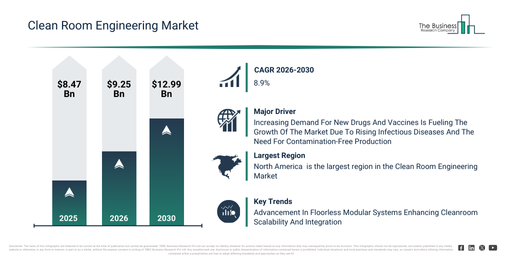
The clean room engineering market size has shown robust growth in recent years. It is projected to expand from $8.47 billion in 2025 to $9.25 billion in 2026, registering a compound annual growth rate (CAGR) of 9.2%. This historical growth can be ascribed to elements such as increasing adoption of cleanroom technologies, rising demand for contamination control, expansion of pharmaceutical and biotechnology facilities, growth in electronics manufacturing, and an increasing focus on operational compliance.
The clean room engineering market is projected to experience robust expansion over the coming years. This market is anticipated to reach a valuation of $12.99 billion by 2030, demonstrating a compound annual growth rate (CAGR) of 8.9%. This projected growth during the forecast period is attributable to factors such as the growing integration of AI-enabled monitoring, the uptake of cloud-based environmental control systems, the expansion of predictive maintenance offerings, the creation of automated validation and certification instruments, and the increasing utilization of IoT-enabled cleanroom management. Key trends anticipated throughout this period encompass the implementation of AI-based cleanroom monitoring systems, the incorporation of real-time environmental control platforms, the embrace of predictive maintenance strategies for HVAC systems, the broadening application of cloud-based data analytics specifically for cleanrooms, and the ongoing development of automated tools for cleanroom validation and certification.
Download A Free Sample Report For Comprehensive Market Insights:
#Clean Room Engineering Market Demand Drivers Creating New Revenue Opportunities
The growing demand for novel pharmaceuticals and immunizations is projected to fuel the expansion of the clean room engineering market in the future. Novel drugs refer to recently developed pharmaceutical substances approved for treating various health conditions, whereas vaccines are biological preparations intended to stimulate the immune system to ward off infectious diseases. This heightened demand for new drugs and vaccines stems from the swift appearance of infectious diseases, compelling healthcare systems to devise quicker and more potent solutions. Cleanroom engineering facilitates the creation of new drugs and vaccines by guaranteeing a sterile, regulated setting that guards against contamination during manufacturing. For example, in July 2023, the World Health Organization, a Switzerland-based intergovernmental organization, stated that approximately 40–60 million doses of malaria vaccinations would be required globally each year in 2026, with this figure anticipated to increase to 80–100 million doses annually by 2030. Consequently, the escalating requirement for new drugs and vaccines is boosting the clean room engineering market’s growth.
Clean Room Engineering Market Segment Landscape: Which Areas Lead Market Development?
The clean room engineering market covered in this report is segmented –
1) By Component: Heating, Ventilation, And Air Conditioning (HVAC) Systems, High-Efficiency Particulate Air (HEPA) Filters, Fan Filter Units, Laminar Air Flow Systems, Other Components
2) By Type Of Cleanroom: Conventional Cleanrooms, Biohazard Cleanrooms, Modular Cleanrooms, Portable Cleanrooms, Softwall Cleanrooms, Hardwall Cleanrooms
3) By Construction Materials: Stainless Steel, Vinyl, Laminar Flow Ceiling, Glass, Rubber
4) By Cleanroom Classification: Class 1, Class 10, Class 100, Class 1,000, Class 10,000, Class 100,000
5) By End-User: Pharmaceutical, Biotechnology, Medical Device, Electronics, Food And Beverage, Other End-Users
Subsegments:
1) By Heating, Ventilation, And Air Conditioning (HVAC) Systems: Air Handling Units (AHUs), Chillers, Ductwork And Diffusers, Control Systems, Cleanroom Dehumidifiers
2) By High-Efficiency Particulate Air (HEPA) Filters: Terminal HEPA Filters, Box-Type HEPA Filters, Separator Vs. Separatorless HEPA Filters, Mini-Pleat HEPA Filters, HEPA Filter Housings
3) By Fan Filter Units: Standard FFUs, Low-Profile FFUs, Ducted FFUs, Energy-Efficient FFUs, Variable Speed FFUs
4) By Laminar Air Flow Systems: Vertical Laminar Flow Systems, Horizontal Laminar Flow Systems, Mobile Laminar Flow Units, Bench-Top Laminar Flow Cabinets, Ceiling-Mounted Laminar Flow Modules
5) By Other Components: Cleanroom Lighting Systems, Control Panels And Monitoring Systems, Cleanroom Walls And Panels, Air Showers, Pass-Through Chambers
Clean Room Engineering Market Trends Driving Strategic Industry Expansion
Leading companies within the clean room engineering market are prioritizing the development of technologically advanced solutions, such as modular floorless cleanroom structures, to satisfy complex facility integration requirements and improve project scalability. A modular floorless cleanroom is characterized as a prefabricated, self-contained unit built without an integrated floor, which enables direct utility and process connections to the host facility and facilitates the rapid deployment of contamination-controlled environments. As an illustration, in April 2024, G-CON Manufacturing Inc., a US-based entity focused on designing and fabricating modular clean rooms, unveiled floorlessPOD, a freestanding cleanroom system that lacks an integrated floor. This product features fully integrated mechanical, electrical, and plumbing systems, precisely engineered to align seamlessly with the facility floor, thereby eliminating the need for ramps, platforms, or stairs. It permits direct connection of waste lines, utilities, and process equipment to the base facility, enhancing installation flexibility and simplifying integration. This particular solution optimizes space utilization and streamlines the scaling of operations by utilizing multiple interconnected PODs for commercial-scale manufacturing.
Clean Room Engineering Market Industry Leaders And Market Competition
Major companies operating in the clean room engineering market are Exyte AG, Lindner SE, Azbil Corporation, Taikisha Ltd., Camfil AB, Ardmac Ltd., AES Clean Technology Pty Ltd., Asgard Cleanroom Solutions Ltd., Nicomac Srl, Allied Cleanrooms, MAK Clean Air Systems Pvt. Ltd., Nicos Group Srl, Hodess Cleanroom Construction, BioClean International Inc., Clean Air Products Inc., Integrated Cleanroom Technologies Pvt. Ltd., American Cleanroom Systems Inc., Clean Room Infra Solutions Pvt. Ltd., Modular Cleanrooms Inc., NGS Cleanroom Solutions.
Access The Complete Clean Room Engineering Market Report:
Clean Room Engineering Market Regional Distribution: Which Areas Drive Market Expansion?
North America was the largest region in the clean room engineering market in 2025. Asia-Pacific is expected to be the fastest-growing region in the forecast period. The regions covered in the clean room engineering market report are Asia-Pacific, South East Asia, Western Europe, Eastern Europe, North America, South America, Middle East, Africa.
Get in touch with us:
The Business Research Company: https://www.thebusinessresearchcompany.com/
Americas: +1 310-496-7795
Asia: +44 7882 955267 & +91 8897263534
Europe: +44 7882 955267
Email us at: marketing@tbrc.info
Follow us on:
LinkedIn: https://in.linkedin.com/company/the-business-research-company
YouTube: https://www.youtube.com/channel/UC24_fI0rV8cR5DxlCpgmyFQ
Global Market Model: https://www.thebusinessresearchcompany.com/global-market-model

Wasay has over a decade of experience in market research, data modelling, and analytics, with prior experience at GlobalData and Decision Tree Consulting Services. At The Business Research Company , he leads research operations across syndicated studies, customized consulting engagements, and the Global Market Model platform. His professional experience includes supporting organizations such as Boston Consulting Group, KPMG, and Ernst & Young. Wasay holds a degree in Electronics and Communications Engineering, postgraduate management qualifications from International Management Institute Belgium and Indian School of Business and Entrepreneurship, and completed the Integrated Program in Business Analytics from Indian Institute of Management Indore.