Built to provide research that’s more actionable and strategically valuable, The Business Research Company’s 2026 market reports include market attractiveness analysis, total addressable market sizing, company benchmarking matrices, interactive Excel dashboards, broader supply chain intelligence, emerging startup tracking, and in-depth product insights.
Connected Building Market Revenue Outlook: What CAGR Lies Ahead Through 2030?
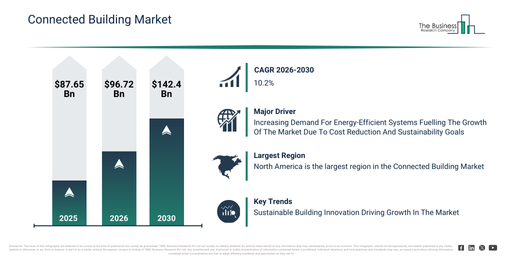
The connected building market size has seen rapid growth in recent years. It is anticipated to expand from $87.65 billion in 2025 to $96.72 billion in 2026, exhibiting a compound annual growth rate (CAGR) of 10.3%. This historical growth can be linked to the early adoption of building automation technologies, the proliferation of smart commercial infrastructure, an increasing need for centralized facility monitoring, the integration of digital energy-saving systems, and the establishment of connected residential communities.
The connected building market size is expected to undergo rapid expansion in the coming years. It is projected to achieve a value of $142.4 billion by 2030, exhibiting a compound annual growth rate (CAGR) of 10.2%. The anticipated growth within the forecast period can be attributed to the increasing deployment of AI-driven building management, the broadening of cloud-based automation platforms, enhanced investment in IoT-enabled infrastructure, a heightened focus on sustainable smart buildings, and the accelerating adoption of predictive building analytics. Prominent trends for the forecast period include a rising demand for smart building automation, the growing application of integrated energy optimization, the expansion of real-time sensor monitoring, increased implementation of smart access and safety systems, and the growth in connected residential infrastructure.
Get A Free Sample Report With In-Depth Market Insights:
Connected Building Market Demand Drivers: What’s Powering Industry Growth?
The expanding need for energy-efficient systems is projected to fuel the growth of the connected building market moving forward. Energy efficiency describes a system, device, or process’s ability to consume less energy while performing the same function or achieving optimal output with minimal waste. The heightened demand for energy-efficient systems stems from the necessity to reduce energy consumption and lessen environmental impact. As energy costs continue their upward trend, businesses and homeowners are actively searching for ways to decrease expenses by implementing energy-efficient solutions such as smart HVAC systems and automated building controls. Connected buildings leverage IoT-enabled devices, sensors, and automation systems to continuously monitor and manage lighting and other operations that consume energy. These technologies help reduce energy wastage, decrease utility expenses, and improve sustainability, making them appealing to both businesses and homeowners. For example, in October 2022, a report from Energy UK, a UK-based trade association representing the UK’s energy industry, indicated that the volume of energy efficiency projects should increase from 500,000 installs in 2025 to one million per year by 2030. Consequently, the rising demand for energy-efficient systems is a key driver for the expansion of the connected building market.
Connected Building Market Breakdown By Product Type And Application
The connected building market covered in this report is segmented –
1) By Component: Solutions, Services
2) By Technology Platform: Internet Of Things (IoT), Mobile Applications, Artificial Intelligence And Machine Learning, Big Data Analytics, Edge Computing Technologies
2) By Deployment Type: On-Premises Solutions, Cloud-Based Solutions, Hybrid Solutions
4) By End-User: Manufacturing, IT And Telecom, Banking, Financial Services, And Insurance (BFSI), Healthcare, Residential, Other End-Users
Subsegments:
1) By Solutions: Energy Management Solutions, Lighting Control Systems, HVAC Management Solutions, Security And Access Control Systems, Building Automation Platforms, Data Analytics And IoT Solutions, Smart Metering Solutions, Fire And Life Safety Solutions, Network Management Solutions
2) By Services: Consulting Services, Deployment And Integration Services, Managed Services, Support And Maintenance Services, Training And Education Services, Professional Services, Cloud-Based Services
Connected Building Market Innovation Trends: What Developments Are Reshaping The Industry?
Leading companies operating in the connected building market are prioritizing the development of innovative products, including sustainable building, to enhance efficiency, reduce environmental impact, and promote sustainable urban forestry practices. Sustainable building encompasses the creation and implementation of eco-friendly technologies, materials, and practices that improve buildings’ energy efficiency, environmental performance, and resilience. For instance, in June 2024, Schneider Electric, a France-based automation company, launched a SMART buildings division to drive sustainable building innovation. This new division is designed to accelerate the adoption of intelligent, energy-efficient, and digitally connected building solutions. This initiative aligns with Canada’s sustainability goals and the increasing demand for smart, net-zero buildings, reinforcing Schneider Electric’s commitment to driving the future of energy-efficient and digitally advanced infrastructure.
Connected Building Market Company Landscape And Competitive Strategy
Major companies operating in the connected building market are Microsoft Corporation, Amazon Web Services (AWS), Huawei Technologies Co Ltd, Hitachi Ltd, Siemens AG, Intel Corporation, IBM Corporation, Cisco Systems Inc, Schneider Electric, Honeywell International Inc, Mitsubishi Electric, ABB Ltd, Johnson Controls, Eaton Corporation, Delta Electronics Inc, Legrand, Rockwell Automation, Advantech Co Ltd, Bosch Building Technologies, Lutron Electronics
View The Full Connected Building Market Report:
Connected Building Market Global Footprint: Which Region Leads The Market?
North America was the largest region in the connected building market in 2025. Asia-Pacific is expected to be the fastest-growing region in the forecast period. The regions covered in the connected building market report are Asia-Pacific, South East Asia, Western Europe, Eastern Europe, North America, South America, Middle East, Africa.
Reach Out To Our Team:
The Business Research Company: https://www.thebusinessresearchcompany.com/
Americas: +1 310-496-7795
Asia: +44 7882 955267 & +91 8897263534
Europe: +44 7882 955267
Email us at: marketing@tbrc.info
Follow us on:
LinkedIn: https://in.linkedin.com/company/the-business-research-company
YouTube: https://www.youtube.com/channel/UC24_fI0rV8cR5DxlCpgmyFQ
Global Market Model: https://www.thebusinessresearchcompany.com/global-market-model

Wasay has over a decade of experience in market research, data modelling, and analytics, with prior experience at GlobalData and Decision Tree Consulting Services. At The Business Research Company , he leads research operations across syndicated studies, customized consulting engagements, and the Global Market Model platform. His professional experience includes supporting organizations such as Boston Consulting Group, KPMG, and Ernst & Young. Wasay holds a degree in Electronics and Communications Engineering, postgraduate management qualifications from International Management Institute Belgium and Indian School of Business and Entrepreneurship, and completed the Integrated Program in Business Analytics from Indian Institute of Management Indore.