Built to provide research that’s more actionable and strategically valuable, The Business Research Company’s 2026 market reports include market attractiveness analysis, total addressable market sizing, company benchmarking matrices, interactive Excel dashboards, broader supply chain intelligence, emerging startup tracking, and in-depth product insights.
Construction Cybersecurity Market Size And Revenue Outlook Through 2030
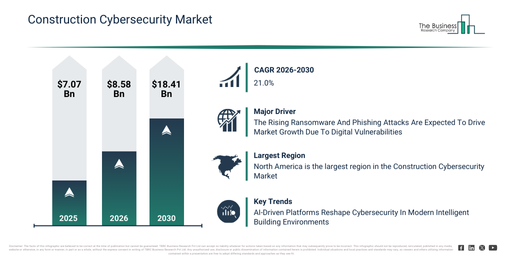
The construction cybersecurity market size has experienced exponential growth in recent years. It is projected to expand from $7.07 billion in 2025 to $8.58 billion in 2026, achieving a compound annual growth rate (CAGR) of 21.3%. Historically, this growth can be attributed to factors such as the increasing digitization of construction workflows, the rising integration of connected construction equipment, the growing use of cloud-based construction tools, the expansion of BIM-driven project environments, and a reliance on imported cybersecurity appliances.
The market size for construction cybersecurity is anticipated to undergo substantial growth in the coming years. It is projected to climb to $18.41 billion by 2030, achieving a compound annual growth rate (CAGR) of 21.0%. This expansion over the forecast period can be attributed to factors such as the increasing adoption of AI-driven cybersecurity instruments, the broadening requirements for IoT protection, the rise in localized manufacturing of cybersecurity hardware, a growing demand for integrated cyber-physical defense, and the escalating need for advanced construction data governance. Noteworthy trends during this period include the integration of AI-powered threat detection, the expansion of cloud-native cybersecurity platforms, the development of IoT security for connected construction sites, advancements in industrial cyber-physical security integration, and the utilization of blockchain for secure project data management.
Get A Free Sample Report With In-Depth Market Insights:
Construction Cybersecurity Market Opportunity Drivers: What’s Unlocking New Revenue Potential?
The increasing occurrences of ransomware and phishing attacks are projected to drive the growth of the construction cybersecurity market in the future. These attacks represent malicious cyber threats, where ransomware encrypts data for ransom payments, while phishing deceives individuals into divulging sensitive information through fraudulent messages. The frequency of ransomware and phishing incidents is escalating significantly as cybercriminals employ increasingly sophisticated social engineering techniques to manipulate human behavior, making it easier to trick individuals into clicking malicious links or disclosing sensitive data. Construction cybersecurity plays a vital role in mitigating ransomware and phishing threats by implementing robust protective measures, monitoring digital infrastructures, and enhancing organizational resilience against unauthorized access and data compromise. For instance, in June 2025, Ascendant Technologies Inc., a US-based IT service company, stated that cybersecurity threats in the construction sector have surged by 23% over the past year, with phishing, ransomware, and data breaches posing risks that could push industry losses to $1.2 trillion by 2025. Consequently, the rising incidents of ransomware and phishing attacks are stimulating the growth of the construction cybersecurity market.
Construction Cybersecurity Market Segment Breakdown: Which Categories Lead On Revenue?
The construction cybersecurity market covered in this report is segmented –
1) By Type: Network Security, Endpoint Security, Cloud Security, Identity And Access Management
2) By Component: Solution, Services
3) By Enterprise Size: Large Enterprises, Small And Medium Enterprises (SME)
4) By Application: Smart Building Protection, Project Data Safety, Remote Operations, BIM System Protection, Industrial Internet Of Things (IoT)
5) By End-User Industry: Residential Construction, Commercial Construction, Industrial Construction
Subsegments:
1) By Network Security: Firewalls, Intrusion Detection And Prevention Systems (IDPS), Virtual Private Networks (VPNs), Network Access Control (NAC)
2) By Endpoint Security: Endpoint Detection And Response (EDR), Mobile Device Security, Antivirus Or Antimalware, Application Control
3) By Cloud Security: Cloud Access Security Brokers (CASB), Secure Web Gateways, Cloud Workload Protection Platforms (CWPP), Cloud Security Posture Management (CSPM)
4) By Identity and Access Management (IAM): Multi-Factor Authentication (MFA), Privileged Access Management (PAM), Single Sign-On (SSO), Identity Governance and Administration (IGA)
Construction Cybersecurity Market Innovation Trends Shaping Future Development
Leading companies operating within the construction cybersecurity market are concentrating on developing innovative solutions, such as AI-enabled intelligent building platforms, to enhance operational visibility, security, and efficiency across modern building environments. An AI-enabled intelligent building platform serves as a digital interface utilizing artificial intelligence to unify building systems, facilitating real-time analytics, remote monitoring, predictive maintenance, and advanced cybersecurity controls. For instance, in June 2025, Honeywell International Inc., a US-based technology and manufacturing company, introduced Connected Solutions, an AI-powered building management platform that integrates critical building software, systems, and devices into a single interface to enable more efficient operations. This platform, built on Honeywell Forge, provides an AI-enabled installation process that can be completed in hours, furnishing facility managers and operators with real-time data, remote monitoring, prompts for predictive maintenance, advanced encryption for cybersecurity, and energy management tools to support decarbonization efforts.
Construction Cybersecurity Market Leading Players And Competitive Positioning
Major companies operating in the construction cybersecurity market are Siemens AG, International Business Machines Corporation (IBM), Cisco Systems Inc., Honeywell International Inc., Johnson Controls International plc, Palo Alto Networks Inc., Hexagon AB, Fortinet Inc., Trimble Inc., Check Point Software Technologies Ltd., Trend Micro Incorporated, CrowdStrike Holdings Inc., Deltek Inc., Procore Technologies Inc., Rapid7 Inc., Tenable Holdings Inc., Arctic Wolf Networks Inc., Optiv Security Inc., eSentire Inc., Dragos Inc., Ntiva Inc., Pentera Security Ltd., Eventura Limited, BlueArmor LLC, Rhebo GmbH.
View The Full Construction Cybersecurity Market Report:
Construction Cybersecurity Market Largest Region: Which Geography Holds The Biggest Share?
North America was the largest region in the construction cybersecurity market in 2025. Asia-Pacific is expected to be the fastest-growing region in the forecast period. The regions covered in the construction cybersecurity market report are Asia-Pacific, South East Asia, Western Europe, Eastern Europe, North America, South America, Middle East, Africa.
Reach Out To Our Team:
The Business Research Company: https://www.thebusinessresearchcompany.com/
Americas: +1 310-496-7795
Asia: +44 7882 955267 & +91 8897263534
Europe: +44 7882 955267
Email us at: marketing@tbrc.info
Follow us on:
LinkedIn: https://in.linkedin.com/company/the-business-research-company
YouTube: https://www.youtube.com/channel/UC24_fI0rV8cR5DxlCpgmyFQ
Global Market Model: https://www.thebusinessresearchcompany.com/global-market-model

Wasay has over a decade of experience in market research, data modelling, and analytics, with prior experience at GlobalData and Decision Tree Consulting Services. At The Business Research Company , he leads research operations across syndicated studies, customized consulting engagements, and the Global Market Model platform. His professional experience includes supporting organizations such as Boston Consulting Group, KPMG, and Ernst & Young. Wasay holds a degree in Electronics and Communications Engineering, postgraduate management qualifications from International Management Institute Belgium and Indian School of Business and Entrepreneurship, and completed the Integrated Program in Business Analytics from Indian Institute of Management Indore.