Enhanced with market attractiveness analysis, total addressable market evaluation, company benchmarking matrices, interactive Excel dashboards, expanded supply chain intelligence, emerging startup coverage, and detailed product insights, The Business Research Company’s 2026 market reports deliver more actionable and strategically valuable research.
Construction Wearable Technology Market Growth From $5.09 Billion In 2026 To $7.55 Billion By 2030 At A CAGR Of 10.4%
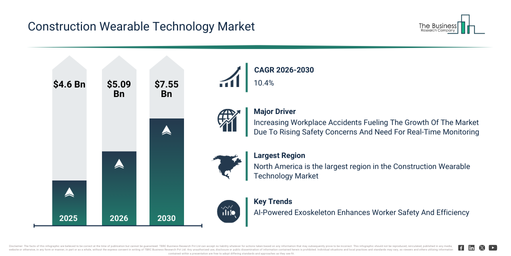
The construction wearable technology market has experienced significant growth in recent years. It is anticipated to expand from $4.6 billion in 2025 to $5.09 billion in 2026, at a compound annual growth rate (CAGR) of 10.7%. This historical growth can be attributed to the increasing adoption of safety monitoring technologies, a rising focus on reducing workplace injuries, the expansion of connected construction sites, increasing reliance on real-time worker tracking, and the rising deployment of wearable productivity tools.
The construction wearable technology market size is expected to experience significant growth in the coming years. It is projected to reach $7.55 billion in 2030, demonstrating a compound annual growth rate (CAGR) of 10.4%. This growth during the forecast period can be attributed to the increasing development of advanced biometric sensors, the rising adoption of AI-enabled safety systems, the expansion of ruggedized industrial wearables, the growing integration of AR-based training tools, and the growth in cloud-connected wearable ecosystems. Key trends anticipated for the forecast period include the integration of AI-based wearable safety analytics, the proliferation of IOT-connected wearable devices, the advancement of cloud-enabled worker monitoring systems, the growth of robotics-assisted wearable technologies, and the deployment of smart automation-driven wearable platforms.
Download A Free Sample Report For Comprehensive Market Insights:
Construction Wearable Technology Market Growth Drivers: What Factors Are Accelerating Expansion?
The increasing occurrence of workplace accidents is anticipated to stimulate the expansion of the construction wearable technology market. These incidents are defined as unforeseen and unscheduled events occurring during work, resulting in injury, illness, or damage to individuals, property, or the environment. The primary reason for the rise in workplace accidents is insufficient safety training, which leaves employees unprepared to identify and manage potential job hazards. Construction wearable technology helps reduce workplace accidents by enabling continuous monitoring of worker health and safety conditions. It also boosts job site efficiency by providing data-driven insights and immediate alerts, fostering proactive risk management and safer working environments. For instance, in August 2025, Goldcross Training Services, a UK-based construction industry firm, reported that between April 2024 and March 2025, a total of 124 workers lost their lives due to work-related incidents. Therefore, the escalating number of workplace accidents is driving the growth of the construction wearable technology market.
Construction Wearable Technology Market Segment Breakdown: Which Categories Generate The Most Revenue?
The construction wearable technology market covered in this report is segmented –
1) By Product Type: Watch, Boot, Smart Helmet, Smart Glasses, Body Wear Or Vest, Exoskeleton, Other Product Types
2) By Connectivity Technology Type: Bluetooth, Wireless Fidelity (Wi-Fi), Fourth Generation (4G) Or Fifth Generation (5G), Radio-Frequency Identification (RFID) Or Near Field Communication (NFC)
3) By Application Type: Worker Safety, Productivity Monitoring, Communication, Health Monitoring, Training And Simulation
4) By End-User: Residential, Commercial, Industrial, Infrastructure, Other End-Users
Subsegments:
1) By Watch: Global Positioning System (GPS)-Enabled Watches, Health And Safety Monitoring Watches, Communication-Integrated Smartwatches, Time-Tracking Wearables
2) By Boot: Slip Or Fall Detection Boots, Global Positioning System (GPS) Or Location Tracking Boots, Impact-Sensing Boots, Smart Soles
3) By Smart Helmet: Augmented Reality (AR)-Enabled Helmets, Sensor-Integrated Helmets, Communication-Equipped Helmets, Camera-Integrated Helmets
4) By Smart Glasses: Augmented Reality (AR) Display Glasses, Compliance Tracking Glasses, Remote Assistance Glasses, Data Visualization Glasses
5) By Body Wear Or Vest: Vital Monitoring Vests, Temperature-Regulating Vests, Posture-Sensing Wearables, High-Visibility Smart Vests
6) By Exoskeleton: Upper-Body Exoskeletons, Full-Body Powered Exoskeletons, Passive Lifting Exosuits, Motion-Assist Wearables
7) By Other Product Types: Smart Hearing Protection, Wearable Cameras, Environmental Sensing Badges, Connected Identification (ID) Tags
Construction Wearable Technology Market Trends: What Is Shaping Future Industry Growth?
Leading companies in the construction wearable technology market are concentrating on creating sophisticated items, such as AI-powered exoskeletons, with the aim of increasing efficiency, improving safety, and lessening the physical burden on workers. These AI-powered exoskeletons are defined as wearable robotic systems that leverage artificial intelligence to offer adaptable support, thereby decreasing fatigue and the risk of injury while simultaneously enhancing productivity. As an illustration, German Bionic, a robotics and wearable technology firm based in Germany, unveiled Exia, the inaugural augmented AI-powered exoskeleton, in May 2025. The Exia incorporates intelligent motion sensing and live biomechanical analysis, automatically tailoring support levels according to the user’s movements and activity. Furthermore, it offers ergonomic load assistance, intelligent safety notifications, and cloud-connected performance monitoring, facilitating effortless integration into contemporary construction processes while significantly reducing physical strain on personnel. This advancement underscores the expanding adoption of AI-driven wearable technology within the construction sector, ultimately focused on enhancing worker welfare and operational effectiveness.
Construction Wearable Technology Market Key Players And Strategic Industry Positioning
Major companies operating in the construction wearable technology market are 3M Company, Trimble Inc., Magic Leap Inc., Lantronix Inc., RealWear Inc., Vuzix Corporation, StrongArm Technology, Kinetic Construction Ltd., German Bionic GmbH, XOEye Technologies, viAct GmbH, Redpoint Positioning Corp., SuitX Inc., Lansitec Technology Co. Ltd., Båstadgruppen AB, GuardHat Inc., Modjoul Inc., WakeCap Technologies, Kwant.ai, VisiLean Ltd., iSmarch Technology Co. Ltd.
Access The Complete Construction Wearable Technology Market Report:
#Construction Wearable Technology Market Largest Region: Which Geography Holds The Highest Market Share?
North America was the largest region in the construction wearable technology market in 2025. The regions covered in the construction wearable technology market report are Asia-Pacific, South East Asia, Western Europe, Eastern Europe, North America, South America, Middle East, Africa.
Get in touch with us:
The Business Research Company: https://www.thebusinessresearchcompany.com/
Americas: +1 310-496-7795
Asia: +44 7882 955267 & +91 8897263534
Europe: +44 7882 955267
Email us at: marketing@tbrc.info
Follow us on:
LinkedIn: https://in.linkedin.com/company/the-business-research-company
YouTube: https://www.youtube.com/channel/UC24_fI0rV8cR5DxlCpgmyFQ
Global Market Model: https://www.thebusinessresearchcompany.com/global-market-model

Wasay has over a decade of experience in market research, data modelling, and analytics, with prior experience at GlobalData and Decision Tree Consulting Services. At The Business Research Company , he leads research operations across syndicated studies, customized consulting engagements, and the Global Market Model platform. His professional experience includes supporting organizations such as Boston Consulting Group, KPMG, and Ernst & Young. Wasay holds a degree in Electronics and Communications Engineering, postgraduate management qualifications from International Management Institute Belgium and Indian School of Business and Entrepreneurship, and completed the Integrated Program in Business Analytics from Indian Institute of Management Indore.