Backed by market attractiveness analysis, total addressable market sizing, company benchmarking matrices, interactive Excel dashboards, wider supply chain intelligence, emerging startup coverage, and detailed product-level insights, The Business Research Company’s 2026 market reports are designed to offer research that is more actionable and strategically valuable than ever.
Container Houses Market Size Forecast: How Big Could The Market Get By 2030?
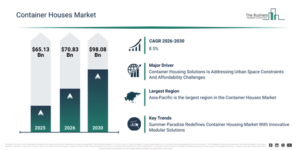
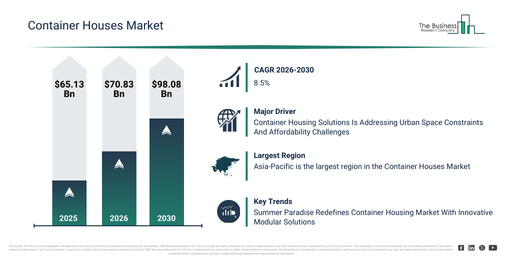
The container houses market has witnessed robust growth in recent years. The market is projected to expand from $65.13 billion in 2025 to $70.83 billion in 2026, demonstrating a compound annual growth rate (CAGR) of 8.8%. Historically, this growth has been driven by factors such as the surging need for economical housing, the advancement of sustainable building projects, the increasing acceptance of modular housing, a greater utilization of prefabricated container units, and the broadening of housing options for emergency and disaster relief.
The container houses market size is forecast for robust expansion over the next few years, projected to achieve $98.08 billion by 2030, growing at a compound annual growth rate (CAGR) of 8.5%. This anticipated growth during the forecast period is propelled by the increasing deployment of IoT-enabled container monitoring, the adoption of AI-assisted design platforms, advancements in modular construction automation, the implementation of smart stackable container solutions, and the creation of resilient and energy-efficient container homes. Prominent trends within this period are expected to encompass the embrace of eco-friendly modular container construction, the application of AI-assisted design for container homes, the integration of digital construction management systems, a wider expansion of IoT-enabled monitoring for container structures, and the development of intelligent stackable housing solutions.
Get A Free Sample Report With In-Depth Market Insights:
Container Houses Market Growth Drivers: What’s Behind The Acceleration?
Global cities are experiencing growing space constraints and rising housing costs, which are fueling the expansion of the container houses market. These homes are constructed from old shipping containers, requiring significantly less land than traditional houses, thus optimizing space utilization. According to Discover Containers, recycling and reusing a 40-foot container to build a house saves approximately 3500 kilograms of steel that would otherwise be melted. Moreover, urban residents are choosing container houses for a more affordable lifestyle, as they are less expensive than conventional homes. The affordable housing program in Alberta received $10 million in funding from the US federal government, with the aim of constructing houses using repurposed shipping containers. The container houses market is expected to thrive from increasing space limitations and housing prices during the forecast period. The increasing occurrence of natural disasters is projected to boost the growth of the container houses market in the coming years. Natural disasters are catastrophic events caused by Earth’s natural processes, leading to extensive destruction, fatalities, and major disruptions to normal life. Container houses are built to withstand transport stresses and offer benefits such as easy mobility, quick assembly, flexibility, sustainability, durability, and stackability, providing enhanced security and protection for inhabitants during and after natural disasters. For instance, in May 2025, the United Nations, citing a US-based health agency, reported that North America incurred $69.57 billion in direct disaster-related losses in 2023, which was more than any other region, though it constituted just 0.23% of its Gross Domestic Product (GDP). Therefore, the rising number of natural disasters is a key driver for the container houses market.
Container Houses Market Segment Landscape: Which Areas Lead Development?
The container houses market covered in this report is segmented –
1) By Construction Type: Fixed, Movable
2) By End User: Residential Homes, Recreational Homes, Emergency Homes, Nursing Homes
3) By Architecture Type: Duplex Or Bungalow, Tiny House, Multistory Building Or Apartments
Subsegments:
1) By Fixed: Modular Fixed Container Houses, Permanent Structure Container Houses, Single-Unit Fixed Container Homes, Multi-Unit Fixed Container Complexes
2) By Movable: Mobile Container Homes, Transportable Container Housing Units, Temporary Container Housing Solutions, Folding Or Expandable Movable Container Homes
Container Houses Market Trends: What’s Defining The Industry’s Next Phase?
Leading companies in the container houses market are developing new products, such as modular container houses, to achieve a competitive edge. Modular container houses are prefabricated dwelling units constructed primarily using shipping containers. For instance, in August 2023, Summer Paradise, a China-based manufacturer of container houses, launched high-quality flat-pack container houses. These inventive, customizable container homes are designed to assist a wide range of businesses and disaster relief efforts. The company’s container houses are suitable for various functions due to their emphasis on state-of-the-art technology, rapid assembly, easy transportation, excellent quality, quick shipping, simple installation, and customization. In addition to offering tailored solutions, Summer Paradise provides a range of container housing styles, including eco-friendly choices with robust seismic performance. The company is focused on revolutionizing temporary housing with its superior container houses and is dedicated to producing flat-pack containers with utmost precision.
Container Houses Market Industry Leaders And Competitive Landscape
Major companies operating in the container houses market are Boxman Studios, Honomobo, Logical Homes, Meka Modular, Rhino Cubed, Giant Containers, SG Blocks, Nova Deko Modular, Alternative Living Spaces, Backcountry Containers, Modhouse, Kubed Living, Montainer Homes, MODS International, Bob’s Containers, Recycled Containers, Stackhouse Container Homes, Container Build Group, ShelterKraft, Custom Container Living, Container Homes USA, Cargotecture, BMarko Structures, Container Solutions Group, Tiny House Container, Container Living, Steelblox, Saracen Containers, ShipHaus, HyBrid Architecture
View The Full Container Houses Market Report:
Container Houses Market Regional Analysis And Top Geography
Asia-Pacific was the largest region in the container houses market in 2025. The regions covered in the container houses market report are Asia-Pacific, South East Asia, Western Europe, Eastern Europe, North America, South America, Middle East, Africa.
Reach Out To Our Team:
The Business Research Company: https://www.thebusinessresearchcompany.com/
Americas: +1 310-496-7795
Asia: +44 7882 955267 & +91 8897263534
Europe: +44 7882 955267
Email us at: marketing@tbrc.info
Follow us on:
LinkedIn: https://in.linkedin.com/company/the-business-research-company
YouTube: https://www.youtube.com/channel/UC24_fI0rV8cR5DxlCpgmyFQ
Global Market Model: https://www.thebusinessresearchcompany.com/global-market-model

Wasay has over a decade of experience in market research, data modelling, and analytics, with prior experience at GlobalData and Decision Tree Consulting Services. At The Business Research Company , he leads research operations across syndicated studies, customized consulting engagements, and the Global Market Model platform. His professional experience includes supporting organizations such as Boston Consulting Group, KPMG, and Ernst & Young. Wasay holds a degree in Electronics and Communications Engineering, postgraduate management qualifications from International Management Institute Belgium and Indian School of Business and Entrepreneurship, and completed the Integrated Program in Business Analytics from Indian Institute of Management Indore.