Designed to make market research more actionable and strategically valuable, The Business Research Company’s 2026 market reports feature market attractiveness scoring, total addressable market sizing, company benchmarking matrices, interactive Excel dashboards, deeper supply chain intelligence, emerging startup tracking, and granular product-level insights.
Digital Structural Health Dashboard Market To Expand At A 13.4% CAGR: Size And Growth Projections Through 2030
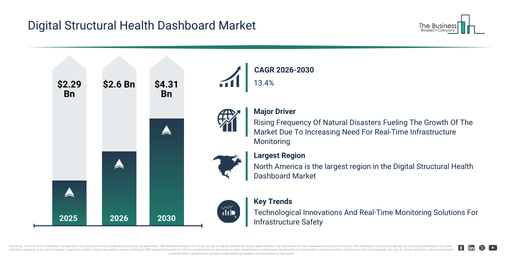
The digital structural health dashboard market size has experienced rapid expansion in recent years. It is projected to grow from $2.29 billion in 2025 to $2.6 billion in 2026, at a compound annual growth rate (CAGR) of 13.7%. The growth observed in the historic period can be attributed to factors such as the rising deployment of structural sensors, increasing demand for infrastructure safety, the growth of preventive maintenance initiatives, a reliance on manual inspection methods, and the expansion of critical infrastructure projects.
The digital structural health dashboard market is projected for significant expansion in the coming years, reaching a valuation of $4.31 billion by 2030, exhibiting a compound annual growth rate (CAGR) of 13.4%. This anticipated growth during the forecast period is driven by factors such as the increasing embrace of predictive maintenance solutions, the proliferation of connected structural monitoring systems, the emergence of AI-driven analytics platforms, the growing reliance on real-time dashboards for informed decision-making, and the broadened scope of integrated remote inspection services. Key trends shaping the market during this period encompass the adoption of AI-enhanced structural monitoring, the rollout of predictive maintenance dashboards, the integration of real-time sensor data analytics, the uptake of connected infrastructure monitoring systems, and the widening application of remote inspection and reporting tools.
Get Your Free Digital Structural Health Dashboard Market Report Sample Today:
Which Factor Is Expected To Drive The Digital Structural Health Dashboard Market Over The Forecast Period?
The anticipated growth of the digital structural health dashboard market is primarily driven by the increasing occurrence of natural disasters. These are severe natural occurrences that manifest unexpectedly, causing widespread harm to populations, infrastructure, and ecosystems. Their prevalence is escalating largely due to climate change, where rising global temperatures intensify extreme weather phenomena such as storms, floods, and wildfires. The heightened frequency of natural disasters necessitates digital structural health dashboards, which provide real-time monitoring and swift evaluation of infrastructural damage, thereby assisting authorities in making faster and more secure recovery decisions. For example, in January 2024, the National Centers for Environmental Information (NCEI), a US-based government agency, reported that the United States was affected by 28 distinct weather and climate disasters during 2023, each incurring damages exceeding $1 billion, culminating in total estimated losses of $92.9 billion for the year. Thus, the rising frequency of natural disasters is a significant force propelling the expansion of the digital structural health dashboard market.
Digital Structural Health Dashboard Market Segmentation Insights: How Is The Industry Categorized?
The digital structural health dashboard market covered in this report is segmented –
1) By Component: Software, Hardware, Services
2) By Deployment Mode: On-Premises, Cloud-Based
3) By Application: Bridges And Tunnels, Buildings, Dams, Wind Turbines, Oil And Gas Infrastructure, Aerospace, Other Applications
Subsegments:
1) By Software: Cloud-Based Platforms, On-Premises Solutions, Data Analytics And Visualization Tools, Predictive Maintenance Software
2) By Hardware: Sensors, Data Acquisition Systems, Communication Devices, Edge Devices, Monitoring Instruments
3) By Services: Consulting Services, Integration And Deployment Services, Maintenance And Support Services, Training And Education Services
Digital Structural Health Dashboard Market Trends Explained: What Is Changing And Why It Matters
Leading firms in the digital structural health dashboard market are concentrating on creating sophisticated methods, like synchronized dataset integration, to offer infrastructure professionals and engineers enhanced monitoring capabilities. These solutions facilitate instantaneous analysis of structural, environmental, and traffic information. Synchronized dataset integration involves gathering and correlating diverse sensor inputs in real-time, allowing for a combined examination of structural, environmental, and traffic parameters to ensure precise and thorough surveillance. As an illustration, in May 2025, the Swiss technology firm Kistler Group introduced a cloud-native platform for structural health monitoring. This platform combines cutting-edge sensor technology with weigh-in-motion systems to deliver uninterrupted, live monitoring of bridges. It gathers and assesses data on vibration, strain, environmental conditions, and traffic flow, providing robust analytics and notification features. All data is securely stored in the cloud, empowering operators to identify potential problems promptly, schedule preventative maintenance, and make well-informed choices to boost structural safety and prolong operational longevity.
Digital Structural Health Dashboard Market Competitor Landscape: Who Are The Major Companies?
Major companies operating in the digital structural health dashboard market are Siemens AG, IBM Corporation, Cisco Systems Inc., General Electric Company, Oracle Corporation, Schneider Electric SE, Honeywell International Inc., SAP SE, Atkins, Trimble Inc., Fugro N.V., National Instruments Corporation, AVEVA Group Plc, Bentley Systems Incorporated, COWI A/S, Strainstall UK Limited, Nova Metrix LLC, Kinemetrics Inc., Acellent Technologies Inc., Digitexx Data Systems Inc.
See The Full Digital Structural Health Dashboard Market Report For Complete Market Sizing And Trends:
Digital Structural Health Dashboard Market Regional Demand Analysis And Leading Geography
North America was the largest region in the digital structural health dashboard market in 2025. Asia-Pacific is expected to be the fastest-growing region in the forecast period. The regions covered in the digital structural health dashboard market report are Asia-Pacific, South East Asia, Western Europe, Eastern Europe, North America, South America, Middle East, Africa.
Reach Out To Our Team:
The Business Research Company: https://www.thebusinessresearchcompany.com/
Americas: +1 310-496-7795
Asia: +44 7882 955267 & +91 8897263534
Europe: +44 7882 955267
Email us at: marketing@tbrc.info
Follow us on:
LinkedIn: https://in.linkedin.com/company/the-business-research-company
YouTube: https://www.youtube.com/channel/UC24_fI0rV8cR5DxlCpgmyFQ
Global Market Model: https://www.thebusinessresearchcompany.com/global-market-model

Wasay has over a decade of experience in market research, data modelling, and analytics, with prior experience at GlobalData and Decision Tree Consulting Services. At The Business Research Company , he leads research operations across syndicated studies, customized consulting engagements, and the Global Market Model platform. His professional experience includes supporting organizations such as Boston Consulting Group, KPMG, and Ernst & Young. Wasay holds a degree in Electronics and Communications Engineering, postgraduate management qualifications from International Management Institute Belgium and Indian School of Business and Entrepreneurship, and completed the Integrated Program in Business Analytics from Indian Institute of Management Indore.