Backed by market attractiveness analysis, total addressable market sizing, company benchmarking matrices, interactive Excel dashboards, wider supply chain intelligence, emerging startup coverage, and detailed product-level insights, The Business Research Company’s 2026 market reports are designed to offer research that is more actionable and strategically valuable than ever.
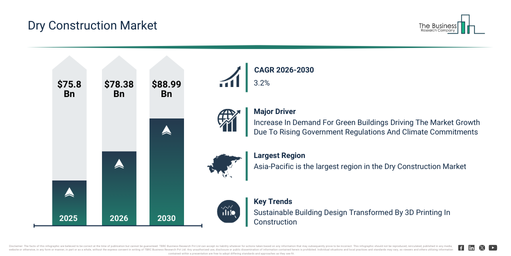
Dry Construction Market Set To Climb From $78.38 Billion In 2026 To $88.99 Billion By 2030
The dry construction market has shown consistent expansion in recent years. It is anticipated to increase from $75.8 billion in 2025 to $78.38 billion in 2026, at a compound annual growth rate (CAGR) of 3.4%. This historical growth can be attributed to several factors, including the increasing adoption of lightweight materials, a rising demand for more rapid construction methods, the expansion of commercial building projects, enhanced awareness of moisture-resistant construction solutions, and a growing preference for modular interior systems.
The dry construction market is anticipated to experience consistent expansion over the upcoming years. Its valuation is projected to reach $88.99 billion by 2030, exhibiting a compound annual growth rate (CAGR) of 3.2%. This projected increase can be ascribed to several factors, including the proliferation of sustainable building methods, the greater incorporation of prefabricated dry construction solutions, a surge in the uptake of insulated and acoustic panels, an increase in residential renovation projects, and innovations in engineered dry construction materials. Key trends during this period are expected to encompass the growing preference for lightweight construction materials, expanded deployment of pre-engineered and modular systems, heightened demand for moisture-resistant and fire-safe boards, broader utilization of drywall in both residential and commercial sectors, and technological improvements in acoustic and insulated board products.
Get A Free Sample Report With In-Depth Market Insights:
Dry Construction Market Industry Drivers: What’s Behind The Revenue Growth?
The rising demand for green buildings is anticipated to boost the growth of the dry construction market in the future. Green buildings are structures planned, built, and managed to minimize environmental impact through energy efficiency, resource conservation, and sustainable methods. This increasing demand for green buildings is primarily driven by expanding government regulations and climate commitments, as cities and states implement stricter building codes and mandate energy-efficient construction to meet emission reduction targets. Buildings designed with energy-efficient features and sustainable materials necessitate advanced dry construction methods that provide superior insulation, faster installation, and reduced material waste. For instance, in May 2024, according to the U.S. Environmental Protection Agency, a US-based federal government agency responsible for environmental protection, the number of commercial buildings that earned ENERGY STAR certification rose from more than 7,000 in 2022 to more than 8,800 in 2023, reflecting an increase of approximately 1,800 buildings. Consequently, the increased demand for green buildings is propelling the growth of the dry construction market.
Dry Construction Market Segment Outlook: Which Categories Are Growing Fastest?
The dry construction market covered in this report is segmented –
1) By Type: Supporting Framework, Boarding
2) By Material: Plasterboard, Wood, Metal, Plastic
3) By System: Ceiling System, Wall System, Flooring System
4) By Application: Residential, Non Residential
Subsegments:
1) By Supporting Framework: Metal Studs and Tracks, Wooden Studs, Steel Frames, Pre-engineered Frames
2) By Boarding: Gypsum Boards (Drywall), Cement Boards, Plywood and Particle Boards, Insulated Boards, Acoustic Boards
#Dry Construction Market Growth Trends: What’s Shaping The Future Outlook?
Leading construction firms are concentrating on developing advanced solutions, specifically 3D printing technology, to boost efficiency, sustainability, and design adaptability in construction. This technology functions as an additive manufacturing method, constructing walls, floors, and roofs in successive layers with advanced materials, thereby reducing waste, accelerating project timelines, and facilitating intricate, personalized architectural concepts. As an illustration, in August 2023, the German construction enterprise MENSE KORTE utilized a 3D printer to erect Europe’s largest 3D-printed structure within the city of Heidelberg. This structure serves as a small dwelling for bikers and incorporates cement-free concrete to decrease CO2 emissions. This pioneering endeavor underscores the capabilities of 3D printing in the construction sector, especially regarding environmental friendliness and design versatility. Situated near a biker railway in Beckum, the tiny house showcases an outward-curving elliptical facade, an aesthetic achieved through 3D printing. The MC-PowerPrint GeCO₂ cement-free 3D dry mortar employed in this project allows for a substantial decrease in CO2 emissions when contrasted with conventional cement-based mortar products.
Dry Construction Market Leading Companies And Competitive Benchmarking
Major companies operating in the dry construction market are Saint Gobain SA, Etex Group Ltd., Fletcher Building Limited, USG Boral Pvt. Ltd., Knauf AG, Panel Rey SA, PABCO Building Products LLC, Armstrong World Industries Inc., Georgia pacisific LLC, Beijing New Building Materials Public Limited, 3G Drywall LLC, Cano Estructuras, Knauf Gips KG, USG Corporation, Boral Limited, National Gypsum Company, Compagnie de Saint-Gobain S.A., James Hardie Industries plc, Continental Building Products Inc., CertainTeed Corporation, LafargeHolcim Ltd., Paneltech Systems Ltd., Pennar Industries Limited, Rondo Building Services Pty Ltd., Siniat Ltd., VANS Gypsum Pvt. Ltd., Winstone Wallboards Limited, Zhejiang Yulong Building Materials Co. Ltd., China National Building Material Company Limited, Etex Building Performance NV
View The Full Dry Construction Market Report:
Dry Construction Market Geographic Landscape: Which Region Leads Industry Growth?
Asia-Pacific was the largest region in the dry construction market in 2025. North America is expected to be the fastest-growing region in the dry construction market during the forecast period. The regions covered in the dry construction market report are Asia-Pacific, South East Asia, Western Europe, Eastern Europe, North America, South America, Middle East, Africa.
Reach Out To Our Team:
The Business Research Company: https://www.thebusinessresearchcompany.com/
Americas: +1 310-496-7795
Asia: +44 7882 955267 & +91 8897263534
Europe: +44 7882 955267
Email us at: marketing@tbrc.info
Follow us on:
LinkedIn: https://in.linkedin.com/company/the-business-research-company
YouTube: https://www.youtube.com/channel/UC24_fI0rV8cR5DxlCpgmyFQ
Global Market Model: https://www.thebusinessresearchcompany.com/global-market-model

Wasay has over a decade of experience in market research, data modelling, and analytics, with prior experience at GlobalData and Decision Tree Consulting Services. At The Business Research Company , he leads research operations across syndicated studies, customized consulting engagements, and the Global Market Model platform. His professional experience includes supporting organizations such as Boston Consulting Group, KPMG, and Ernst & Young. Wasay holds a degree in Electronics and Communications Engineering, postgraduate management qualifications from International Management Institute Belgium and Indian School of Business and Entrepreneurship, and completed the Integrated Program in Business Analytics from Indian Institute of Management Indore.