Enhanced with market attractiveness analysis, total addressable market evaluation, company benchmarking matrices, interactive Excel dashboards, expanded supply chain intelligence, emerging startup coverage, and detailed product insights, The Business Research Company’s 2026 market reports deliver more actionable and strategically valuable research.
Energy-Efficient Building Market Value Analysis: What Growth Is Expected Over The Forecast Period?
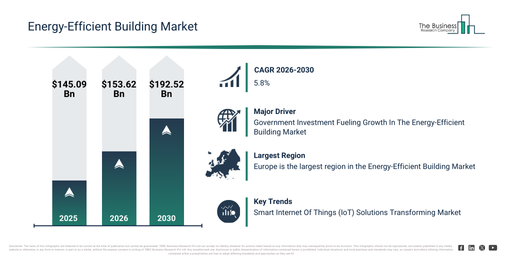
The energy-efficient building market has demonstrated substantial growth in recent years. Projections indicate it will increase from $145.09 billion in 2025 to $153.62 billion in 2026, achieving a compound annual growth rate (CAGR) of 5.9%. The market’s past expansion can be attributed to factors such as rising demand for sustainable construction practices, the early implementation of efficient lighting and HVAC systems, an increase in green building certifications, a heightened focus on minimizing operational costs, and the broadening of regulatory standards for energy efficiency.
The energy-efficient building market is projected to witness robust expansion over the coming years. It is forecast to grow to $192.52 billion by 2030, exhibiting a compound annual growth rate (CAGR) of 5.8%. The impetus for this growth during the forecast period can be attributed to increasing investment in net-zero building projects, the rising adoption of smart building technologies, enhanced integration of renewable energy systems, the broadening of energy management services, and advancements in building envelope materials. Key trends expected in the forecast period include the increasing incorporation of high-efficiency HVAC solutions, a growing uptake of smart energy management systems, wider renewable energy integration in buildings, more extensive use of advanced insulation materials, and an expansion of net-zero and near-zero energy building projects.
Download A Free Sample Report For Comprehensive Market Insights:
Energy-Efficient Building Market Growth Drivers: What Factors Are Accelerating Expansion?
Future expansion of the energy-efficient building market is anticipated to be driven by rising government investment. This investment encompasses capital deployed by governmental bodies for diverse objectives, including infrastructure development, social programs, education, healthcare, research and development, and clean energy initiatives. Specifically, government spending on energy-efficient building endeavors is vital for boosting the adoption of sustainable construction practices, cutting down energy consumption, decreasing greenhouse gas emissions, and fostering economic development and resilience. As an illustration, the Office for National Statistics, an executive body of the UK Statistics Authority, reported in July 2024 that infrastructure investment by the total market sector reached $14.93 billion (in constant prices) in 2023, marking a 3.9% increase compared to 2022. Consequently, heightened government investment is a key driver for the energy-efficient building market.
Energy-Efficient Building Market Segment Performance And Strategic Opportunities
The energy-efficient building market covered in this report is segmented –
1) By Type: Heating, Ventilation, And Air Conditioning (HVAC), Lighting, Building Controls, Water Efficiency, Water Heating, Building Envelope, Other Types
2) By Material: Roofing, Fiber Cement, Concrete Tiles, Insulation, Construction Chemicals, Sealants, Water Proofers, Other Materials
3) By End User: Residential, Commercial, Industrial Sector
Subsegments:
1) By Heating, Ventilation, And Air Conditioning (HVAC): High-Efficiency HVAC Systems, Geothermal Heating And Cooling Systems, Smart Thermostats, Variable Refrigerant Flow (VRF) Systems
2) By Lighting: LED Lighting, Smart Lighting Systems, Solar-Powered Lighting, Dimmable Lighting, Lighting Controls
3) By Building Controls: Building Management Systems (BMS), Energy Management Systems (EMS), Smart Thermostats, Occupancy Sensors, Advanced Metering Infrastructure (AMI)
4) By Water Efficiency: Low-Flow Fixtures, Water-Efficient Landscaping, Rainwater Harvesting Systems, Greywater Recycling Systems
5) By Water Heating: Solar Water Heating Systems, Heat Pump Water Heaters, Tankless Water Heaters, High-Efficiency Water Heaters
6) By Building Envelope: Insulation Materials, Energy-Efficient Windows, Roofing Solutions, Air Sealing And Draft Prevention, Reflective And Insulating Materials
7) By Other Types: Energy-Efficient Appliances, Renewable Energy Systems, Smart Home Technology For Energy Efficiency, Green Building Materials
Energy-Efficient Building Market Trends: What Is Shaping Future Industry Growth?
Leading companies within the energy-efficient building market are concentrating on developing innovative products featuring advanced technologies, like smart IoT solutions, to enhance their market profitability. Such intelligent IoT solutions are instrumental in advancing energy efficiency across various sectors, including homes, buildings, industries, and cities, ultimately contributing to efforts in sustainability and environmental conservation. As an illustration, in March 2023, Siemens AG, a Germany-based energy technology and manufacturing company, unveiled Connect Box. The Connect Box is an IoT solution specifically designed for small to medium-sized buildings, facilitating seamless integration of wired or wireless devices. It works by optimizing energy consumption, monitoring performance, and improving indoor air quality through continuous real-time analysis. With its plug-and-play installation, flexible licensing options, and user-friendly interfaces, it addresses diverse requirements while ensuring adherence to sustainability regulations and providing up to 30% energy savings.
Energy-Efficient Building Market Key Players: Which Companies Shape Industry Competition?
Major companies operating in the energy-efficient building market are Siemens AG, Panasonic Corporation, GE Electrical Equipment, Veolia Environnement S.A., Mitsubishi Electric Corporation, Schneider Electric SE, Honeywell International Inc., ABB Ltd., Daikin Industries Ltd., Toshiba Corporation, Johnson Controls International plc, Eaton Corporation PLC, Carrier Global Corporation, Koninklijke Philips N.V., Trane Technologies plc, Emerson Electric Co., Legrand S.A., Osram GmbH, Acuity Brands Inc., Itron Inc., Zumtobel Group AG, Cree Inc., GridPoint Inc., Pacific Controls Inc., BuildingIQ Inc
Access The Complete Energy-Efficient Building Market Report:
Energy-Efficient Building Market Regional Distribution: Which Areas Drive Market Expansion?
Europe was the largest region in the energy-efficient building market in 2025. Asia-Pacific is expected to be the fastest-growing region in the forecast period. The regions covered in the energy-efficient building market report are Asia-Pacific, South East Asia, Western Europe, Eastern Europe, North America, South America, Middle East, Africa.
Get in touch with us:
The Business Research Company: https://www.thebusinessresearchcompany.com/
Americas: +1 310-496-7795
Asia: +44 7882 955267 & +91 8897263534
Europe: +44 7882 955267
Email us at: marketing@tbrc.info
Follow us on:
LinkedIn: https://in.linkedin.com/company/the-business-research-company
YouTube: https://www.youtube.com/channel/UC24_fI0rV8cR5DxlCpgmyFQ
Global Market Model: https://www.thebusinessresearchcompany.com/global-market-model

Wasay has over a decade of experience in market research, data modelling, and analytics, with prior experience at GlobalData and Decision Tree Consulting Services. At The Business Research Company , he leads research operations across syndicated studies, customized consulting engagements, and the Global Market Model platform. His professional experience includes supporting organizations such as Boston Consulting Group, KPMG, and Ernst & Young. Wasay holds a degree in Electronics and Communications Engineering, postgraduate management qualifications from International Management Institute Belgium and Indian School of Business and Entrepreneurship, and completed the Integrated Program in Business Analytics from Indian Institute of Management Indore.