Featuring market attractiveness scoring, total addressable market sizing, company benchmarking matrices, interactive Excel dashboards, deeper supply chain intelligence, emerging startup tracking, and granular product-level insights, The Business Research Company’s 2026 market reports are built to deliver research that is both more actionable and more strategically valuable.
Factory Buildings Market Revenue Growth On Track For A 3.2% CAGR Through 2030
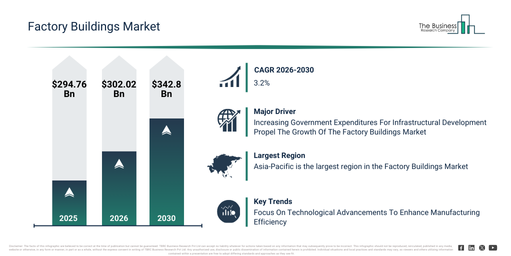
The factory buildings market size has shown steady growth recently. It is projected to increase from $294.76 billion in 2025 to $302.02 billion in 2026, at a compound annual growth rate (CAGR) of 2.5%. This historical expansion can be attributed to several factors, including the advancement of industrialization, the broadening of manufacturing capacity, a rising need for warehouse areas, amplified investment in production facilities, and the establishment of extensive distribution networks.
The factory buildings market size is anticipated to undergo consistent expansion in the coming years. It is predicted to reach $342.8 billion by 2030, showing a compound annual growth rate (CAGR) of 3.2%. The growth observed in the forecast period stems from factors such as the increasing adoption of smart factories, a growing transition to sustainable construction materials, the development of automated manufacturing facilities, the expansion of global logistics infrastructure, and a heightened demand for high-efficiency industrial buildings. Significant trends during this period include the rising construction of large-scale distribution warehouses, the increasing establishment of light assembly and flexible production facilities, a greater need for factory buildings with high clear-heights, the expansion of heavy manufacturing structures to enhance industrial capacity, and an increase in the renovation of aging industrial plants.
Get A Free Sample Report With In-Depth Market Insights:
Factory Buildings Market Growth Factors Behind Sustained Expansion
Rising government expenditures on infrastructural development are anticipated to stimulate the expansion of the factory buildings market. Governments allocate funds to infrastructure primarily to elevate national investment levels and foster economic growth. Since factory buildings constitute industrial construction, a segment of infrastructural development, increased governmental outlays for infrastructure will correspondingly heighten the demand for these structures. For instance, data from July 2024, provided by the Office for National Statistics, a UK-based government department, indicated that total investment in the infrastructure sector reached $18.0 billion (£13.8 billion) in constant prices in 2023, showing a 3.9% rise from 2022. Furthermore, the estimated net stocks of infrastructure in the market sector stood at $456.9 billion (£350.2 billion) in constant prices for 2023, marking a 0.3% increase over the preceding year. This demonstrates that augmented government spending on infrastructural development is indeed a key factor propelling the growth of the factory buildings market.
Factory Buildings Market Segment Analysis Spotlighting Growth Areas
The factory buildings market covered in this report is segmented –
1) By Type: Heavy Manufacturing Buildings, Light Assembly Buildings, General Warehouses
2) By Material: Aggregates, Bricks, Cement
3) By Construction Type: New Construction, Renovation
4) By Application: Owned, Rental
5) By End User: Private, Public
Subsegments:
1) By Heavy Manufacturing Buildings: Steel And Metal Fabrication Plants, Automotive And Heavy Equipment Manufacturing Plants, Chemical And Petrochemical Processing Facilities, Machinery And Equipment Production Units
2) By Light Assembly Buildings: Electronics Assembly Units, Consumer Goods Assembly Facilities, Medical Device Assembly Plants, Small Component Manufacturing Units
3) By General Warehouses: Raw Material Storage Warehouses, Finished Goods Warehouses, Cold Storage Warehouses, Automated Warehouses
Factory Buildings Market Industry Trends Fueling Future Revenue Growth
Major companies operating in the factory buildings market are concentrating on developing technological advancements, specifically digital twin orchestration, to optimize facility performance, enhance operational efficiency, and enable predictive maintenance across manufacturing infrastructures. Digital twin orchestration refers to the process of integrating and managing multiple digital twins within a manufacturing ecosystem, facilitating seamless data flow, coordinated operations, and improved decision-making through real-time insights and automation. For instance, in October 2025, Accenture Plc, an Ireland-based professional services company, introduced the Physical AI Orchestrator, a cloud-based solution aimed at helping manufacturers transform current and future factories and warehouses into software-defined facilities. This solution enhances operational efficiency, minimizes design and capital costs, and improves safety through real-time simulations and AI-powered automation. The solution is designed to support agile manufacturing environments that can dynamically adapt to evolving requirements, enabling faster innovation and optimized facility planning.
Factory Buildings Market Leading Companies: Who Holds The Strongest Market Presence?
Major companies operating in the factory buildings market are Pretorius Structures Ltd., FEG Global Ltd., Tasin Company Ltd., Ajinomoto Engineering Corporation, N.S.L Construction Co. Ltd., Tata Projects Limited, Larsen & Toubro Limited, Hitachi Plant Construction Ltd., Primus Builders Inc., Sika AG, AME Construction Services Ltd., Hindustan Construction Company, Dilip Buildcon Ltd., Turner Construction Co., Bechtel Corporation, Fluor Corporation, AECOM Technology Corporation, Whiting-Turner Contracting Company, Kiewit Corporation, Skanska USA, PCL Construction Enterprises Inc., Leopardo Companies, Layton Construction Company LLC, McGough Construction Company LLC, Hill & Wilkinson Construction Group Ltd., Kraus-Anderson Company, Schimenti Construction Company, LeChase Construction Services LLC, ThermalTech Engineering Inc., W.E. O’Neil Construction Company, Robins & Morton Group, Nabholz Construction Corporation, Plaza Construction LLC, Hunter Roberts Construction Group, Hill International Inc., Hoar Construction LLC, Ghafari Associates LLC, Kitchell Corporation, IMC Construction Inc., KBE Building Corporation, Joeris General Contractors Ltd., STV Group Inc., Batson-Cook Company, Cumming Corporation, HITT Contracting Inc., Holder Construction Group LLC, Brasfield & Gorrie LLC
View The Full Factory Buildings Market Report:
Factory Buildings Market Largest Region: Which Geography Holds The Biggest Share?
Asia-Pacific was the largest region in the factory buildings market in 2025. The regions covered in the factory buildings market report are Asia-Pacific, South East Asia, Western Europe, Eastern Europe, North America, South America, Middle East, Africa.
Reach Out To Our Team:
The Business Research Company: https://www.thebusinessresearchcompany.com/
Americas: +1 310-496-7795
Asia: +44 7882 955267 & +91 8897263534
Europe: +44 7882 955267
Email us at: marketing@tbrc.info
Follow us on:
LinkedIn: https://in.linkedin.com/company/the-business-research-company
YouTube: https://www.youtube.com/channel/UC24_fI0rV8cR5DxlCpgmyFQ
Global Market Model: https://www.thebusinessresearchcompany.com/global-market-model

Wasay has over a decade of experience in market research, data modelling, and analytics, with prior experience at GlobalData and Decision Tree Consulting Services. At The Business Research Company , he leads research operations across syndicated studies, customized consulting engagements, and the Global Market Model platform. His professional experience includes supporting organizations such as Boston Consulting Group, KPMG, and Ernst & Young. Wasay holds a degree in Electronics and Communications Engineering, postgraduate management qualifications from International Management Institute Belgium and Indian School of Business and Entrepreneurship, and completed the Integrated Program in Business Analytics from Indian Institute of Management Indore.