Built to provide research that’s more actionable and strategically valuable, The Business Research Company’s 2026 market reports include market attractiveness analysis, total addressable market sizing, company benchmarking matrices, interactive Excel dashboards, broader supply chain intelligence, emerging startup tracking, and in-depth product insights.
Foldable Houses Market CAGR Outlook And Future Development
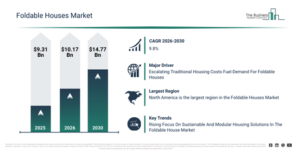
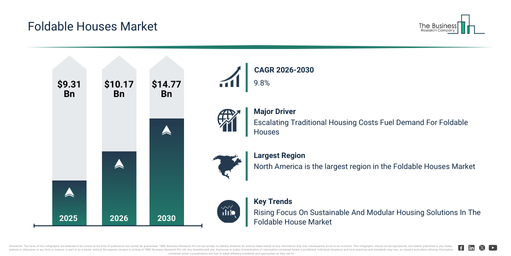
The foldable houses market size has experienced considerable expansion in recent years. Its value is expected to rise from $9.31 billion in 2025 to $10.17 billion in 2026, reflecting a compound annual growth rate (CAGR) of 9.3%. Historically, this growth can be attributed to a heightened demand for low-cost housing, the initial adoption of container-based living units, the wider application of modular construction practices, reliance on manual assembly processes, and the increasing use of basic prefabricated materials.
The foldable houses market is projected to experience substantial growth in the next few years, reaching $14.77 billion in 2030 at a compound annual growth rate (CAGR) of 9.8%. This expansion in the forecast period is attributed to several factors, including the increasing adoption of sustainable modular housing, the growing popularity of expandable foldable units, rising investment in emergency and temporary housing solutions, the expansion of digitally enabled modular manufacturing, and advancements in lightweight high-performance materials. Major trends expected during this period include a heightened demand for affordable modular housing, an increasing adoption of foldable and portable living units, growth in disaster-relief and emergency housing applications, the broadening of multi-section and connectable housing designs, and a higher interest in energy-efficient foldable construction materials.
Get A Free Sample Report With In-Depth Market Insights:
Foldable Houses Market Opportunity Drivers: What’s Unlocking New Revenue Potential?
The increasing expense of conventional housing is anticipated to fuel the expansion of the foldable house market moving forward. Traditional homes are understood as dwellings that reflect the societal norms and cultural values of a specific location or community. Foldable homes present a viable alternative to traditional housing due to their affordability, high quality, energy efficiency, soundproofing, and damage resistance. Consequently, the escalating costs associated with traditional housing will generate demand for foldable houses among those who cannot afford conventional options. For instance, in Northern Ireland, a February 2024 report by the Office for National Statistics, a UK-based government department, indicated that average house prices rose by 1.4% in the year leading up to the fourth quarter (October to December) of 2023. Therefore, the rising cost of traditional housing is a key factor driving the growth of the foldable house market.
Foldable Houses Market Segment Outlook: Which Categories Are Growing Fastest?
The foldable houses market covered in this report is segmented –
1) By Construction Type: Single Section, Multi-Section
2) By Architecture Type: Slope Roof, Flat Roof
3) By End-User: Single Family, Multi-Family
Subsegments:
1) By Single Section: Compact Foldable Homes, Modular Single-Section Units
2) By Multi-Section: Expandable Multi-Section Homes, Modular Multi-Section Units, Connectable Foldable Structures
Foldable Houses Market Innovation Trends Shaping Future Development
Major companies operating within the foldable house market are dedicating efforts to creating advanced solutions, particularly modular housing options, aiming to offer cost-effective and environmentally conscious living spaces for today’s consumers. Modular housing solutions employ prefabricated modules built off-site and then put together on-site, facilitating quicker and more streamlined construction while delivering economical, adaptable, and sustainable homes characterized by consistent quality and reduced waste. For instance, in January 2024, 3X NEST Pte Ltd, a China-based modular home producer, unveiled Foldable Integrated Homes. This launch signifies a considerable step forward in sustainable housing, mirroring broader sector inclinations towards eco-friendly, modular, and smart home innovations. These homes integrate recycled components, energy-saving technologies, and modular designs for rapid deployment and straightforward customization, appealing to consumers focused on sustainability and serving purposes such as disaster relief and off-grid living.
Foldable Houses Market Leading Companies And Competitive Benchmarking
Major companies operating in the foldable houses market are Boxabl, MODS International, Pallet Shelter, Liv-Connected, NOMAD Micro Homes, Quick Smart House (China), Zhejiang Putian Integrated Housing Co. Ltd., Henan K-Home Steel Structure Co. Ltd., Hebei Weizhengheng Modular House Co. Ltd., Guangzhou Moneybox Steel Structure Engineering Co. Ltd., Tianjin Quick Smart House Co. Ltd., Suzhou Tiandi Color Steel Manufacturing Co. Ltd., Foshan Jingtao Steel Structure Co. Ltd., WZH Group (Weizhengheng), Champion Prefab House Co. Ltd., Lida Group, Yaoda Housing Technology Group, Ace Container & Parts Co. Ltd., Flat Pack Containers Australia, Kwikspace Modular Buildings
View The Full Foldable Houses Market Report:
Foldable Houses Market Geographic Spread And Regional Opportunities
North America was the largest region in the foldable house market in 2025. The regions covered in the foldable houses market report are Asia-Pacific, South East Asia, Western Europe, Eastern Europe, North America, South America, Middle East, Africa.
Reach Out To Our Team:
The Business Research Company: https://www.thebusinessresearchcompany.com/
Americas: +1 310-496-7795
Asia: +44 7882 955267 & +91 8897263534
Europe: +44 7882 955267
Email us at: marketing@tbrc.info
Follow us on:
LinkedIn: https://in.linkedin.com/company/the-business-research-company
YouTube: https://www.youtube.com/channel/UC24_fI0rV8cR5DxlCpgmyFQ
Global Market Model: https://www.thebusinessresearchcompany.com/global-market-model

Wasay has over a decade of experience in market research, data modelling, and analytics, with prior experience at GlobalData and Decision Tree Consulting Services. At The Business Research Company , he leads research operations across syndicated studies, customized consulting engagements, and the Global Market Model platform. His professional experience includes supporting organizations such as Boston Consulting Group, KPMG, and Ernst & Young. Wasay holds a degree in Electronics and Communications Engineering, postgraduate management qualifications from International Management Institute Belgium and Indian School of Business and Entrepreneurship, and completed the Integrated Program in Business Analytics from Indian Institute of Management Indore.