Market attractiveness scoring, total addressable market sizing, company benchmarking matrices, interactive Excel dashboards, deeper supply chain intelligence, emerging startup tracking, and granular product-level insights are among the key offerings featured in The Business Research Company’s 2026 market reports, designed to deliver more actionable and strategically valuable research.
Geosynthetics Market Growth Outlook: How Much Bigger Will The Market Be By 2030?
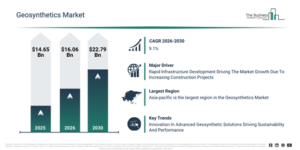
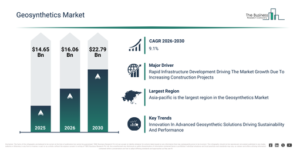
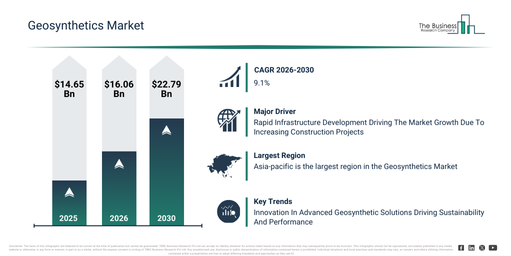
The geosynthetics market size has experienced strong growth in recent years. It is projected to expand from $14.65 billion in 2025 to $16.06 billion in 2026, demonstrating a compound annual growth rate (CAGR) of 9.6%. The expansion observed in previous periods was driven by factors such as the growing need for road and highway reinforcement, the increased adoption of geotextiles in filtration and separation, the proliferation of waste and water management projects, the foundational use of geomembranes for containment, and the rising demand for cost-effective construction materials.
The geosynthetics market is projected to experience robust expansion over the coming years. This market is set to reach $22.79 billion by 2030, exhibiting a compound annual growth rate (CAGR) of 9.1%. This projected expansion is primarily driven by an increased focus on sustainable building materials, greater deployment of geogrids in major infrastructure projects, an uptick in erosion control solutions, innovations in composite geosynthetic technologies, and the broader application of geofoam in lightweight construction. Key developments expected during this period involve the increasing integration of geotextiles and geogrids for reinforcing roadways, enhanced application of geomembranes in waste and water management initiatives, a surging need for erosion control in infrastructure development, the broader utilization of geocomposites for diverse construction purposes, and more extensive deployment of geofoam in lightweight fill and embankment operations.
Request A Free Geosynthetics Market Sample From The Business Research Company:
How Is The Key Growth Driver Influencing The Geosynthetics Market?
Rapid infrastructure development is anticipated to propel the growth of the geosynthetics market going forward. This refers to the accelerated construction and modernization of public works systems, including roads, bridges, railways, and utility networks. The growing emphasis on infrastructure development is primarily driven by government initiatives to modernize aging systems, as increased federal and state funding programs are accelerating the pace of construction projects across transportation, water, and energy sectors. This acceleration of infrastructure projects boosts demand for geosynthetics, as these synthetic materials are essential for soil stabilization, erosion control, drainage management, and reinforcement in roads, railways, embankments, and retaining walls. For instance, in July 2025, according to the Office for National Statistics, a UK-based government department, total investment in the infrastructure sector reached £20.3 billion ($23.64 billion) in 2024, marking a 16.9% increase compared to 2023. Therefore, rapid infrastructure development is a key driver for the growth of the geosynthetics market.
Geosynthetics Market Segmentation By Category: What Does The 2026 Report Cover?
The geosynthetics market covered in this report is segmented –
1) By Type: Geotextiles, Geomembranes, Geogrids, Geofoam, Geonets, Other Types
2) By Material: Polyethylene, Polypropylene, Polyester, PVC, Other Materials
3) By Function: Separation, Filtration, Drainage, Reinforcement, Protection (Cushion), Barrier Or Containment, Erosion Control
4) By Application: Waste Management, Water Management, Transportation Infrastructure, Civil Construction, Other Applications
Subsegments:
1) By Geotextiles: Woven Geotextiles, Non-Woven Geotextiles, Knitted Geotextiles
2) By Geomembranes: HDPE (High-Density Polyethylene) Geomembranes, LDPE (Low-Density Polyethylene) Geomembranes, PVC (Polyvinyl Chloride) Geomembranes
3) By Geogrids: Uniaxial Geogrids, Biaxial Geogrids, Triaxial Geogrids
4) By Geofoam: Expanded Polypropylene (EPP) Geofoam, Expanded Polystyrene (EPS) Geofoam
5) By Geonets: Plastic Geonets, Composite Geonets
6) By Other Types: Geocomposites, Geotextile Tubes, Geocells
How Are Industry Players Changing The Geosynthetics Market Landscape?
Leading firms within the geosynthetics market are concentrating on creating sophisticated solutions, like technical-textile integration, to improve product longevity and worldwide usability. This integration involves embedding high-performance industrial fabrics, frequently originating from established geosynthetics technologies, into a wider array of applications, resulting in more resilient, dependable, and globally scalable products for the agriculture, recreation, and specialty industrial markets. An example of this trend is Solmax, a geosynthetics manufacturer based in Canada, which introduced its Performance Materials platform, incorporating technical-textile integration, in June 2025. This new platform preserves existing trusted product lines and technical know-how, simultaneously providing increased global access and resources. It provides extensive technical understanding, practical innovation, and a direct approach to addressing practical problems, assisting clients in optimizing their work, safeguarding vital resources, and succeeding amidst evolving conditions. This initiative reinforces Solmax’s product range for the agriculture, recreation, and specialty markets, all while upholding the core values that have built customer confidence.
Geosynthetics Market Global Key Players And Competitive Overview
Major companies operating in the geosynthetics market are GSE Holdings Inc., NAUE GmbH & Co. KG, Fibertex Nonwovens A/S, HUESKER Synthetic GmbH, Tensar International Corporation, AGRU America Inc., Low & Bonar PLC, Groupe Solmax Inc., Officine Maccaferri SpA, Asahi Kasei Advance Corporation, Belton Industries Inc., Propex Operating Company LLC, Global Synthetics Pty Ltd., TYPAR, Tenax Pidilite India Private Limited, Solmax International Inc., CETCO Minerals Technologies Inc., Carthage Mills, Geofabrics Australasia, Geosynthetics Limited, Hanes Geo Components, Kaytech Engineered Fabrics, Maccaferri Canada Ltd., Mattex Geosynthetics, Nilex Inc., Owens-Corning Fiberglass Company, Polymer Group Inc., Presto Geosystems, Raven Industries, Strata Systems, TenCate Geosynthetics Americas, Thrace Group, Titan Environmental Containment, Tuflex India Pvt. Ltd., Wrekin Products Ltd.
Explore Comprehensive Geosynthetics Market Coverage In The Full Report:
Regional Analysis Of The Geosynthetics Market: Where Is The Industry Concentrated?
Asia-pacific was the largest region in geosynthetics market in 2025. Asia-Pacific is expected to be the fastest-growing region in the forecast period. The regions covered in the geosynthetics market report are Asia-Pacific, South East Asia, Western Europe, Eastern Europe, North America, South America, Middle East, Africa.
Reach Out To Our Team:
The Business Research Company: https://www.thebusinessresearchcompany.com/
Americas: +1 310-496-7795
Asia: +44 7882 955267 & +91 8897263534
Europe: +44 7882 955267
Email us at: marketing@tbrc.info
Follow us on:
LinkedIn: https://in.linkedin.com/company/the-business-research-company
YouTube: https://www.youtube.com/channel/UC24_fI0rV8cR5DxlCpgmyFQ
Global Market Model: https://www.thebusinessresearchcompany.com/global-market-model

Wasay has over a decade of experience in market research, data modelling, and analytics, with prior experience at GlobalData and Decision Tree Consulting Services. At The Business Research Company , he leads research operations across syndicated studies, customized consulting engagements, and the Global Market Model platform. His professional experience includes supporting organizations such as Boston Consulting Group, KPMG, and Ernst & Young. Wasay holds a degree in Electronics and Communications Engineering, postgraduate management qualifications from International Management Institute Belgium and Indian School of Business and Entrepreneurship, and completed the Integrated Program in Business Analytics from Indian Institute of Management Indore.