
Backed by market attractiveness analysis, total addressable market sizing, company benchmarking matrices, interactive Excel dashboards, wider supply chain intelligence, emerging startup coverage, and detailed product-level insights, The Business Research Company’s 2026 market reports are designed to offer research that is more actionable and strategically valuable than ever.
Hydrogen Refueling Station Construction Market Growth Potential: How Will Market Size Shift Through 2030?
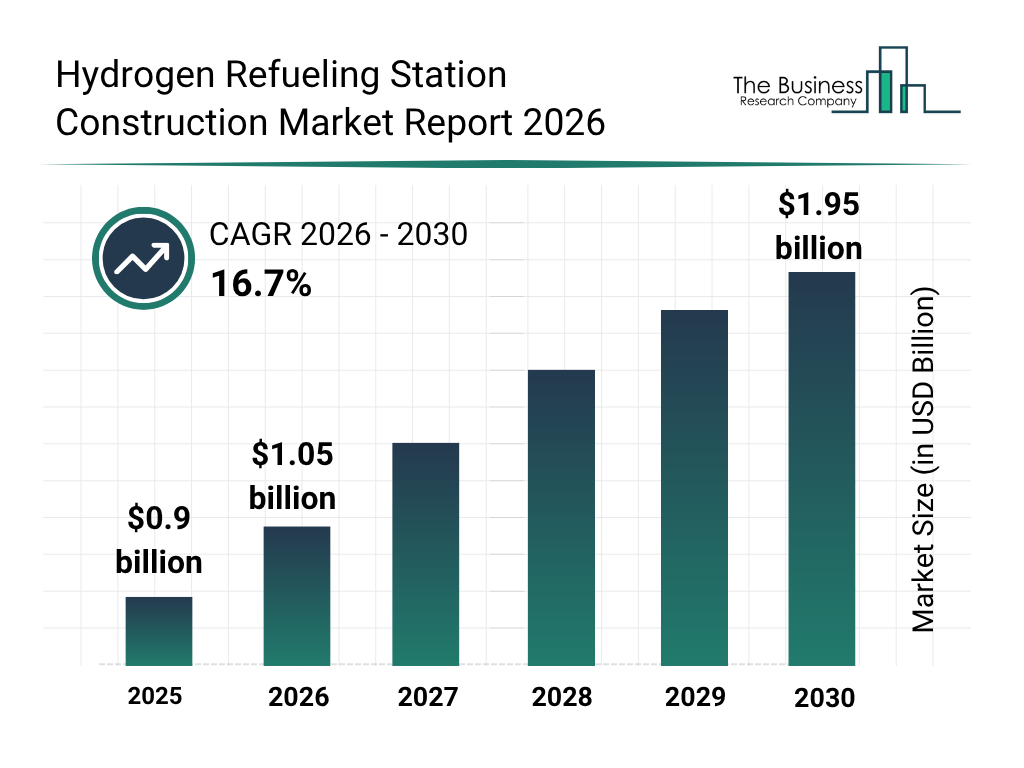
The hydrogen refueling station construction market has seen rapid expansion in recent years. It is projected to grow from $0.9 billion in 2025 to $1.05 billion in 2026, demonstrating a compound annual growth rate (CAGR) of 16.5%. The market’s past growth is attributable to factors such as the increasing adoption of fuel cell vehicles, government incentives supporting hydrogen infrastructure, a rising global demand for low-emission transportation solutions, technological advancements in hydrogen storage, and early investments in pilot hydrogen stations.
The hydrogen refueling station construction market is anticipated to experience substantial expansion over the coming years. Projections indicate it will reach $1.95 billion by 2030, demonstrating a compound annual growth rate (CAGR) of 16.7%. This anticipated growth is driven by several factors, including the expansion of hydrogen mobility networks, a rising need for quick and effective refueling options, the incorporation of smart infrastructure and IoT systems, an increase in both public and private investment for hydrogen initiatives, and progress in hydrogen compression and dispensing technologies. Key developments expected during this period involve the enlargement of hydrogen refueling infrastructure, the integration of on-site hydrogen production systems, the uptake of rapid refueling innovations, the deployment of sophisticated safety and monitoring mechanisms, and increasing capital directed towards large-scale hydrogen stations.
Get A Free Sample Report With In-Depth Market Insights:
Hydrogen Refueling Station Construction Market Expansion Drivers: What’s Shaping Future Growth?
The increasing acceptance of fuel cell electric vehicles (FCEVs) is projected to drive the expansion of the hydrogen refueling station construction market moving forward. These FCEVs are zero-emission vehicles that utilize hydrogen fuel cells to convert hydrogen gas into electricity, with only water vapor emitted as a byproduct. The growing uptake of FCEVs is predominantly fueled by stringent global emission regulations and government-supported decarbonization targets, as countries in developed economies enforce swift transitions away from fossil-fuel-dependent transportation. The rising deployment of FCEVs directly escalates the requirement for supporting refueling infrastructure, compelling governments and private operators to accelerate the development of new hydrogen stations to ensure sufficient coverage for increasing vehicle fleets. For instance, as per the ANNUAL REPORT 2023 issued by the International Energy Agency, a France-based intergovernmental organization, the worldwide total of fuel cell electric vehicles (FCEVs) stood at 87,600 units by the end of 2023, indicating a 20% increase from the previous year. Therefore, the rising adoption of fuel cell electric vehicles is propelling the growth of the hydrogen refueling station construction market.
Hydrogen Refueling Station Construction Market Segment Outlook: Which Categories Are Growing Fastest?
The hydrogen refueling station construction market covered in this report is segmented –
1) By Solution: Engineering Procurement And Construction, Components And Equipment
2) By Station Type: Fixed Or Stationary Stations, Mobile Or Relocatable Stations
3) By Station Size: Small Scale Stations, Medium Scale Stations, Large Scale Stations
4) By Fueling Type: Fast Refueling Stations, Standard Refueling Stations, On-Site Generation Stations
5) By End-Use: Transportation, Light-duty Vehicles, Heavy-duty Vehicles, Public Transportation, Industrial Applications, Backup Power Systems, Material Handling Equipment
Subsegments:
1) By Engineering Procurement And Construction: Design And Planning Services, Site Preparation Services, Civil Construction Services, Electrical Installation Services, Mechanical Installation Services, System Integration Services, Commissioning And Testing Services, Maintenance And Support Services
2) By Components And Equipment: Hydrogen Storage Tanks, Hydrogen Compressors, Hydrogen Dispensers, Hydrogen Cooling Systems, Hydrogen Pumps, Hydrogen Valves And Regulators, Hydrogen Sensors And Safety Systems, Piping And Tubing Systems, Control And Monitoring Systems
Hydrogen Refueling Station Construction Market Strategic Trends: What Defines The Next Growth Phase?
Companies operating in the hydrogen refueling station construction market are prioritizing the development of advanced green hydrogen infrastructure to support zero-emission transportation and accelerate the adoption of hydrogen-powered vehicles. Green hydrogen infrastructure refers to the integrated network of facilities and technologies utilized to produce, store, transport, and distribute hydrogen generated from renewable energy sources for large-scale industrial and transportation use. For example, in June 2025, Viva Energy, an Australia-based energy infrastructure company, launched Australia’s first publicly accessible renewable hydrogen refueling station at its Energy Hub in Geelong, Victoria. The facility incorporates a 2.5-megawatt electrolyzer that generates green hydrogen using renewable electricity and recycled water, enabling the refueling of hydrogen-powered trucks, buses, and other heavy vehicles. It is engineered to dispense up to 300 kilograms of hydrogen in under two hours. This station can support multiple vehicles consecutively and marks a significant advancement toward decarbonizing heavy transport, while also fostering hydrogen infrastructure deployment in Australia.
Hydrogen Refueling Station Construction Market Top Companies Driving Competitive Growth
Major companies operating in the hydrogen refueling station construction market are Shell plc, TotalEnergies SE, Hyundai Engineering & Construction Co Ltd, Cummins Inc, Linde plc, L Air Liquide SA, Tokyo Gas Co Ltd, Kawasaki Heavy Industries Ltd, Air Products and Chemicals Inc, Chart Industries Inc, Plug Power Inc, Hexagon Purus ASA, Nel ASA, Enapter AG, Hydrogen Refueling Solutions SA, McPhy Energy SA, Everfuel AS, ITM Power plc, FirstElement Fuel Inc, H2 MOBILITY Deutschland GmbH & Co KG.
View The Full Hydrogen Refueling Station Construction Market Report:
Hydrogen Refueling Station Construction Market Global Footprint: Which Region Leads The Market?
North America was the largest region in the hydrogen refueling station construction market in 2025. Asia-Pacific is expected to be the fastest-growing region in the forecast period. The regions covered in the hydrogen refueling station construction market report are Asia-Pacific, South East Asia, Western Europe, Eastern Europe, North America, South America, Middle East, Africa.
Reach Out To Our Team:
The Business Research Company: https://www.thebusinessresearchcompany.com/
Americas: +1 310-496-7795
Asia: +44 7882 955267 & +91 8897263534
Europe: +44 7882 955267
Email us at: marketing@tbrc.info
Follow us on:
LinkedIn: https://in.linkedin.com/company/the-business-research-company
YouTube: https://www.youtube.com/channel/UC24_fI0rV8cR5DxlCpgmyFQ
Global Market Model: https://www.thebusinessresearchcompany.com/global-market-model

Wasay has over a decade of experience in market research, data modelling, and analytics, with prior experience at GlobalData and Decision Tree Consulting Services. At The Business Research Company , he leads research operations across syndicated studies, customized consulting engagements, and the Global Market Model platform. His professional experience includes supporting organizations such as Boston Consulting Group, KPMG, and Ernst & Young. Wasay holds a degree in Electronics and Communications Engineering, postgraduate management qualifications from International Management Institute Belgium and Indian School of Business and Entrepreneurship, and completed the Integrated Program in Business Analytics from Indian Institute of Management Indore.