Designed to make market research more actionable and strategically valuable, The Business Research Company’s 2026 market reports feature market attractiveness scoring, total addressable market sizing, company benchmarking matrices, interactive Excel dashboards, deeper supply chain intelligence, emerging startup tracking, and granular product-level insights.
Low Carbon Buildings Market Forecast 2026–2030: Size, Value And Compound Annual Growth Rate
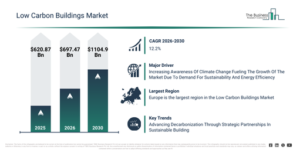
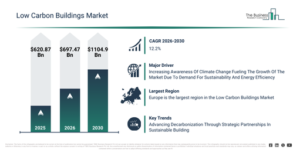
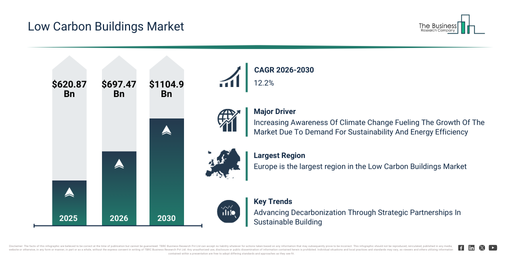
The low carbon buildings market has seen rapid expansion in recent years. It is projected to increase from $620.87 billion in 2025 to $697.47 billion in 2026, achieving a compound annual growth rate (CAGR) of 12.3%. Historically, this growth can be attributed to a rising emphasis on energy-efficient construction, the early adoption of low-carbon building materials, increasing demand for green-certified structures, a surge in corporate sustainability commitments, and enhanced investment in carbon-reduction technologies.
The low carbon buildings market size is projected to experience substantial expansion in the coming years. It is forecast to reach $1104.9 billion by 2030, exhibiting a compound annual growth rate (CAGR) of 12.2%. This expansion during the forecast period can be attributed to factors such as the increasing integration of renewable building systems, the rising adoption of circular-economy construction materials, the ongoing development of ultra-low-carbon concrete, the expansion of large-scale green infrastructure, and the growth in AI-driven building energy optimization. Key trends anticipated in this period include the rising use of low-emission building materials, the growth in green-certified construction, the expansion of energy-efficient architectural design, increased adoption of renewable building systems, and a higher demand for carbon-neutral construction technologies.
Try Before You Buy: Free Sample Of The Low Carbon Buildings Market Report:
Low Carbon Buildings Market Growth Engine: The Factor Boosting Demand Globally
The expanding understanding of climate change is projected to stimulate the growth of the low-carbon buildings market in the future. This climate change awareness arises from increasing environmental concerns, extensive information accessibility, and amplified media reporting, which fosters heightened public involvement and a requirement for sustainable approaches. Low-carbon buildings lessen greenhouse gas emissions via energy-efficient designs, sustainable materials, and renewable energy systems, thus promoting sustainability and confronting climate change. To illustrate, in 2023, data from the European Commission, a Belgium-based governmental entity, indicates that 87% of Europeans are expected to endorse greater renewable energy use, and 86% will advocate for improved energy efficiency by 2030. Consequently, the heightened recognition of climate change is fueling the expansion of the low-carbon buildings market.
Which Categories And Subcategories Shape The Low Carbon Buildings Market?
The low carbon buildings market covered in this report is segmented –
1) By Type: Low-Carbon Concrete, Mass Timber, Sustainable Steel
2) By Material: Low-Carbon Cement & Concrete, Engineered Wood (Mass Timber), Recycled Steel, Low-Carbon Steel
3) By Application: Commercial, Residential, Industrial
Subsegments:
1) By Low-Carbon Concrete: Supplementary Cementitious Material (SCM) Concrete, Carbon-Cured Concrete, Recycled Aggregate Concrete, Geopolymer Concrete
2) By Mass Timber: Cross-Laminated Timber (CLT), Glue-Laminated Timber (Glulam), Nail-Laminated Timber (NLT), Laminated Veneer Lumber (LVL)
3) By Sustainable Steel: Electric Arc Furnace (EAF) Steel, Recycled Steel Rebar, Low-Carbon Structural Steel, Green Hydrogen Steel
Low Carbon Buildings Market Trend Insights: Strategic Focus Areas Of Leading Companies
Leading companies within the low-carbon buildings market are prioritizing strategic collaborations to roll out decarbonization initiatives, aiming to accelerate the shift towards sustainable construction, boost energy efficiency, and diminish carbon emissions. These partnerships are essential for scaling sustainable construction methods, speeding up decarbonization programs, and stimulating innovation across the low-carbon buildings market. For example, in June 2024, Mahindra Group, an India-based industrial company, joined forces with Johnson Controls, an Ireland-based industrial machinery manufacturing company, to introduce a net zero buildings initiative. This program endeavors to decarbonize commercial, urban, residential, and public buildings throughout India by providing free toolkits and training. It streamlines access to vital resources and best practices, empowering organizations to implement sustainable building solutions. Ultimately, the initiative seeks to drive a sustainable transformation in the built environment and contribute to India’s low-carbon development objectives by guiding building owners on conservation strategies, regulatory adherence, financing options, and advanced technologies.
Leading Organizations In The Low Carbon Buildings Market
Major companies operating in the low carbon buildings market are Holcim Group, Heidelberg Materials, CEMEX, Lafarge Canada, Vicat Group, CRH plc, Stora Enso, Binderholz GmbH, KLH Massivholz GmbH, Structurlam Mass Timber Corporation, Mayr-Melnhof Holz, Metsä Wood, Nippon Steel Corporation, SSAB AB, ArcelorMittal, Tata Steel Europe, Nucor Corporation, Steel Dynamics Inc., CarbonCure Technologies Inc., Ecocera Concrete Solutions.
Continue Reading: The Full Low Carbon Buildings Market Report:
Low Carbon Buildings Market Regional Spotlight: Top Geography And Report Coverage
Europe was the largest region in the low-carbon buildings market in 2025. Asia-Pacific is expected to be the fastest-growing region in the forecast period. The regions covered in the low carbon buildings market report are Asia-Pacific, South East Asia, Western Europe, Eastern Europe, North America, South America, Middle East, Africa.
Reach Out To Our Team:
The Business Research Company: https://www.thebusinessresearchcompany.com/
Americas: +1 310-496-7795
Asia: +44 7882 955267 & +91 8897263534
Europe: +44 7882 955267
Email us at: marketing@tbrc.info
Follow us on:
LinkedIn: https://in.linkedin.com/company/the-business-research-company
YouTube: https://www.youtube.com/channel/UC24_fI0rV8cR5DxlCpgmyFQ
Global Market Model: https://www.thebusinessresearchcompany.com/global-market-model

Wasay has over a decade of experience in market research, data modelling, and analytics, with prior experience at GlobalData and Decision Tree Consulting Services. At The Business Research Company , he leads research operations across syndicated studies, customized consulting engagements, and the Global Market Model platform. His professional experience includes supporting organizations such as Boston Consulting Group, KPMG, and Ernst & Young. Wasay holds a degree in Electronics and Communications Engineering, postgraduate management qualifications from International Management Institute Belgium and Indian School of Business and Entrepreneurship, and completed the Integrated Program in Business Analytics from Indian Institute of Management Indore.