Designed to make market research more actionable and strategically valuable, The Business Research Company’s 2026 market reports feature market attractiveness scoring, total addressable market sizing, company benchmarking matrices, interactive Excel dashboards, deeper supply chain intelligence, emerging startup tracking, and granular product-level insights.
How Big Is The Low-Carbon Cement Alternatives Market In 2026, And How Fast Will It Grow?
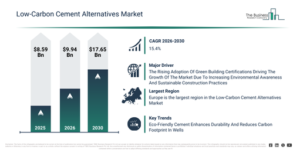
The low-carbon cement alternatives market has experienced swift expansion recently. It is projected to expand from $8.59 billion in 2025 to $9.94 billion in 2026, demonstrating a compound annual growth rate (CAGR) of 15.7%. Historically, this growth stemmed from factors such as the increasing uptake of eco-friendly cements, greater utilization of industrial by-products, a heightened need for carbon reduction in the construction sector, the proliferation of sustainable infrastructure initiatives, and a dependence on alternative cementitious materials.
The market for low-carbon cement alternatives is projected to undergo substantial expansion over the coming years. It is predicted to reach $17.65 billion by 2030, exhibiting a compound annual growth rate (CAGR) of 15.4%. This anticipated growth is fueled by several factors, including the increasing advancement of high-performance low-carbon cement options, the rising adoption of carbon-capturing concrete, the broadened usage of precast and ready-mix applications, the creation of hybrid sustainable cement solutions, and the increased deployment of geopolymers and magnesium-based cements. Key developments during this period are expected to feature the creation of limestone calcined clay cement alternatives, the embrace of alkali-activated materials, the wider application of carboncure-enhanced concrete, the incorporation of supplementary cementitious material blends, and the implementation of geopolymer and magnesium-based cement solutions.
Download A Free Low-Carbon Cement Alternatives Market Sample Report With Size And Forecast Data:
Low-Carbon Cement Alternatives Market Growth Driver: The Key Factor Behind Rising Demand
The increased uptake of green building certifications is anticipated to drive expansion in the low-carbon cement alternatives market moving forward. These certifications are official acknowledgments given to structures that fulfill particular environmental, energy efficiency, and sustainability criteria. The growing acceptance of green building certifications stems from heightened environmental consciousness, as both individuals and entities pursue sustainable building methods that lessen energy use, carbon output, and overall ecological footprint. Low-carbon cement alternatives contribute to green buildings by substantially cutting carbon emissions, boosting energy efficiency, and encouraging sustainable building techniques. For example, as reported by the U.S. Green Building Council (USGBC), a non-profit organization based in the United States, in July 2024, the council played a part in over 46,000 residential projects achieving certification under the leadership in energy and environmental design (LEED) green building rating system in 2024, building on a roughly 5% rise in new LEED residential project sign-ups during 2023. Consequently, the increased integration of green building certifications is fueling the expansion of the low-carbon cement alternatives market.
Low-Carbon Cement Alternatives Market Segmentation: Key Segments And Subsegments Covered
The low-carbon cement alternatives market covered in this report is segmented –
1) By Type: Calcium Sulfoaluminate Cement (CSA), Alkali-Activated Materials, Supplementary Cementitious Materials (SCM) Blends, Geopolymer Cement, Magnesium-Based Cement
2) By Raw Material: Industrial By-products, Alternative Calcium Sources, Natural Pozzolans, Novel Binding Materials, Calcined Clays, Other Raw Materials
3) By Application: Ready-Mix Concrete, Structural Concrete, Non-structural Applications, Precast Concrete Products, Other Applications
4) By End-User: Infrastructure Development, Residential Construction, Commercial Construction, Industrial Facilities, Other End-Users
Subsegments:
1) By Calcium Sulfoaluminate Cement: Hydraulic Calcium Sulfoaluminate Cement, Rapid-Setting Calcium Sulfoaluminate Cement, Blended Calcium Sulfoaluminate Cement
2) By Alkali-Activated Materials: Fly Ash-Based Alkali-Activated Materials, Slag-Based Alkali-Activated Materials, Metakaolin-Based Alkali-Activated Materials
3) By Supplementary Cementitious Materials Blends: Fly Ash Blends, Slag Blends, Silica Fume Blends, Natural Pozzolan Blends
4) By Geopolymer Cement: Fly Ash Geopolymer Cement, Slag Geopolymer Cement, Metakaolin Geopolymer Cement
5) By Magnesium-Based Cement: Magnesium Oxide Cement, Magnesium Phosphate Cement, Sorel Cement
Low-Carbon Cement Alternatives Market Trends: Key Developments Shaping 2026 And Beyond
Companies leading in the low-carbon cement alternatives market are prioritizing the creation of innovative solutions, such as geopolymer cements, to diminish carbon emissions and foster sustainable construction. Geopolymer cement is an environmentally friendly type of cement produced from industrial by-products like fly ash or slag, which solidifies through a chemical reaction with alkaline solutions instead of conventional Portland cement, thereby substantially reducing carbon emissions. For instance, in March 2023, Schlumberger Limited, a US-based technology company, unveiled the EcoShield geopolymer cement-free system, a low-carbon alternative designed for well construction. This system cuts up to 85% of embodied CO2 emissions compared to traditional Portland cement, significantly reducing the carbon footprint of well construction. It provides comparable rheology, thickening time, and compressive strength to conventional cement, ensuring reliable zonal isolation and well integrity without altering existing cementing workflows. Additionally, EcoShield boasts enhanced durability and corrosion resistance, making it suitable for challenging downhole conditions and various stages of the well lifecycle, including abandonment.
Leading Companies Operating In The Low-Carbon Cement Alternatives Market
Major companies operating in the low-carbon cement alternatives market are ThyssenKrupp AG, CEMEX S.A.B. de C.V., The Siam Cement Public Company Limited, Adani Enterprises Limited, UltraTech Cement Limited, Taiheiyo Cement Corporation, Vicat S.A., Shree Cement Limited, Breedon Group plc, Dalmia Bharat Cement Limited, Calix Limited, JSW Cement Limited, HeidelbergCement AG, Sublime Systems Inc., CarbonCure Technologies Inc., Carbon Upcycling Technologies Inc., CarbiCrete Inc., Ecocem Materials Ltd., CarbonBuilt Inc., Hoffman Green Technologies Inc., BioMason Inc., Terra CO2 Technologies Inc., Brimstone Energy Inc.
Access The Full Low-Carbon Cement Alternatives Market Research Report:
Low-Carbon Cement Alternatives Market Regional Analysis: Largest Region And Key Geographies Covered
Europe was the largest region in the low-carbon cement alternatives market in 2025. Asia-Pacific is expected to be the fastest-growing region in the forecast period. The regions covered in the low-carbon cement alternatives market report are Asia-Pacific, South East Asia, Western Europe, Eastern Europe, North America, South America, Middle East, Africa.
Reach Out To Our Team:
The Business Research Company: https://www.thebusinessresearchcompany.com/
Americas: +1 310-496-7795
Asia: +44 7882 955267 & +91 8897263534
Europe: +44 7882 955267
Email us at: marketing@tbrc.info
Follow us on:
LinkedIn: https://in.linkedin.com/company/the-business-research-company
YouTube: https://www.youtube.com/channel/UC24_fI0rV8cR5DxlCpgmyFQ
Global Market Model: https://www.thebusinessresearchcompany.com/global-market-model

Wasay has over a decade of experience in market research, data modelling, and analytics, with prior experience at GlobalData and Decision Tree Consulting Services. At The Business Research Company , he leads research operations across syndicated studies, customized consulting engagements, and the Global Market Model platform. His professional experience includes supporting organizations such as Boston Consulting Group, KPMG, and Ernst & Young. Wasay holds a degree in Electronics and Communications Engineering, postgraduate management qualifications from International Management Institute Belgium and Indian School of Business and Entrepreneurship, and completed the Integrated Program in Business Analytics from Indian Institute of Management Indore.