Enhanced with market attractiveness analysis, total addressable market evaluation, company benchmarking matrices, interactive Excel dashboards, expanded supply chain intelligence, emerging startup coverage, and detailed product insights, The Business Research Company’s 2026 market reports deliver more actionable and strategically valuable research.
Low Carbon Cement Market Size Forecast: How Large Could The Market Become By 2030?
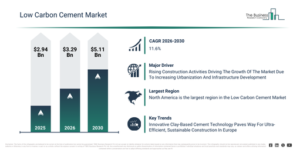
The low carbon cement market has seen rapid expansion over recent years. Its valuation is predicted to increase from $2.94 billion in 2025 to $3.29 billion in 2026, achieving a compound annual growth rate (CAGR) of 11.9%. Factors contributing to its historical growth include increasingly stringent environmental regulations, a growing need for sustainable construction materials, the widespread adoption of blended cement solutions, ongoing infrastructure development, and the enlargement of both residential and commercial projects.
The low carbon cement market is projected to experience swift expansion over the coming years. This market is anticipated to reach a value of $5.11 billion by 2030, exhibiting a compound annual growth rate (CAGR) of 11.6%. Factors contributing to this growth during the forecast period include the escalating production of low-carbon cement, the increasing uptake of rapid-setting and optimized mix cements, the emergence of high-performance sustainable cement, the broadening scope of commercial and industrial construction, and the incorporation of intelligent monitoring and manufacturing systems. Key developments expected over this period encompass the widespread use of low-carbon cement blends, the integration of smart cement production technologies, the introduction of AI-driven quality control solutions, the deployment of digital monitoring in cement manufacturing facilities, and the expansion of networks for sustainable construction materials.
Download A Free Sample Report For Comprehensive Market Insights:
Low Carbon Cement Market Industry Drivers: What Is Driving Revenue Growth?
The expanding volume of construction activities is anticipated to propel the growth of the low carbon cement market in the coming years. This increase in construction is primarily fueled by escalating urbanization, as growing city populations generate a greater need for residential, commercial, and infrastructure development. Low carbon cement enhances these construction efforts by presenting an environmentally friendly, durable, and sustainable alternative to traditional cement, thereby enabling faster project completion while simultaneously reducing the carbon footprint of building ventures. For instance, in July 2023, the Australian Bureau of Statistics, a government agency based in Australia, reported that in the March quarter of 2023, the count of dwellings under construction climbed to 240,813 from 240,065 in 2022. Specifically, new houses within this total reached 103,778 in 2023, an increase from 101,240 in 2022. Thus, the escalating construction activities are acting as a significant driver for the expansion of the low carbon cement market.
Low Carbon Cement Market Segment Analysis: What Are The Major Market Categories?
The low carbon cement market covered in this report is segmented –
1) By Product Type: Blended Cement, Geopolymer Cement, Limestone Calcined Clay Cement, Other Product Types
2) By Raw Material: Fly Ash, Slag, Limestone, Silica Fume, Other Raw Materials
3) By Application: Residential, Commercial, Infrastructure, Industrial
4) By Distribution Channel: Direct Sales, Distributors, Online Sales, Other Distribution Channels
Subsegments:
1) By Blended Cement: Portland Pozzolana Cement, Portland Slag Cement, Composite Cement, High-Performance Blended Cement
2) By Geopolymer Cement: Fly Ash Based Geopolymer Cement, Slag Based Geopolymer Cement, Metakaolin Based Geopolymer Cement, Mixed Source Geopolymer Cement
3) By Limestone Calcined Clay Cement: Low-Clinker Limestone Calcined Clay Cement, High-Clinker Limestone Calcined Clay Cement, Optimized Mix Limestone Calcined Clay Cement, Rapid-Setting Limestone Calcined Clay Cement
4) By Other Product Types: Sulfoaluminate Cement, Magnesium-Based Cement, Calcium Sulfoaluminate Cement, Eco-Friendly Specialty Cement
#Low Carbon Cement Market Growth Trends: What Is Influencing The Future Outlook?
Leading companies in the low carbon cement market are concentrating on developing innovative solutions, such as calcined clay blends, to reduce carbon emissions and promote sustainable construction. Calcined clay blends are a type of low-carbon cement material created by heating clay to high temperatures, which is then blended with clinker to lower CO2 emissions while maintaining strength and durability. For instance, in February 2023, Holcim Ltd., a Switzerland-based building material company, launched its low-carbon cement operation. This advanced production line, a global first, utilizes Holcim’s proprietary proximA Tech technology and can produce up to 500,000 tonnes of low-carbon cement annually. The facility’s sustainable operations are entirely powered by biomass-based alternative fuels and waste heat recovery systems, making the manufacturing of calcined clay nearly carbon-free and highly efficient. The opening of Europe’s first calcined clay cement production line represents a significant milestone in Holcim’s mission to decarbonize the building industry.
Low Carbon Cement Market Leading Companies Driving Competitive Growth
Major companies operating in the low carbon cement market are LafargeHolcim Ltd., Anhui Conch Cement Company Limited, CEMEX S.A.B. de C.V., Siam Cement Group Public Company Limited, Adani Group, UltraTech Cement Limited, Taiheiyo Cement Corporation, Vicat Group, Titan Cement Company S.A., Shree Cement Limited, Breedon Group plc, Dalmia Bharat Limited, Secil – Sociedade de Exploração de Cimentos S.A., Buzzi Unicem S.p.A., JSW Cement Limited, Sublime Systems Inc., Carbon Upcycling Technologies, Ecocem Materials Limited, CarbonBuilt Inc., Hoffman Green Technologies Inc., Brimstone Energy Inc., Terra CO2 Technologies Inc.
Access The Complete Low Carbon Cement Market Report:
Low Carbon Cement Market Regional Analysis And Leading Geography
North America was the largest region in the low carbon cement market in 2025. The regions covered in the low carbon cement market report are Asia-Pacific, South East Asia, Western Europe, Eastern Europe, North America, South America, Middle East, Africa.
Get in touch with us:
The Business Research Company: https://www.thebusinessresearchcompany.com/
Americas: +1 310-496-7795
Asia: +44 7882 955267 & +91 8897263534
Europe: +44 7882 955267
Email us at: marketing@tbrc.info
Follow us on:
LinkedIn: https://in.linkedin.com/company/the-business-research-company
YouTube: https://www.youtube.com/channel/UC24_fI0rV8cR5DxlCpgmyFQ
Global Market Model: https://www.thebusinessresearchcompany.com/global-market-model

Wasay has over a decade of experience in market research, data modelling, and analytics, with prior experience at GlobalData and Decision Tree Consulting Services. At The Business Research Company , he leads research operations across syndicated studies, customized consulting engagements, and the Global Market Model platform. His professional experience includes supporting organizations such as Boston Consulting Group, KPMG, and Ernst & Young. Wasay holds a degree in Electronics and Communications Engineering, postgraduate management qualifications from International Management Institute Belgium and Indian School of Business and Entrepreneurship, and completed the Integrated Program in Business Analytics from Indian Institute of Management Indore.