Backed by market attractiveness analysis, total addressable market sizing, company benchmarking matrices, interactive Excel dashboards, wider supply chain intelligence, emerging startup coverage, and detailed product-level insights, The Business Research Company’s 2026 market reports are designed to offer research that is more actionable and strategically valuable than ever.
Modular Construction Market Forecast: What Value Will The Market Reach By 2030?
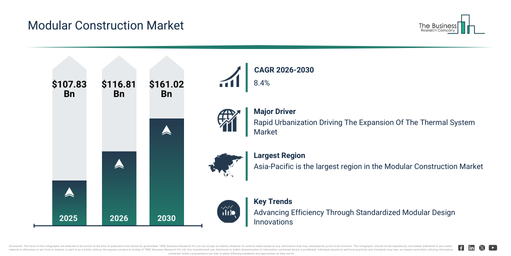
The modular construction market has experienced significant expansion recently. Projections indicate it will increase from $107.83 billion in 2025 to $116.81 billion in 2026, demonstrating a compound annual growth rate (CAGR) of 8.3%. Historically, this growth is linked to factors such as the early embrace of prefabricated building techniques, the escalating demand for quicker construction schedules, the rise in economical construction approaches, the wider availability of standardized module production, and a greater need for temporary, relocatable structures.
The modular construction market size is anticipated to experience substantial growth over the next few years. It is forecast to expand to $161.02 billion in 2030, achieving a compound annual growth rate (CAGR) of 8.4%. This increase during the forecast period can be attributed to the rising adoption of automated modular manufacturing, an increasing emphasis on sustainable building materials, the growing demand for modular healthcare and education facilities, the expansion of permanent modular housing projects, and greater integration of IoT-enabled building systems. Significant trends expected in this period encompass the rising adoption of off-site construction methods, the expansion of standardized prefabricated components, a growing demand for cost-efficient modular housing, increased utilization of mixed-module structural designs, and a higher market focus on temporary and mobile modular units.
Get A Free Sample Report With In-Depth Market Insights:
Modular Construction Market Growth Backed By Core Demand Fundamentals
The expansion of urbanization is anticipated to propel the future growth of the modular construction market. This phenomenon, urbanization, describes the concentration of populations within specific geographical regions. The escalating trend of urbanization fosters a favorable setting for the expansion of the modular construction market, given that its attributes are well-suited to address the complexities and demands of construction within heavily populated urban environments. As an illustration, data from a 2022 report released by the US-based international organization, the World Bank, indicates that over 50% of the global populace lives in urban areas. Projections suggest that the urban population will escalate to 6 billion by 2045, representing a 1.5-fold increase. It is foreseen that by 2030, an additional 1.2 million km2 of urban built-up area will emerge globally, as the consumption of urban land is projected to expand at a pace up to 50% quicker than the rate of population growth. Consequently, the increasing urbanization is a key impetus for the expansion of the modular construction market.
Modular Construction Market Segment Performance And Emerging Opportunities
The modular construction market covered in this report is segmented –
1) By Type: Permanent, Relocatable
2) By Material: Steel, Wood, Concrete
3) By Module: Four-sided, Open-Sided, Partially Open-Sided, Mixed modules And Floor Cassettes, Modules supported By A primary structure, Other Modules
4) By End-Use Sector: Residential, Office, Education, Retail And Commercial, Hospitality, Healthcare, Other End Users
Subsegments:
1) By Permanent: Modular Buildings, Permanent Structures
2) By Relocatable: Temporary Facilities, Mobile Units
Modular Construction Market Growth Trends Reshaping The Competitive Landscape
Major companies operating in the modular construction market are actively developing technological advancements, including standardized design modules, to expedite project timelines, enhance scalability, lower construction costs, and maintain consistent quality across various undertakings. Standardized design modules are pre-engineered and prefabricated building components that feature uniform dimensions and specifications, facilitating straightforward assembly, scalability, and replication across numerous construction projects. For instance, in November 2023, TenneT, a Netherlands-based energy company, introduced a modular construction approach for its Large Projects program aimed at accelerating the expansion of the electricity grid. This initiative concentrates on building 380 kV substations and high-voltage pylons utilizing standard designs and fixed modules. The modular methodology simplifies and standardizes the design, planning, and implementation phases, thereby improving the efficiency of procurement, plot acquisition, and environmental discussions. It also minimizes repetitive tasks, allowing engineers and workers to devote their attention to more demanding and intricate aspects of grid expansion projects. This program represents a crucial stride towards enabling quicker and more effective grid expansion, which is vital for supporting the energy transition and addressing increasing electricity demands.
Modular Construction Market Key Players: Which Companies Lead Industry Competition?
Major companies operating in the modular construction market are Bouygues Construction SA, Laing O’Rourke, Skanska AB, ATCO Ltd., Balfour Beatty Plc., Taisei Corporation, Supertech Industries LLC, Anderco Pte. Ltd., Giant Containers Inc., Honomobo Corporation, Lendlease Corporation, SG Blocks Inc., Guerdon L.L.C, Modulex PLC, Bechtel Corporation, ACS Group, Fluor Corporation, JL Construction, Julius Berger Nigeria PLC, Kiewit Corporation, Larsen & Toubro Limited, McGRATH RENTCORP, Palomar Modular Buildings, Red Sea Housing Services, SEKISUI CHEMICAL CO. LTD, System House R & C Co. Ltd, WillScot Mobile Mini Holdings Corp, Westchester Modular Homes, Koma Modular
View The Full Modular Construction Market Report:
Modular Construction Market Regional Analysis: Which Geography Leads On Revenue?
Asia-Pacific was the largest region in the modular construction market share in 2025. The regions covered in the modular construction market report are Asia-Pacific, South East Asia, Western Europe, Eastern Europe, North America, South America, Middle East, Africa.
Reach Out To Our Team:
The Business Research Company: https://www.thebusinessresearchcompany.com/
Americas: +1 310-496-7795
Asia: +44 7882 955267 & +91 8897263534
Europe: +44 7882 955267
Email us at: marketing@tbrc.info
Follow us on:
LinkedIn: https://in.linkedin.com/company/the-business-research-company
YouTube: https://www.youtube.com/channel/UC24_fI0rV8cR5DxlCpgmyFQ
Global Market Model: https://www.thebusinessresearchcompany.com/global-market-model

Wasay has over a decade of experience in market research, data modelling, and analytics, with prior experience at GlobalData and Decision Tree Consulting Services. At The Business Research Company , he leads research operations across syndicated studies, customized consulting engagements, and the Global Market Model platform. His professional experience includes supporting organizations such as Boston Consulting Group, KPMG, and Ernst & Young. Wasay holds a degree in Electronics and Communications Engineering, postgraduate management qualifications from International Management Institute Belgium and Indian School of Business and Entrepreneurship, and completed the Integrated Program in Business Analytics from Indian Institute of Management Indore.