Delivering more actionable and strategically valuable research, The Business Research Company’s 2026 market reports feature market attractiveness analysis, total addressable market evaluation, company benchmarking matrices, interactive Excel dashboards, expanded supply chain intelligence, emerging startup coverage, and detailed product insights.
Off-Site Prefabricated Building Market Forecast Highlighting Growth From $129.55 Billion To $169.7 Billion
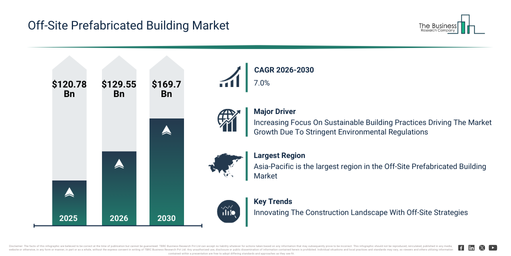
The off-site prefabricated building market size has experienced robust expansion in recent years. This market is projected to increase from $120.78 billion in 2025 to $129.55 billion in 2026, demonstrating a compound annual growth rate (CAGR) of 7.3%. The historic growth can be attributed to factors such as the rising adoption of modular construction, the increasing use of panelized building systems, the advancement of off-site construction methods, the expansion of residential and commercial projects, and the growing demand for faster project delivery.
The off-site prefabricated building market is projected to experience substantial expansion over the coming years. This market is set to reach $169.7 billion by 2030, exhibiting a compound annual growth rate (CAGR) of 7.0%. Factors contributing to this anticipated growth include the expanded use of off-site prefabricated buildings, the emergence of hybrid modular systems, the embracing of smart factory fabrication techniques, a rise in construction activities within the educational and healthcare sectors, and the incorporation of digital monitoring and assembly systems. Key trends anticipated during this period involve the wider implementation of off-site prefabricated buildings, the widespread adoption of modular construction methods, the increased deployment of panelized and portable structures, the scaling up of smart fabrication and assembly systems, and the integration of interconnected building components.
Download A Free Sample Report For Comprehensive Market Insights:
#Off-Site Prefabricated Building Market Demand Drivers Creating New Revenue Opportunities
A growing emphasis on sustainable building practices is anticipated to stimulate the expansion of the off-site prefabricated building market in the coming period. These practices encompass construction techniques and design approaches aimed at reducing environmental footprint, enhancing resource utilization, and promoting the welfare of occupants. The heightened focus on sustainability in construction stems from strict government regulations and environmental policies designed to cut carbon emissions, with governments globally introducing compulsory building codes and certification standards to address climate change. This increased attention to sustainable building practices fosters the adoption of off-site prefabricated construction by encouraging resource conservation, lessening material waste, mitigating environmental effects at construction sites, and allowing for improved quality control and energy efficiency across the building’s entire lifecycle. For example, in July 2024, the U.S. Green Building Council, a US-based non-profit body, reported involvement in more than 46,000 residential projects certified by the leadership in energy and environmental design (LEED) green building rating system; specifically, 2023 witnessed an almost 5% increase in new LEED residential project registrations. Consequently, the rising focus on sustainable building practices is propelling the expansion of the off-site prefabricated building market.
Off-Site Prefabricated Building Market Segmentation And Category Breakdown
The off-site prefabricated building market covered in this report is segmented –
1) By Product Type: Modular Buildings, Panelized Structures, Portable Buildings, Mobile Homes, Container Homes
2) By Material Type: Wood, Steel, Concrete, Composite Materials, Insulated Panels
3) By Construction Method: Off-Site Fabrication, On-Site Construction
4) By Customer Type: Government Agencies, Private Developers, Non-Profit Organizations, Individual Homeowners, Corporations
5) By End-User: Residential, Commercial, Industrial, Educational, Healthcare
Subsegments:
1) By Modular Buildings: Steel Modular Buildings, Concrete Modular Buildings, Timber Modular Buildings, Hybrid Modular Buildings
2) By Panelized Structures: Wall Panel Systems, Floor Panel Systems, Roof Panel Systems, Hybrid Panelized Structures
3) By Portable Buildings: Temporary Offices, Construction Site Cabins, Mobile Classrooms, Emergency Shelters
4) By Mobile Homes: Single-Wide Mobile Homes, Double-Wide Mobile Homes, Triple-Wide Mobile Homes, Luxury Mobile Homes
5) By Container Homes: Standard Shipping Container Homes, Modified Shipping Container Homes, Stacked Container Homes, Luxury Container Homes
Off-Site Prefabricated Building Market Trends Driving Strategic Industry Expansion
Leading companies in the off-site prefabricated building market are concentrating on developing innovative solutions like modular construction systems to accelerate project delivery and boost efficiency. Modular construction systems entail fabricating building sections off-site and then assembling them on-site, which helps to shorten construction periods, enhance quality, reduce expenses, and improve safety, while also ensuring greater sustainability and effectiveness in project execution. For instance, in May 2025, Turner Construction Company, a US-based international construction services firm, unveiled xPL Offsite, a novel off-site manufacturing business dedicated to highly complex projects. This initiative employs advanced Design for Manufacturing and Assembly (DfMA) and Off-site Manufacturing (OSM) approaches to streamline project execution, elevate safety and quality, and decrease construction durations. xPL Offsite integrates Turner’s profound knowledge in prefabrication, modular construction, and supply chain management to offer efficient, scalable solutions for intricate projects such as data centers, airports, and large industrial facilities, enabling clients to achieve improved cost predictability, enhanced productivity, and expedited schedules while adhering to the highest performance and sustainability standards.
Off-Site Prefabricated Building Market Competitive Analysis Of Major Industry Participants
Major companies operating in the off-site prefabricated building market are China Railway Group Limited, Bouygues Construction S.A., Daiwa House Industry Co. Ltd., Skanska AB, Balfour Beatty plc, Royal BAM Group NV, Lendlease Group, Dorce Construction Pvt. Ltd., Clark Pacific Inc., Z Modular Inc., Red Sea Housing Services Co. Ltd., Lester Building Systems Inc., Palomar Modular Buildings Inc., Allied Modular Building Systems Inc., Inland Buildings Inc., Modern Building Systems Inc., Dvele Inc., PortaFab Corporation, Alan Pre-Fab Building Corp, Turner Construction Company.
Access The Complete Off-Site Prefabricated Building Market Report:
Off-Site Prefabricated Building Market Geographic Analysis: Where Is Demand Growing The Fastest?
Asia-Pacific was the largest region in the off-site prefabricated building market in 2025, and it is expected to be the fastest-growing region in the forecast period. The regions covered in the off-site prefabricated building market report are Asia-Pacific, South East Asia, Western Europe, Eastern Europe, North America, South America, Middle East, Africa.
Get in touch with us:
The Business Research Company: https://www.thebusinessresearchcompany.com/
Americas: +1 310-496-7795
Asia: +44 7882 955267 & +91 8897263534
Europe: +44 7882 955267
Email us at: marketing@tbrc.info
Follow us on:
LinkedIn: https://in.linkedin.com/company/the-business-research-company
YouTube: https://www.youtube.com/channel/UC24_fI0rV8cR5DxlCpgmyFQ
Global Market Model: https://www.thebusinessresearchcompany.com/global-market-model

Wasay has over a decade of experience in market research, data modelling, and analytics, with prior experience at GlobalData and Decision Tree Consulting Services. At The Business Research Company , he leads research operations across syndicated studies, customized consulting engagements, and the Global Market Model platform. His professional experience includes supporting organizations such as Boston Consulting Group, KPMG, and Ernst & Young. Wasay holds a degree in Electronics and Communications Engineering, postgraduate management qualifications from International Management Institute Belgium and Indian School of Business and Entrepreneurship, and completed the Integrated Program in Business Analytics from Indian Institute of Management Indore.