
Delivering more actionable and strategically valuable research, The Business Research Company’s 2026 market reports feature market attractiveness analysis, total addressable market evaluation, company benchmarking matrices, interactive Excel dashboards, expanded supply chain intelligence, emerging startup coverage, and detailed product insights.
Prefabricated Construction Market Forecast Highlighting Growth From $151.48 Billion To $213.88 Billion
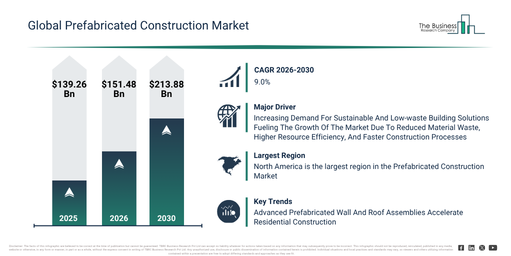
The prefabricated construction market has experienced significant growth in recent years. It is forecast to expand from $139.26 billion in 2025 to $151.48 billion in 2026, demonstrating a compound annual growth rate (CAGR) of 8.8%. This historical expansion can be linked to factors such as increasing urbanization and housing demand, rising labor shortages in the construction industry, a growing need for reduced construction timelines, the expansion of commercial infrastructure projects, and an increasing focus on construction cost predictability.
The prefabricated construction market is anticipated to experience robust expansion in the coming years, with its size projected to reach $213.88 billion by 2030, exhibiting a compound annual growth rate (CAGR) of 9.0%. This growth during the forecast period can be attributed to increasing investment in smart city infrastructure, a rising demand for sustainable building solutions, the growing adoption of automated off-site manufacturing, the expansion of affordable housing projects, and an increasing need for disaster-resilient construction methods. Major trends identified for this period include the wider embrace of modular building solutions, a rising demand for fast-track construction methods, the growing use of lightweight composite construction materials, the expansion of off-site manufacturing facilities, and a heightened preference for cost-efficient, standardized building components.
Download A Free Sample Report For Comprehensive Market Insights:
https://www.thebusinessresearchcompany.com/sample_request?id=36961798&type=smp
Prefabricated Construction Market Development Factors: Which Trends Are Supporting Demand?
The rising need for sustainable and low-waste building solutions is expected to boost the growth of the prefabricated construction market moving forward. This demand reflects a growing preference among homebuyers, developers, institutions, and commercial property owners for structures that minimize material waste, enhance resource efficiency, and reduce environmental impact during both construction and use. The increasing adoption of sustainable and low-waste building solutions is attributed to a rising preference among consumers and developers for environmentally responsible construction methods that cut down on material waste and improve resource utilization. Prefabricated construction contributes to sustainable and low-waste building solutions by enabling precise, factory-based production, which significantly reduces material waste, lowers energy consumption, minimizes on-site disruption, and improves overall construction efficiency. For instance, in February 2024, the Green Building Council, a US-based non-profit organization, stated that in 2023, there was a 9% rise in LEED certifications from the previous year, along with 21 additional certifications for single-family homes. Furthermore, new LEED project registrations soared by 51%, demonstrating remarkable growth. Thus, the escalating demand for sustainable and low-waste building solutions is propelling the expansion of the prefabricated construction market.
Prefabricated Construction Market Categorization By Product Type And Application
The prefabricated construction market covered in this report is segmented –
1) By Product Type: Modular Buildings, Prefabricated Panels, Pre-Engineered Buildings, Volumetric Modules
2) By Material Type: Concrete, Steel, Wood, Glass, Plastic And Composite Materials
3) By Construction Type: Permanent Construction, Relocatable Construction
4) By Installation Type: On-Site Assembly, Off-Site Assembly
5) By End User Application: Residential Construction, Commercial Construction, Industrial Construction, Institutional Construction, Infrastructure Construction
Subsegments:
1) By Modular Buildings: Permanent Modular Buildings, Relocatable Modular Buildings, Residential Modular Buildings, Commercial Modular Buildings, Institutional Modular Buildings
2) By Prefabricated Panels: Wall Panels, Floor Panels, Roof Panels, Facade Panels, Insulated Panels
3) By Pre-Engineered Buildings: Industrial Pre-Engineered Buildings, Commercial Pre-Engineered Buildings, Warehouse Pre-Engineered Buildings, Agricultural Pre-Engineered Buildings, Institutional Pre-Engineered Buildings
4) By Volumetric Modules: Bathroom Pods, Kitchen Modules, Bedroom Modules, Living Room Modules, Utility Modules
Prefabricated Construction Market Transformation Trends: Which Innovations Are Driving Change?
Major companies active in the prefabricated construction market are concentrating on developing innovative products, such as precision-engineered prefabricated wall, floor, ceiling, and roof assemblies, to accelerate residential project completion, enhance construction quality, reduce reliance on on-site labor, and minimize jobsite risks. Precision-engineered prefabricated wall, floor, ceiling, and roof assemblies refer to building components manufactured in a factory, designed to exact specifications, and delivered ready for rapid on-site installation, ensuring higher accuracy, faster construction, and improved quality control. For instance, in March 2023, CertainTeed, a US-based building materials company, launched one precision assembly. This offsite panelized construction solution integrates digital design processes with factory-built wall, floor, and roof assemblies. It provides features such as pre-engineered panel systems for faster installation, improved thermal performance for energy efficiency, and reduced on-site labor dependency.
Prefabricated Construction Market Company Landscape And Strategic Competition
Major companies operating in the prefabricated construction market are Daiwa House Industry Co. Ltd., Laing O’Rourke Holdings Limited, Tata BlueScope Steel Private Limited, Interarch Building Products Limited, Pennar Industries Limited, Everest Industries Limited, Lindbäcks Group AB, Alghanim Industries, Walker Modular Ltd., Interpod Offsite Pty Ltd., Huf Haus GmbH & Co. KG, Guerdon LLC, Dvele Omega Inc., SurePods, Zamil Steel Holding Company, Algeco UK Limited, EPACK Prefab Technologies Limited, NorgesHus Tootmise OÜ, Guizhou Glamni Prefabricated Housing Co. Ltd., Modulart SpA.
Access The Complete Prefabricated Construction Market Report:
https://www.thebusinessresearchcompany.com/report/prefabricated-construction-market-report
Prefabricated Construction Market Leading Geography: Which Region Generates The Most Revenue?
North America was the largest region in the prefabricated construction market in 2025. Asia-Pacific is expected to be the fastest-growing region in the forecast period. The regions covered in the prefabricated construction market report are Asia-Pacific, South East Asia, Western Europe, Eastern Europe, North America, South America, Middle East, Africa.
Get in touch with us:
The Business Research Company: https://www.thebusinessresearchcompany.com/
Americas: +1 310-496-7795
Asia: +44 7882 955267 & +91 8897263534
Europe: +44 7882 955267
Email us at: marketing@tbrc.info
Follow us on:
LinkedIn: https://in.linkedin.com/company/the-business-research-company
YouTube: https://www.youtube.com/channel/UC24_fI0rV8cR5DxlCpgmyFQ
Global Market Model: https://www.thebusinessresearchcompany.com/global-market-model

Wasay has over a decade of experience in market research, data modelling, and analytics, with prior experience at GlobalData and Decision Tree Consulting Services. At The Business Research Company , he leads research operations across syndicated studies, customized consulting engagements, and the Global Market Model platform. His professional experience includes supporting organizations such as Boston Consulting Group, KPMG, and Ernst & Young. Wasay holds a degree in Electronics and Communications Engineering, postgraduate management qualifications from International Management Institute Belgium and Indian School of Business and Entrepreneurship, and completed the Integrated Program in Business Analytics from Indian Institute of Management Indore.