
Through market attractiveness analysis, total addressable market evaluation, company benchmarking matrices, interactive Excel dashboards, expanded supply chain intelligence, emerging startup coverage, and detailed product insights, The Business Research Company’s 2026 market reports provide more actionable and strategically valuable research.
Proximity Alert Wearables Market Size Outlook: How Fast Will Revenue Grow Through 2030?
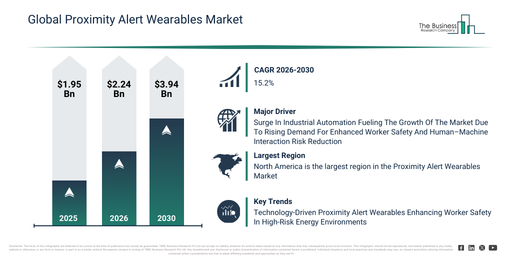
The proximity alert wearables market has seen swift growth in recent years. Its size is anticipated to expand from $1.95 billion in 2025 to $2.24 billion in 2026, achieving a compound annual growth rate (CAGR) of 15.0%. The historical development of this market is attributable to a rise in workplace safety regulations, an increase in industrial accident reporting, the growing adoption of wearable devices, the expansion of RFID tracking systems, and early deployment in healthcare safety.
The proximity alert wearables market size is anticipated to experience significant expansion in the next few years. It is projected to reach $3.94 billion by 2030, demonstrating a compound annual growth rate (CAGR) of 15.2%. This growth during the forecast period is fueled by increasing investments in smart factories, a surge in demand for worker monitoring, the expansion of connected safety ecosystems, elevated enterprise spending on safety technology, and greater implementation at construction sites. Prominent trends for the forecast period include the increased utilization of multi-sensor proximity devices, a growing uptake in workplace safety programs, the incorporation of real-time alert and notification features, the development of contact tracing wearable solutions, and an escalating requirement for industrial-grade wearables.
Download A Free Sample Report For Comprehensive Market Insights:
#Proximity Alert Wearables Market Growth Drivers And Industry Catalysts
The anticipated expansion of industrial automation is projected to drive the growth of the proximity alert wearables market in the future. This automation involves employing control systems, machinery, and digital innovations to manage industrial operations with reduced human involvement, thereby enhancing efficiency, precision, and safety. The surge in industrial automation is fueled by the demand for better operational effectiveness, given that automated systems decrease manual work, lower error rates, and facilitate quicker, more uniform production processes. In industrial automation, proximity alert wearables serve to boost worker safety and operational efficiency by providing real-time warnings that avert collisions, mitigate risks associated with human–machine interaction, and foster safer automated processes where robot and machine density is rising. As an illustration, data from September 2024, provided by the International Federation of Robotics, a non-profit organization based in Germany, indicated that the global adoption of industrial robots continued to rise in 2023. Annual installations exceeded 541,000 units for the third year running, pushing the global operational stock to 4.3 million robots, representing a 10% increase and bringing the total number of robots in operation worldwide to well over four million globally. Consequently, the expansion of industrial automation is a key factor propelling the growth of the proximity alert wearables market.
Proximity Alert Wearables Market Segmentation Trends And Revenue Drivers
The proximity alert wearables market covered in this report is segmented –
1) By Product Type: Wristbands; Badges; Smartwatches; Clip On Devices; Other Product Types
2) By Technology: Bluetooth; Radio Frequency Identification; Ultra Wideband; Global Positioning System; Other Technologies
3) By Application: Workplace Safety; Healthcare; Social Distancing; Child And Elderly Monitoring; Other Applications
4) By Distribution Channel: Online; Offline
5) By End User: Industrial; Healthcare; Education; Retail; Sports And Fitness; Other End Users
Subsegments:
1) By Wristbands: Disposable Proximity Wristbands; Rechargeable Proximity Wristbands; Waterproof Proximity Wristbands; Industrial Grade Proximity Wristbands
2) By Badges: Employee Proximity Badges; Visitor Proximity Badges; Identification Integrated Proximity Badges; Contact Tracing Proximity Badges
3) By Smartwatches: Health Monitoring Smartwatches; Workplace Safety Smartwatches; Location Tracking Smartwatches; Notification Enabled Smartwatches
4) By Clip On Devices: Clothing Mounted Proximity Devices; Belt Clip Proximity Devices; Portable Proximity Alert Devices; Lightweight Proximity Sensors
5) By Other Product Types: Lanyard Based Proximity Devices; Card Based Proximity Alerts; Helmet Mounted Proximity Devices; Shoe Mounted Proximity Sensors
#Proximity Alert Wearables Market Trends Influencing Long-Term Demand
Major companies operating in the proximity alert wearables market are prioritizing the development of advanced solutions like real-time risk detection and haptic feedback systems to enhance worker safety and maintain operational continuity. Real-time risk detection, paired with haptic feedback, functions by employing integrated sensors and software to consistently monitor worker location, proximity to hazards, and various environmental and operational risks, subsequently alerting users with tactile signals to prompt immediate action and reduce accidents. For example, in October 2024, Altave, a Brazil-based technology company, introduced the Altave Wearable, which integrates with its Altave Harpia software. This software utilizes artificial intelligence to analyze risks and activate vibration alerts on the device. The wearable is designed to be integrated into offshore workers’ vests, enabling real-time location monitoring and providing access control warnings to prevent unauthorized entry into high-risk zones, as well as proximity alerts for approaching heavy equipment. It also supports automatic machinery shutdown in critical situations, adding a proactive layer of prevention. The device possesses IECEx and Inmetro Ex certifications, confirming its suitability for hazardous areas, and is protected by a U.S. patent, underscoring its innovative application in energy industry safety management.
#Proximity Alert Wearables Market Industry Leaders: Which Organizations Are Driving Competition?
Major companies operating in the proximity alert wearables market are Samsung Electronics Co. Ltd., Hitachi Ltd., Honeywell International Inc, Garmin Ltd., Zebra Technologies, HID Global Corporation, Laird Connectivity, Nymi Inc., Blackline Safety, Mine Site Technologies Pty Ltd, Kinexon GmbH, Kontakt.io Inc., Ubisense Group plc, Estimote, Reactec Ltd., Guardhat Inc., ELA Innovation, Proxxi Technologies Inc., SafeZone Technologies, Social Distancer, Safe Spacer
Access The Complete Proximity Alert Wearables Market Report:
Proximity Alert Wearables Market Regional Analysis And Leading Geography
North America was the largest region in the proximity alert wearables market in 2025. Asia-Pacific is expected to be the fastest-growing region in the forecast period. The regions covered in the proximity alert wearables market report are Asia-Pacific, South East Asia, Western Europe, Eastern Europe, North America, South America, Middle East, Africa.
Get in touch with us:
The Business Research Company: https://www.thebusinessresearchcompany.com/
Americas: +1 310-496-7795
Asia: +44 7882 955267 & +91 8897263534
Europe: +44 7882 955267
Email us at: marketing@tbrc.info
Follow us on:
LinkedIn: https://in.linkedin.com/company/the-business-research-company
YouTube: https://www.youtube.com/channel/UC24_fI0rV8cR5DxlCpgmyFQ
Global Market Model: https://www.thebusinessresearchcompany.com/global-market-model

Wasay has over a decade of experience in market research, data modelling, and analytics, with prior experience at GlobalData and Decision Tree Consulting Services. At The Business Research Company , he leads research operations across syndicated studies, customized consulting engagements, and the Global Market Model platform. His professional experience includes supporting organizations such as Boston Consulting Group, KPMG, and Ernst & Young. Wasay holds a degree in Electronics and Communications Engineering, postgraduate management qualifications from International Management Institute Belgium and Indian School of Business and Entrepreneurship, and completed the Integrated Program in Business Analytics from Indian Institute of Management Indore.