The Business Research Company’s 2026 market reports combine market attractiveness scoring, total addressable market sizing, company benchmarking matrices, interactive Excel dashboards, deeper supply chain intelligence, emerging startup tracking, and granular product-level insights to deliver research that is more actionable and strategically valuable.
Reinforced Elastomeric Bearing Market Revenue Forecast: $1.48 Billion In 2026 Rising To $2.15 Billion In 2030
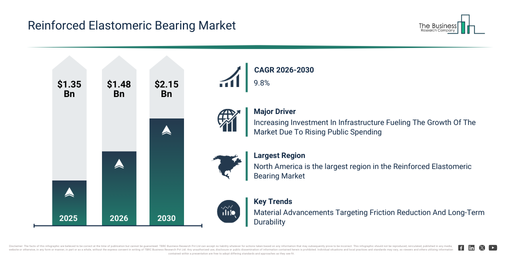
The reinforced elastomeric bearing market size has shown robust growth recently. It is set to expand from $1.35 billion in 2025 to $1.48 billion in 2026, exhibiting a compound annual growth rate (CAGR) of 9.6%. The historical growth of this market is attributable to the increasing application of reinforced elastomeric bearings in bridges, a rise in the adoption of laminated bearings, growing demand for high-damping bearings, the expansion into heavy machinery and industrial uses, and the increasing incorporation of sliding bearing systems.
The reinforced elastomeric bearing market is projected to experience substantial expansion over the coming years. This market is anticipated to reach a valuation of $2.15 billion by 2030, exhibiting a compound annual growth rate (CAGR) of 9.8%. Key drivers for this projected growth include the advancement of smart IoT-enabled bearings, a rising adoption of sustainable elastomeric materials, the broadened application of composite and steel-reinforced bearings, the incorporation of AI for monitoring load and movement, and the proliferation of sophisticated bearing solutions for infrastructure projects. Significant trends identified for the forecast timeframe encompass the implementation of steel-reinforced and laminated elastomeric bearings, the integration of AI for analyzing load and movement, the spread of IoT-enabled bearing monitoring systems, the uptake of high-damping and sliding bearing technologies, and ongoing innovations in sustainable elastomeric materials.
Free Sample Report: Reinforced Elastomeric Bearing Market Size, Trends And Forecast To 2030:
Reinforced Elastomeric Bearing Market Growth Catalyst: What Is Creating New Demand?
The growing investment in infrastructure is projected to boost the reinforced elastomeric bearings market in the coming years. Infrastructure investment pertains to dedicating financial resources and assets towards establishing, maintaining, or upgrading vital physical systems such as transport networks, utilities, and public facilities. The surge in infrastructure spending is attributed to urbanization, as a greater influx of people into cities necessitates that governments and businesses expand and modernize transportation, housing, and utility services to meet escalating demands. This investment directly influences the demand for reinforced elastomeric bearings, given their crucial role in supporting bridges and elevated structures by absorbing vibrations and enabling controlled movement, thereby enhancing the safety and lifespan of these constructions. For instance, in June 2025, as reported by the State Council Information Office, a China-based press office, China’s fixed-asset investment in road and waterway infrastructure increased by 11.4% year-over-year, reaching $76 billion (512 billion yuan) during that period. Thus, the escalating investment in infrastructure is a key factor driving the expansion of the reinforced elastomeric bearings market.
Reinforced Elastomeric Bearing Market Segment Overview: Categories Covered In The 2026 Report
The reinforced elastomeric bearing market covered in this report is segmented –
1) By Type: Plain Bearings, Laminated Bearings, Sliding Bearings
2) By Material: Natural Rubber, Neoprene, Ethylene Propylene Diene Monomer (EPDM), Other Materials
3) By Application: Bridges, Buildings, Heavy Machinery, Other Applications
4) By End-User: Construction, Industrial, Transportation, Other End-Users
Subsegments:
1) By Plain Bearings: Natural Rubber Plain Bearings, Neoprene Rubber Plain Bearings, High Load Capacity Plain Bearings
2) By Laminated Bearings: Steel Reinforced Laminated Bearings, Fiber Reinforced Laminated Bearings, High Damping Laminated Bearings
3) By Sliding Bearings: Polytetrafluoroethylene (PTFE) Sliding Bearings, Stainless Steel Sliding Bearings, Composite Material Sliding Bearings
How Are Leading Companies Shaping Reinforced Elastomeric Bearing Market Trends?
Major companies operating in the reinforced elastomeric bearing market are directing their efforts toward developing innovative solutions, such as polymer bearing materials, to improve wear resistance, reduce friction, and extend service life in demanding structural applications. Polymer bearing material signifies synthetic, non-metallic substances employed in bearings to deliver low friction, high wear resistance, and corrosion-free performance in diverse mechanical and structural systems. For instance, in October 2024, igus GmbH, a Germany-based manufacturer specializing in high-performance polymer bearings, launched iglide JPF, a novel plain bearing material completely devoid of per- and polyfluoroalkyl substances (PFAS) and polytetrafluoroethylene (PTFE). This development highlights igus’s commitment to sustainability by offering an environmentally responsible alternative to conventional self-lubricating plain bearings, which often depend on per- and polyfluoroalkyl substances (PFAS) and polytetrafluoroethylene (PTFE) for their resistance to water, heat, and dirt. With increasing global regulatory pressure to reduce the use of harmful substances, iglide JPF addresses both environmental and health concerns while maintaining high wear resistance and durability.
Reinforced Elastomeric Bearing Market Players: Key Companies Shaping Competition
Major companies operating in the reinforced elastomeric bearing market are Trelleborg AB, Canam Group Inc., Freyssinet S.A., Mageba SA, Ekspan Limited, FIP Industriale S.p.A., CECO Infratech Private Limited, Maurer SE, Granor Rubber & Engineering Pty Ltd, Scougal Rubber Corporation, Farrat Isolevel Ltd., VSL International Ltd., Structural Rubber Products LLC, R R Engineers, Elastomer Industries Private Limited, Sandhya Enterprises, Metal Engineering & Treatment Co. Pvt. Ltd., Boomarine (Shanghai) Co. Ltd., Hevea Engineering Sdn Bhd, Suzhou Xinyu New Material Technology Co. Ltd.
Access Complete Reinforced Elastomeric Bearing Market Data, Forecasts And Competitive Insights:
Reinforced Elastomeric Bearing Market Regional Performance And Geographic Coverage
North America was the largest region in the reinforced elastomeric bearing market in 2025. Asia-Pacific is expected to be the fastest-growing region in the forecast period. The regions covered in the reinforced elastomeric bearing market report are Asia-Pacific, South East Asia, Western Europe, Eastern Europe, North America, South America, Middle East, Africa.
Reach Out To Our Team:
The Business Research Company: https://www.thebusinessresearchcompany.com/
Americas: +1 310-496-7795
Asia: +44 7882 955267 & +91 8897263534
Europe: +44 7882 955267
Email us at: marketing@tbrc.info
Follow us on:
LinkedIn: https://in.linkedin.com/company/the-business-research-company
YouTube: https://www.youtube.com/channel/UC24_fI0rV8cR5DxlCpgmyFQ
Global Market Model: https://www.thebusinessresearchcompany.com/global-market-model

Wasay has over a decade of experience in market research, data modelling, and analytics, with prior experience at GlobalData and Decision Tree Consulting Services. At The Business Research Company , he leads research operations across syndicated studies, customized consulting engagements, and the Global Market Model platform. His professional experience includes supporting organizations such as Boston Consulting Group, KPMG, and Ernst & Young. Wasay holds a degree in Electronics and Communications Engineering, postgraduate management qualifications from International Management Institute Belgium and Indian School of Business and Entrepreneurship, and completed the Integrated Program in Business Analytics from Indian Institute of Management Indore.