Designed to make market research more actionable and strategically valuable, The Business Research Company’s 2026 market reports feature market attractiveness scoring, total addressable market sizing, company benchmarking matrices, interactive Excel dashboards, deeper supply chain intelligence, emerging startup tracking, and granular product-level insights.
#What Is The Projected CAGR Of The Robotic Warfare Market Through 2030?#_x000D_
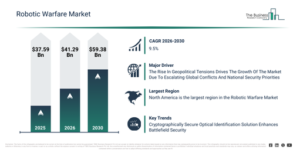
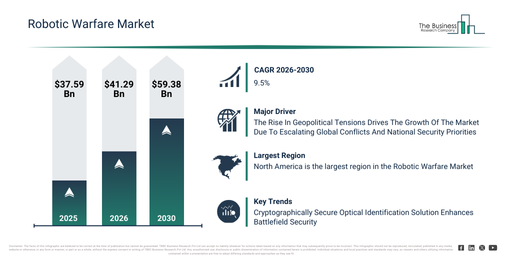
The robotic warfare market size has demonstrated strong growth over recent years. Its expansion is anticipated to be from $37.59 billion in 2025 to $41.29 billion in 2026, at a compound annual growth rate (CAGR) of 9.8%. The historical rise in this market can be attributed to the increased adoption of unmanned combat systems, greater investment in autonomous battlefield technologies, the widening scope of surveillance and reconnaissance robotics, a reliance on imported electronic subsystems, and the burgeoning demand for robotic logistics platforms._x000D_
_x000D_
The robotic warfare market is projected to experience substantial growth over the coming years. Its valuation is anticipated to reach $59.38 billion in 2030, exhibiting a compound annual growth rate (CAGR) of 9.5%. This expansion during the forecast period is fueled by several factors, including the escalating development of AI-driven combat platforms, the growing integration of multi-domain robotic systems, the broadening scope of defense modernization initiatives, the rise of autonomous robotics for mission support, and enhanced innovation in secure robotic communication technologies. Key trends defining this period involve the broadening of AI-powered combat autonomy, an increase in multi-domain robotic platforms, the implementation of secure cloud-connected warfare systems, the uptake of sophisticated robotic manufacturing methods, and the integration of IoT-enabled robotics for battlefield applications._x000D_
_x000D_
#Claim Your Free Robotic Warfare Market Sample Report With Key Data And Trends:#_x000D_
_x000D_
#Robotic Warfare Market Demand Analysis: The Driving Force Behind Expansion#_x000D_
The future expansion of the robotic warfare market is anticipated to be driven by escalating geopolitical tensions. These tensions signify strained inter-country or regional relations, whether political, economic, or military, frequently stemming from clashes in national interests, disputes over territory, or contests for power. The increase in such tensions can be attributed to territorial disagreements, which in turn incite nationalistic competition, military expansion, and diplomatic conflicts concerning disputed territories or boundaries. Through the integration of advanced autonomous systems, robotic warfare bolsters a nation’s military prowess, thereby altering power dynamics and serving as a strategic instrument for either mitigating or intensifying geopolitical disputes. For example, reports from Euronews SA, a French television network, indicated in January 2025 that global conflicts worsened in 2024, with political violence seeing a 25% surge from 2023 levels, impacting one in eight individuals and causing approximately 223,000 fatalities, in addition to a 37% increase in total deaths. Consequently, escalating geopolitical tensions are indeed stimulating the expansion of the robotic warfare market._x000D_
_x000D_
#Breaking Down The Robotic Warfare Market By Segment#_x000D_
The robotic warfare market covered in this report is segmented – _x000D_
_x000D_
1) By Type: Unmanned Platforms And Systems, Exoskeleton And Wearables, Target Acquisition Systems, Turret And Weapon Systems, Other Types_x000D_
2) By Mode Of Operation: Autonomous, Semi Autonomous_x000D_
3) By Platform: Land, Marine, Airborne_x000D_
4) By Application: Intelligence, Surveillance And Reconnaissance, Combat Operations, Search And Rescue, Transportation, Mine Clearance, Explosive Ordnance Disposal, Firefighting_x000D_
5) By End User: Military Forces, Homeland Security, Law Enforcement, Special Forces, Fire Departments_x000D_
_x000D_
Subsegments:_x000D_
1) By Unmanned Platforms And Systems: Autonomous Unmanned Ground Vehicles, Unmanned Aerial Vehicles (UAVs) Or Drones, Unmanned Surface Vehicles, Unmanned Underwater Vehicles, Hybrid Or Multidomain Robotic Systems_x000D_
2) By Exoskeleton And Wearables: Powered Combat Exoskeletons, Load-Bearing Exosuits, Augmented Reality (AR) Combat Helmets, Sensor-Integrated Combat Wearables, Medical Or Support Wearables_x000D_
3) By Target Acquisition Systems: Autonomous Target Recognition Systems, Electro-Optical Targeting Pods, Artificial Intelligence-Driven Surveillance Drones, Infrared And Thermal Imaging Systems, Radar-Based Targeting Systems_x000D_
4) By Turret And Weapon Systems: Remote Weapon Stations (RWS), Autonomous Turret Systems, Artificial Intelligence-Based Fire Control Systems, Loitering Munitions (Suicide Drones), Robotic Sniper Platforms_x000D_
5) By Other Types: Combat Robotics Software, C2 (Command and Control) Robotic Interfaces, Robotic Mine Clearance Systems, Logistics And Supply Robots, Training And Simulation Robots_x000D_
_x000D_
#Top Trend Influencing The Robotic Warfare Market Outlook#_x000D_
Leading companies in the robotic warfare market are actively developing sophisticated solutions, including unique cryptographically secure systems, to enable instantaneous and reliable optical identification of drones and other unmanned platforms. This addresses the inherent weaknesses of conventional radio frequency (RF) identification methods, which are susceptible to jamming, spoofing, and detection. This approach refers to a pioneering system that utilizes advanced encryption to guarantee trusted and tamper-proof operations. As an illustration, in October 2025, Allen Control Systems, a U.S.-based defense technology company, unveiled the Friend and Foe Operating System (FAFOS)—a cryptographically secure, radio-silent, long-range optical solution for drone identification. FAFOS employs modulated near-infrared optical signals to identify drones in under 200 milliseconds at distances of up to 2 kilometers, functioning effectively in contested electromagnetic environments without relying on vulnerable RF channels. Engineered for integration across various platforms, it delivers a cost-effective, scalable solution capable of reducing drone deconfliction complexities, enhancing battlefield security, minimizing friendly-fire risks, and complementing ACS’s existing autonomous defense technologies like the Bullfrog weapon system._x000D_
_x000D_
#Robotic Warfare Market Competitive Landscape And Major Players#_x000D_
Major companies operating in the robotic warfare market are Raytheon Technologies Corporation, Lockheed Martin Corporation, Airbus Defence and Space GmbH, BAE Systems plc, Northrop Grumman Systems Corporation, Thales Group, Leonardo S.p.A., Textron Inc., Rheinmetall AG, Elbit Systems Ltd., Israel Aerospace Industries Ltd., Kongsberg Defence And Aerospace AS, QinetiQ Group plc, General Dynamics Land Systems Inc., Saab AB, Anduril Industries Inc., AeroVironment Inc., Shield AI Inc., Hanwha Defense Co. Ltd., Ghost Robotics Inc. _x000D_
_x000D_
#Read The Full Robotic Warfare Market Report By The Business Research Company:#_x000D_
_x000D_
#Where Is The Robotic Warfare Market Largest? Key Regional Insights#_x000D_
North America was the largest region in the robotic warfare market in 2025. Asia-Pacific is expected to be the fastest-growing region in the forecast period. The regions covered in the robotic warfare market report are Asia-Pacific, South East Asia, Western Europe, Eastern Europe, North America, South America, Middle East, Africa._x000D_
_x000D_
#Reach Out To Our Team:#_x000D_
_x000D_
The Business Research Company: https://www.thebusinessresearchcompany.com/_x000D_
Americas: +1 310-496-7795_x000D_
Asia: +44 7882 955267 & +91 8897263534_x000D_
Europe: +44 7882 955267_x000D_
Email us at: marketing@tbrc.info_x000D_
_x000D_
#Follow us on:#_x000D_
_x000D_
LinkedIn: https://in.linkedin.com/company/the-business-research-company_x000D_
YouTube: https://www.youtube.com/channel/UC24_fI0rV8cR5DxlCpgmyFQ_x000D_
Global Market Model: https://www.thebusinessresearchcompany.com/global-market-model

Wasay has over a decade of experience in market research, data modelling, and analytics, with prior experience at GlobalData and Decision Tree Consulting Services. At The Business Research Company , he leads research operations across syndicated studies, customized consulting engagements, and the Global Market Model platform. His professional experience includes supporting organizations such as Boston Consulting Group, KPMG, and Ernst & Young. Wasay holds a degree in Electronics and Communications Engineering, postgraduate management qualifications from International Management Institute Belgium and Indian School of Business and Entrepreneurship, and completed the Integrated Program in Business Analytics from Indian Institute of Management Indore.