Delivering more actionable and strategically valuable research, The Business Research Company’s 2026 market reports feature market attractiveness analysis, total addressable market evaluation, company benchmarking matrices, interactive Excel dashboards, expanded supply chain intelligence, emerging startup coverage, and detailed product insights.
Self-Healing Materials Market Expected To Reach $12.54 Billion By 2030 At 25.9% CAGR
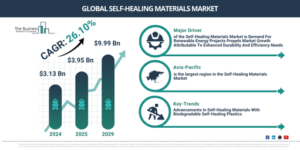
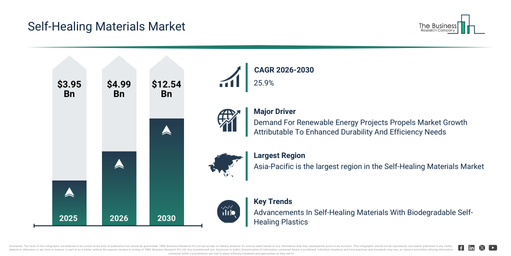
The market for self-healing materials has expanded considerably over recent years. Projections indicate a rise from $3.95 billion in 2025 to $4.99 billion by 2026, demonstrating a compound annual growth rate (CAGR) of 26.3%. Historically, this expansion has stemmed from factors such as increased investigation into advanced material characteristics, the initial integration of composite materials within the aerospace sector, an increase in high-performance coating uses, a heightened demand for resilient infrastructure components, and the creation of intelligent chemical compositions.
The self-healing materials market is anticipated to experience substantial growth in the coming years. It is projected to expand to $12.54 billion by 2030, demonstrating a compound annual growth rate (CAGR) of 25.9%. This expansion during the forecast period can be attributed to factors such as the increased utilization of self-healing composites, the emergence of bio-inspired healing mechanisms, advancements in AI-driven materials engineering, the greater integration of healing systems into commercial offerings, and the development of cost-effective, scalable healing materials. Noteworthy trends for the forecast period include the rising adoption of smart material formulations, progress in automated damage detection, the growing application of high-performance composite materials, the broadening use of multi-functional structural materials, and the accelerated creation of bio-based self-healing technologies.
Download A Free Sample Report For Comprehensive Market Insights:
Self-Healing Materials Market Demand Drivers: What Is Fueling Industry Growth?
The projected rise in renewable energy projects is anticipated to fuel the expansion of the self-healing materials market. These projects represent efforts to produce energy from sustainable sources like solar, wind, hydro, geothermal, and biomass, aiming to lessen environmental impact and reliance on fossil fuels. The growth in renewable energy initiatives stems from various factors, including decarbonization, rising energy demand, advancements in renewable technologies, falling costs of solar and wind power, government policies promoting green energy, and growing awareness of sustainable energy’s environmental and economic benefits. Self-healing materials find application in renewable energy projects to boost durability, lower upkeep expenses, and optimize performance. Specifically, they are employed in solar panels to mend microcracks within photovoltaic cells, thereby preserving efficiency and prolonging operational life. In wind turbines, these materials assist in repairing minor damage to blades and coatings, leading to reduced maintenance costs and decreased downtime. As an illustration, according to the US Energy Information Administration (EIA), a US-based agency of the US Federal Statistical System, renewable energy consumption in the United States expanded by 2% from 2022 to reach a record 8.2 quads in 2023, as of July 2024. Consequently, the increasing prevalence of renewable energy projects is a key driver for the self-healing materials market.
Self-Healing Materials Market Segment Breakdown: Which Categories Generate The Most Revenue?
The self-healing materials market covered in this report is segmented –
1) By Product: Polymer, Concrete, Metal, Coating, Ceramic, Asphalt, Fiber-Reinforced Composites
2) By Form: Intrinsic, Extrinsic
3) By End Use Industry: Transportation, Consumer Goods, Building And Construction, Energy Generation, Healthcare, Other End Use Industries
Subsegments:
1) By Polymer: Microencapsulated Polymers, Vascular Polymers, Intrinsic Polymers
2) By Concrete: Bacterial Concrete, Microcapsule-Based Concrete, Autogenous Concrete
3) By Metal: Shape Memory Alloys, Coated Metal Alloys, Self-Healing Thin Films
4) By Coating: Self-Healing Polymeric Coatings, Nanocoatings, Anti-Corrosion Coatings
5) By Ceramic: Oxide-Based Self-Healing Ceramics, Non-Oxide Self-Healing Ceramics, Composite Ceramics
6) By Asphalt: Induction-Based Self-Healing Asphalt, Capsule-Based Self-Healing Asphalt, Bio-Based Self-Healing Asphalt
7) By Fiber-Reinforced Composites: Polymer Matrix Composites (PMC), Ceramic Matrix Composites (CMC), Metal Matrix Composites (MMC)
Self-Healing Materials Market Innovation Trends: Which Developments Are Transforming The Industry?
Major companies within the self-healing materials market are concentrating on developing innovative products, such as biodegradable self-healing plastic, to tackle environmental challenges by offering a more durable, recyclable, and eco-friendly alternative to traditional plastics. Biodegradable self-healing plastic is an environmentally conscious material capable of autonomously repairing damage while decomposing naturally in the environment. For instance, in November 2023, the University of Tokyo, a Japan-based public research organization, unveiled a novel plastic material named VPR (Vitrimer Incorporated with Polyrotaxane). This material possesses a remarkable capacity to self-repair when subjected to heat, retains its original form, and exhibits partial biodegradability. VPR can mend itself much faster, recover its original shape more swiftly, and undergo chemical recycling at an accelerated rate, outperforming typical vitrimers.
Self-Healing Materials Market Key Players And Strategic Industry Positioning
Major companies operating in the self-healing materials market are BASF SE, The Dow Chemical Company, SABIC, 3M Company, Evonik Industries Corporation, Covestro AG, PPG Industries Inc., Solvay, Arkema SA, Acciona S.A., Akzo Nobel N.V., Momentive Performance Materials, Tnemec Company Inc., MacDermid Autotype Ltd., High Impact Technology LLC, Applied Thin Films Inc., Autonomic Materials Inc., Avecom N.V., Sensor Coating Systems Ltd, NEI Corporation
Access The Complete Self-Healing Materials Market Report:
Self-Healing Materials Market Geographic Analysis: Where Is Demand Growing The Fastest?
Asia-Pacific was the largest region in the self-healing materials market in 2025. North America is expected to be the fastest-growing region in the forecast period. The regions covered in the self-healing materials market report are Asia-Pacific, South East Asia, Western Europe, Eastern Europe, North America, South America, Middle East, Africa.
Get in touch with us:
The Business Research Company: https://www.thebusinessresearchcompany.com/
Americas: +1 310-496-7795
Asia: +44 7882 955267 & +91 8897263534
Europe: +44 7882 955267
Email us at: marketing@tbrc.info
Follow us on:
LinkedIn: https://in.linkedin.com/company/the-business-research-company
YouTube: https://www.youtube.com/channel/UC24_fI0rV8cR5DxlCpgmyFQ
Global Market Model: https://www.thebusinessresearchcompany.com/global-market-model

Wasay has over a decade of experience in market research, data modelling, and analytics, with prior experience at GlobalData and Decision Tree Consulting Services. At The Business Research Company , he leads research operations across syndicated studies, customized consulting engagements, and the Global Market Model platform. His professional experience includes supporting organizations such as Boston Consulting Group, KPMG, and Ernst & Young. Wasay holds a degree in Electronics and Communications Engineering, postgraduate management qualifications from International Management Institute Belgium and Indian School of Business and Entrepreneurship, and completed the Integrated Program in Business Analytics from Indian Institute of Management Indore.