Featuring market attractiveness scoring, total addressable market sizing, company benchmarking matrices, interactive Excel dashboards, deeper supply chain intelligence, emerging startup tracking, and granular product-level insights, The Business Research Company’s 2026 market reports are built to deliver research that is both more actionable and more strategically valuable.
Self Leveling Underlayment Market Expansion Outlook: What Revenue Opportunities Are Ahead?
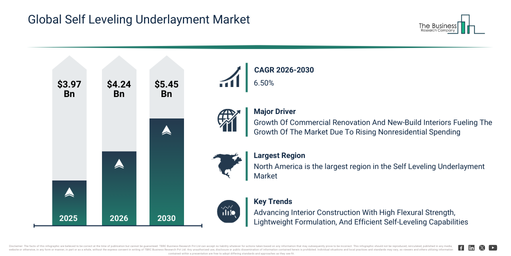
In recent years, the self leveling underlayment market size has experienced robust growth. It is projected to expand from $3.97 billion in 2025 to $4.24 billion in 2026, registering a compound annual growth rate (CAGR) of 6.8%. This historical growth can be linked to several factors, including rapid urbanization and construction expansion, a surge in renovation and retrofit projects, the increasing demand for resilient and high-quality flooring, enhanced labor and time efficiency advantages, and the enlargement of commercial and industrial real estate developments.
The self leveling underlayment market is anticipated to show considerable expansion over the next few years. It is projected to achieve a value of $5.45 billion in 2030, growing at a compound annual growth rate (CAGR) of 6.5%. This growth during the forecast period is influenced by the rising adoption of polymer-modified and fast-setting underlayments, an increased emphasis on eco-friendly and low volatile organic compounds (VOC) materials, greater awareness and training among contractors, the broadening of distribution networks, and the expanding integration of value-added services such as installation and technical consultation. Key trends expected in the forecast period include technological advancements in polymer-modified formulations, innovations in fiber-reinforced and low-shrinkage materials, developments in fast-curing and quick-setting underlayments, research and development initiatives in eco-friendly and sustainable products, and progress in digital tools and automated flooring solutions.
Get A Free Sample Report With In-Depth Market Insights:
Self Leveling Underlayment Market Expansion Drivers: What’s Shaping Future Growth?
The self leveling underlayment market is expected to expand due to the increasing volume of commercial renovation and new-build interiors. These activities involve the preparation of flooring in office, retail, and institutional establishments during either upgrades or new construction. The uptick in commercial renovation and new-build interiors is a consequence of economic expansion and property redevelopment, as these projects demand smooth, level surfaces for durable flooring installations. Self leveling underlayment facilitates commercial renovation and new-build interiors by providing flat, uniform substrates, which prevents cracking and ensures lasting floor performance. As an illustration, in October 2025, Statistics Finland, an official national statistics agency based in Finland, noted that $4.58 billion (€ 3.9 billion) was invested in renovating non residential buildings in 2024, with the overall value of these renovations increasing by 9.6% year on year, and commercial and office building renovations showing the most significant rise at 22.3 per cent. Thus, the expansion of commercial renovation and new-build interiors is propelling the growth of the self leveling underlayment market.
Self Leveling Underlayment Market Breakdown By Product Type And Application
The self leveling underlayment market covered in this report is segmented –
1) By Type: Cementitious, Gypsum-Based, Other Types
2) By Distribution Channel: Direct Sales, Retail Stores, Online Stores, Other Distribution Channels
3) By Application: Residential, Commercial, Industrial, Institutional
4) By End-Use: Flooring, Subfloor Preparation, Other End Users
Subsegments:
1) By Cementitious: Rapid Setting, Fiber Reinforced, Polymer Modified, Standard Strength
2) By Gypsum-Based: Quick Drying, Fiber Reinforced, High Strength, Lightweight
3) By Others Type: Polymer Based, Self-Curing, Hybrid Mix, Specialty Formulations
Self Leveling Underlayment Market Strategic Trends: What Defines The Next Growth Phase?
Leading companies in the self-leveling underlayment market are concentrating on technological advancements, such as high flexural strength, to facilitate quicker installations, improve structural integrity, and simplify handling for diverse construction projects. High flexural strength denotes a material’s capacity to resist bending or deformation under load, thereby ensuring robust and steady surfaces across various base materials. For example, in February 2024, LATICRETE International Inc., a US-based construction solutions company, introduced NXT Level Plus Lite, a versatile self-leveling underlayment designed for residential, commercial, and high-rise applications. This product features a lightweight formula that is pump-friendly, free-flowing, and can be poured up to four inches thick, effectively reducing the need for multiple applications. Its inherent high flexural strength ensures compatibility with diverse substrates like concrete, gypsum, plywood, and OSB, eliminating the requirement for metal lath. By utilizing NXT Level Plus Lite, contractors and architects can manage structural weight limitations while upholding durability, providing antimicrobial protection, and meeting low volatile organic compound compliance for modern construction requirements.
Self Leveling Underlayment Market Leading Players And Competitive Positioning
Major companies operating in the self leveling underlayment market are Sika AG, MAPEI S.p.A., Bostik SA, USG Corporation, Arcosa Specialty Materials, The Quikrete Companies Inc., Master Builders Solutions Holdings GmbH, ARDEX Americas, Custom Building Products Inc., Henry Company LLC, The Euclid Chemical Company, TEC Specialty Construction Brands Inc., LATICRETE International Inc., Flowcrete Group Ltd., W. R. Meadows Inc., CTS Cement Manufacturing Corporation, Dex-O-Tex, KÖSTER Bauchemie AG, CMP Specialty Products, Merkrete LLC, Hacker Industries Inc., Duraamen Engineered Products Inc., Fosroc International Ltd., Spex-Crete Industries
View The Full Self Leveling Underlayment Market Report:
Self Leveling Underlayment Market Regional Distribution: Which Areas Power Market Growth?
North America was the largest region in the self leveling underlayment market in 2025. Asia-Pacific is expected to be the fastest-growing region in the forecast period. The regions covered in the self leveling underlayment market report are Asia-Pacific, South East Asia, Western Europe, Eastern Europe, North America, South America, Middle East, Africa.
Reach Out To Our Team:
The Business Research Company: https://www.thebusinessresearchcompany.com/
Americas: +1 310-496-7795
Asia: +44 7882 955267 & +91 8897263534
Europe: +44 7882 955267
Email us at: marketing@tbrc.info
Follow us on:
LinkedIn: https://in.linkedin.com/company/the-business-research-company
YouTube: https://www.youtube.com/channel/UC24_fI0rV8cR5DxlCpgmyFQ
Global Market Model: https://www.thebusinessresearchcompany.com/global-market-model

Wasay has over a decade of experience in market research, data modelling, and analytics, with prior experience at GlobalData and Decision Tree Consulting Services. At The Business Research Company , he leads research operations across syndicated studies, customized consulting engagements, and the Global Market Model platform. His professional experience includes supporting organizations such as Boston Consulting Group, KPMG, and Ernst & Young. Wasay holds a degree in Electronics and Communications Engineering, postgraduate management qualifications from International Management Institute Belgium and Indian School of Business and Entrepreneurship, and completed the Integrated Program in Business Analytics from Indian Institute of Management Indore.