With a focus on actionable insights and strategic value, The Business Research Company’s 2026 market reports include market attractiveness scoring, total addressable market sizing, company benchmarking matrices, interactive Excel dashboards, deeper supply chain intelligence, emerging startup tracking, and granular product-level insights.
Smart Adaptive Lighting Retrofit Market Size Analysis: Historical Growth And Future Revenue Projections
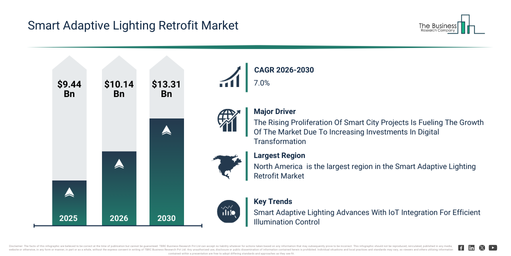
The smart adaptive lighting retrofit market has experienced robust growth over recent years. It will grow from $9.44 billion in 2025 to $10.14 billion in 2026 at a compound annual growth rate (CAGR) of 7.4%. This historical growth can be attributed to several factors, including the increasing adoption of adaptive lighting retrofits, expanded use of IoT-enabled lighting controls, a rise in energy-efficient LED installations, the widespread deployment of motion sensor and daylight harvesting technologies, and an increased demand for smart lighting apps.
The smart adaptive lighting retrofit market size is anticipated to experience substantial growth in the coming years. It is projected to reach $13.31 billion in 2030, showing a compound annual growth rate (CAGR) of 7.0%. This growth during the forecast period can be attributed to factors such as the increasing deployment of AI-driven lighting control systems, rising integration with building management systems, the expansion of cloud-based lighting optimization platforms, the development of automated brightness and color control solutions, and the growth in retrofitting legacy lighting infrastructure. Major trends expected in the forecast period include the deployment of AI-based lighting control systems, the integration of smart sensor networks, the adoption of IOT-enabled adaptive lighting, the expansion of energy optimization software platforms, and the development of connected smart lighting ecosystems.
Preview The Smart Adaptive Lighting Retrofit Market Report With A Free Sample:
Smart Adaptive Lighting Retrofit Market Drivers: What Is Fueling Demand Through 2030?
The increasing spread of smart city initiatives is anticipated to drive expansion in the smart adaptive lighting retrofit market in the future. These projects are defined as urban efforts that incorporate sophisticated technologies like the Internet of Things (IoT), data analysis, and digital frameworks to enhance municipal services and urban structures. The increase in smart city projects stems from a global trend where more cities are investing in digital transformation to address expanding urban populations and infrastructure needs through effective, data-led solutions. Smart adaptive lighting retrofit systems assist smart city projects by converting conventional streetlights into intelligent setups capable of modifying brightness based on traffic, weather conditions, and pedestrian movement, thereby improving energy efficiency, safety, and cost reductions, all while contributing to sustainability objectives. For example, data from April 2023, provided by the International Institute for Management Development, a Switzerland-based business school, indicated that the global count of smart cities grew from 118 cities in 2021 to 141 cities in 2023. Consequently, the growing prevalence of smart city endeavors is fueling the expansion of the smart adaptive lighting retrofit market.
Smart Adaptive Lighting Retrofit Market Segmentation Analysis: Core Categories And Subcategories
The smart adaptive lighting retrofit market covered in this report is segmented –
1) By Product Type: Light Emitting Diode Retrofit Kits, Smart Bulbs, Smart Drivers And Controllers, Sensors, Other Product Types
2) By Communication Technology: Wired, Wireless
3) By Distribution Channel: Online, Offline
4) By Application: Residential, Commercial, Industrial, Public Infrastructure
Subsegments:
1) By Light Emitting Diode Retrofit Kits: Tubular Light Emitting Diode Retrofit Kits, Plug And Play Light Emitting Diode Retrofit Kits, Ballast Bypass Light Emitting Diode Retrofit Kits, Direct Wire Light Emitting Diode Retrofit Kits
2) By Smart Bulbs: Dimmable Smart Bulbs, Color Changing Smart Bulbs, Tunable White Smart Bulbs, Filament Style Smart Bulbs
3) By Smart Drivers And Controllers: Constant Current Drivers, Constant Voltage Drivers, Integrated Smart Controllers, Standalone Smart Controllers
4) By Sensors: Occupancy Sensors, Motion Sensors, Infrared Sensors, Ultrasonic Sensors
5) By Other Product Types: Smart Light Panels, Smart Light Strips, Smart Ceiling Fixtures, Smart Outdoor Lighting Fixtures
Which Trends Will Define The Smart Adaptive Lighting Retrofit Market Through 2030?
Leading companies within the smart adaptive lighting retrofit market are prioritizing the development of advanced solutions, such as integrated Internet of Things (IoT) lighting systems, to boost energy optimization and provide customized illumination experiences. Integrated IoT lighting systems are intelligent, interconnected solutions that leverage the internet for automated and adaptable light management, enhancing energy efficiency and enabling remote surveillance via sensors and data analytics. They also facilitate personalized modifications based on specific conditions and user requirements. For example, in March 2023, MEGAMAN, a China-based producer of smart lighting solutions, unveiled its Infinite IoT Lighting Solution series. This IoT-driven lighting series unifies intelligent illumination control with improved energy efficiency on a single platform. The system employs Bluetooth low energy technology, compatible with most smartphones and tablets, allowing users to manage lighting through their mobile devices or physical switches. A dedicated application permits individuals to power lights on or off, adjust brightness, and modify color temperature, while integrated motion and light sensors automatically fine-tune illumination according to occupancy and ambient light, ensuring energy savings and greater comfort in indoor environments.
Smart Adaptive Lighting Retrofit Market Major Companies And Industry Participants
Major companies operating in the smart adaptive lighting retrofit market are Samsung Electronics Co. Ltd., Panasonic Corporation, LG Electronics Inc., Schneider Electric SE, Honeywell International Inc., Eaton Corporation, Legrand, Signify Holding, Ams Osram, Hubbell Lighting, Acuity Brands, Trilux Group, Zumtobel Group, Wipro Enterprises (P) Ltd, Fagerhult Group, Lutron Electronics, Dialight PLC, Helvar, Yeelight, Sengled Optoelectronics Co. Ltd., Current Lighting Solutions LLC.
Buy The Full Smart Adaptive Lighting Retrofit Global Market Report 2026:
Smart Adaptive Lighting Retrofit Market Geographic Analysis: Which Region Accounts For The Biggest Share?
North America was the largest region in the smart adaptive lighting retrofit market in 2025. Asia-Pacific is expected to be the fastest-growing region in the forecast period. The regions covered in the smart adaptive lighting retrofit market report are Asia-Pacific, South East Asia, Western Europe, Eastern Europe, North America, South America, Middle East, Africa.
Reach Out To Our Team:
The Business Research Company: https://www.thebusinessresearchcompany.com/
Americas: +1 310-496-7795
Asia: +44 7882 955267 & +91 8897263534
Europe: +44 7882 955267
Email us at: marketing@tbrc.info
Follow us on:
LinkedIn: https://in.linkedin.com/company/the-business-research-company
YouTube: https://www.youtube.com/channel/UC24_fI0rV8cR5DxlCpgmyFQ
Global Market Model: https://www.thebusinessresearchcompany.com/global-market-model

Wasay has over a decade of experience in market research, data modelling, and analytics, with prior experience at GlobalData and Decision Tree Consulting Services. At The Business Research Company , he leads research operations across syndicated studies, customized consulting engagements, and the Global Market Model platform. His professional experience includes supporting organizations such as Boston Consulting Group, KPMG, and Ernst & Young. Wasay holds a degree in Electronics and Communications Engineering, postgraduate management qualifications from International Management Institute Belgium and Indian School of Business and Entrepreneurship, and completed the Integrated Program in Business Analytics from Indian Institute of Management Indore.