The Business Research Company’s 2026 market reports are designed to deliver research that is more actionable and strategically valuable. Key offerings include market attractiveness scoring, total addressable market sizing, company benchmarking matrices, interactive Excel dashboards, deeper supply chain intelligence, emerging startup tracking, and granular product-level insights.
Smart Adaptive Street Furniture Market Revenue Projected To Rise To $9.7 Billion By 2030
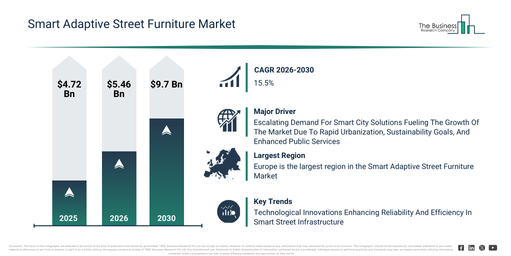
The smart adaptive street furniture market has seen rapid growth in recent years. It is forecast to increase from $4.72 billion in 2025 to $5.46 billion in 2026, exhibiting a compound annual growth rate (CAGR) of 15.7%. This historical expansion can be linked to factors such as the increasing adoption of smart urban infrastructure, enhanced use of sensor-enabled public furniture, growing integration of IoT for street amenities, the spread of solar-powered street furniture, and the deployment of interactive signage in public areas.
The smart adaptive street furniture market size is projected to experience substantial growth over the next few years, reaching $9.7 billion in 2030 at a compound annual growth rate (CAGR) of 15.5%. This expansion during the forecast period is primarily driven by the increasing implementation of connected street furniture, the adoption of adaptive and modular urban infrastructure, the broadening of intelligent monitoring systems, the development of sustainable and energy-efficient urban installations, and the integration with smart city platforms. Significant trends for this period include the incorporation of AI-enabled adaptive street furniture, the deployment of sensor-based smart benches and lighting, the embrace of IoT-connected public seating pods and planters, the enlargement of interactive digital signage platforms, and the creation of smart bus shelter monitoring systems.
Want Deeper Smart Adaptive Street Furniture Market Insights? Get A Free Sample Report:
Primary Growth Driver Shaping The Smart Adaptive Street Furniture Market Outlook
The increasing need for smart city solutions is anticipated to drive the expansion of the smart adaptive street furniture market in the future. These solutions encompass integrated technological and data-powered frameworks aimed at boosting the efficiency, sustainability, and quality of life in urban environments through resource optimization and enhanced public service delivery. The heightened demand for smart city solutions stems from factors such as rapid urban development, a growing requirement for effective resource management, a greater emphasis on environmental sustainability, and increasing worries about public safety. Smart adaptive street furniture aids smart city initiatives by offering interconnected, versatile, and responsive urban infrastructure that improves public amenities and fosters citizen involvement. An example illustrates this: in July 2025, HiveMQ GmbH, a Germany-based software company, reported that AI optimization led to a 31% reduction in peak grid pressure, a 42% rise in renewable energy utilization, and an improvement in transportation on-time performance from 72% to 94% between 2022 and 2023. Consequently, the increasing need for smart city solutions is a primary catalyst for the smart adaptive street furniture market.
Smart Adaptive Street Furniture Market Structure: A Detailed Look At Segments And Subsegments
The smart adaptive street furniture market covered in this report is segmented –
1) By Product Type: Benches, Lighting, Waste Bins, Information Kiosks, Charging Stations, Other Product Types
2) By Technology: Internet of Things-Enabled, Sensor-Based, Solar-Powered, Other Technologies
3) By Application: Urban Areas, Parks, Transportation Hubs, Commercial Spaces, Other Applications
Subsegments:
1) By Benches: Smart Benches, Modular Benches, Solar-Powered Benches, Interactive Benches
2) By Lighting: Smart Streetlights, Solar-Powered Lighting, Motion-Sensor Lighting, Decorative Lighting
3) By Waste Bins: Smart Waste Bins, Solar-Powered Waste Bins, Recycling Waste Bins, Self-Compacting Waste Bins
4) By Information Kiosks: Digital Information Kiosks, Interactive Information Kiosks, Touchscreen Information Kiosks, Wayfinding Information Kiosks
5) By Charging Stations: Electric Vehicle Charging Stations, Solar-Powered Charging Stations, Wireless Charging Stations, Public Device Charging Stations
6) By Other Product Types: Smart Bicycle Stands, Smart Shelters, Air Quality Monitoring Units, Digital Signage
Smart Adaptive Street Furniture Market Innovation And Strategy Trends Among Leading Companies
Leading companies operating in the smart adaptive street furniture market are concentrating on technological innovations, such as utility-grade performance, to improve dependability, reduce running costs, and enhance urban infrastructure efficiency. Utility-grade performance denotes a high benchmark for reliability, durability, and safety, crafted to satisfy the stringent demands of utility and critical infrastructure operations. For example, Ubicquia Inc., a US-based technology company, unveiled its next-generation UbiCell utility-grade universal lighting controller (UGU) in November 2024. This new controller is compatible with both cobra head and decorative streetlights, providing utility-grade performance along with robust surge protection and advanced electrical diagnostics. Powered by Ubicquia’s UbiVu cloud-based artificial intelligence (AI) platform, it offers real-time monitoring of 32 data points per hour, enabling proactive maintenance, better energy efficiency, and decreased operational costs.
Top Companies Competing In The Smart Adaptive Street Furniture Market
Major companies operating in the smart adaptive street furniture market are Delta Electronics Inc., Signify N.V., Valmont Industries Inc., JCDecaux SA, Daktronics Inc., Schréder Group, Landscape Forms Inc., Lappset Group Oy, Soofa Inc., Ekin Smart City Solutions, Iysert Energy Research & Development Pvt. Ltd., Bigbelly Solar LLC, Strawberry Energy Ltd., SEEDiA Sp. z o.o., EnGoPlanet Energy Solutions LLC, Sunbolt LLC, Cartelmatic SAS, ZANO Street Furniture Ltd., City Gecko d.o.o., Polymobyl SA.
View The Complete Smart Adaptive Street Furniture Market Study With Segment And Regional Data:
Smart Adaptive Street Furniture Market Regional Outlook Across Major Geographies
Europe was the largest region in the smart adaptive street furniture market in 2025. Asia-Pacific is expected to be the fastest-growing region in the forecast period. The regions covered in the smart adaptive street furniture market report are Asia-Pacific, South East Asia, Western Europe, Eastern Europe, North America, South America, Middle East, Africa.
Reach Out To Our Team:
The Business Research Company: https://www.thebusinessresearchcompany.com/
Americas: +1 310-496-7795
Asia: +44 7882 955267 & +91 8897263534
Europe: +44 7882 955267
Email us at: marketing@tbrc.info
Follow us on:
LinkedIn: https://in.linkedin.com/company/the-business-research-company
YouTube: https://www.youtube.com/channel/UC24_fI0rV8cR5DxlCpgmyFQ
Global Market Model: https://www.thebusinessresearchcompany.com/global-market-model

Wasay has over a decade of experience in market research, data modelling, and analytics, with prior experience at GlobalData and Decision Tree Consulting Services. At The Business Research Company , he leads research operations across syndicated studies, customized consulting engagements, and the Global Market Model platform. His professional experience includes supporting organizations such as Boston Consulting Group, KPMG, and Ernst & Young. Wasay holds a degree in Electronics and Communications Engineering, postgraduate management qualifications from International Management Institute Belgium and Indian School of Business and Entrepreneurship, and completed the Integrated Program in Business Analytics from Indian Institute of Management Indore.