Enhanced with market attractiveness analysis, total addressable market evaluation, company benchmarking matrices, interactive Excel dashboards, expanded supply chain intelligence, emerging startup coverage, and detailed product insights, The Business Research Company’s 2026 market reports deliver more actionable and strategically valuable research.
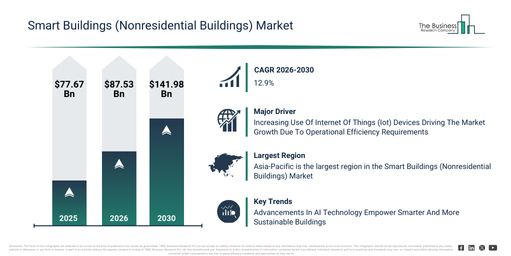
Smart Buildings (Nonresidential Buildings) Market Forecast Highlighting Growth From $87.53 Billion To $141.98 Billion
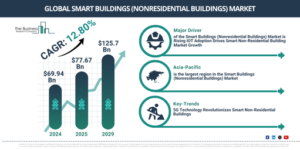
The smart buildings (nonresidential buildings) market has experienced significant expansion in recent years. This market is expected to increase from $77.67 billion in 2025 to $87.53 billion in 2026, demonstrating a compound annual growth rate (CAGR) of 12.7%. Its historical growth can be linked to factors such as a past dependence on traditional building systems, the incremental adoption of automation technologies, a growing desire for energy-efficient commercial structures, the initial integration of access control and surveillance mechanisms, and the expansion of construction projects in the non-residential sector.
The smart buildings (nonresidential buildings) market is poised for significant expansion in the coming years, with its size projected to reach $141.98 billion by 2030, exhibiting a compound annual growth rate (CAGR) of 12.9%. This anticipated growth is primarily driven by the increasing integration of advanced BEMS solutions, a surging demand for cloud-connected automation platforms, the wider adoption of predictive maintenance technologies, the expansion of IoT-enabled smart infrastructure, and escalating regulatory pressure for energy-efficient non-residential buildings. Concurrently, major trends expected during this forecast period include the rising uptake of BEMS-driven energy optimization, an increasing deployment of intelligent security and access-control systems, the broadening of cloud-connected building automation platforms, a notable growth in integrated infrastructure and network management solutions, and the expanding utilization of predictive maintenance and remote monitoring technologies.
Download A Free Sample Report For Comprehensive Market Insights:
Smart Buildings (Nonresidential Buildings) Market Expansion Supported By Key Demand Factors
The expanding deployment of Internet of Things (IoT) devices is anticipated to fuel the future expansion of the smart buildings (nonresidential buildings) market. IoT devices are intelligent, networked tools equipped with sensors, software, and internet access, designed to gather, share, and process data for automated oversight and management of physical spaces. The integration of IoT technology is gaining traction because organizations are keen on achieving operational efficiency and reducing expenditures, actively pursuing automated methods for real-time monitoring of building systems, energy optimization, and lowering running costs. This growing implementation of IoT devices stimulates the demand for smart building infrastructure, as these connected systems facilitate automated management of aspects like lighting, heating, ventilation, security, and overall facility operations, thereby boosting building efficiency and the well-being of occupants. An illustrative example is the projection by BuildOps Inc., a US-based software-as-a-service (SaaS) company, stating in February 2023 that the aggregate count of IoT-connected devices is expected to hit 16 billion by 2023, which signifies a 28% rise from 2022. Consequently, the heightened utilization of Internet of Things (IoT) devices is a key factor propelling the expansion of the smart buildings (nonresidential buildings) market.
Smart Buildings (Nonresidential Buildings) Market Categorization By Product Type And Application
The smart buildings (nonresidential buildings) market covered in this report is segmented –
1) By Automation Type: Intelligent Security System, Building Energy Management System, Infrastructure Management System, Network Management System
2) By Product Type: Institutional Buildings, Commercial Buildings
3) By System Type: New Constructions, Remodeling Projects
4) By Application: Government, Airports, Hospitals, Institutes Manufacturing & Industrial facilities, Other Applications
Subsegments:
1) By Intelligent Security System: Access Control Systems, Video Surveillance Systems, Intrusion Detection Systems
2) By Building Energy Management System (BEMS): HVAC Control Systems, Lighting Control Systems, Energy Monitoring and Optimization Tools
3) By Infrastructure Management System: Facility Management Software, Asset Tracking and Management Tools, Maintenance Management Systems
4) By Network Management System: Network Monitoring and Performance Management, Data Center Management Tools, Cloud-Based Management Solutions
Smart Buildings (Nonresidential Buildings) Market Growth Trends Influencing Competitive Dynamics
Leading companies in the smart buildings (non-residential buildings) market are concentrating on developing innovative offerings, such as Artificial Intelligence (AI)-driven integrated building management systems, to boost energy efficiency, streamline building operations, and enhance occupant comfort. These Artificial Intelligence (AI)-powered integrated building management platforms utilize advanced data analytics, machine learning, and real-time sensor inputs to autonomously monitor, control, and optimize critical building systems. This helps facility managers to reduce energy consumption, lower operating costs, and cultivate safer, more comfortable, and sustainable non-residential environments. For example, in June 2025, Honeywell International Inc., a US–based building-automation and industrial-technology company, introduced Honeywell Connected Solutions (built on their Forge platform), which is an AI-powered platform that consolidates essential building software and technologies into one interface for non-residential portfolios. This solution delivers advanced encryption for cybersecurity, remote monitoring and diagnostics, predictive maintenance, and energy-management capabilities, thereby assisting operators in decreasing labor time, costs, and carbon footprint.
Smart Buildings (Nonresidential Buildings) Market Company Landscape And Strategic Competition
Major companies operating in the smart buildings (nonresidential buildings) market are China State Construction Engineering Co., Ltd., VINCI, Bechtel Corporation, Skanska AB, Turner Construction Company, Jacobs Engineering Group Inc., The Whiting-Turner Contracting Company, PCL Construction, AECOM, BESIX Group, Shanghai Construction Group (SCG), SGS Group, Larsen & Toubro, GMR Group, Hindustan Construction Company, GVK Group, Kajima Corporation, Shimizu Corporation, Shanghai Intelligent Building Technology (SIBT), Obayashi Corporation, Taisei Corporation, Balfour Beatty, Bouygues, Royal BAM Group, Laing O`Rourke, ACS Group, EllisDon Corporation, Aecon Group Incorporated, Ledcor Group of Companies, Gilbane Building Company, Empresas ICA SAB de CV, Carso Infraestructura y Construcción S.A.B., Clark Group, Swinerton, Hensel Phelps, Lendlease, Arabian Construction Company, WBHO Construction (Pty) Ltd., Stefanutti Stocks (Pty) Ltd, WK construction, Redcon Construction Company, Estim Construction Co. Ltd, Eco-Beam, Ecomo, TSAI design studio
Access The Complete Smart Buildings (Nonresidential Buildings) Market Report:
Smart Buildings (Nonresidential Buildings) Market Regional Distribution: Which Areas Drive Market Expansion?
Asia-Pacific was the largest region in the smart buildings (non-residential buildings) market in 2025. South America is expected to be the fastest-growing region in the global smart buildings (nonresidential buildings) market during the forecast period. The regions covered in the smart buildings (nonresidential buildings) market report are Asia-Pacific, South East Asia, Western Europe, Eastern Europe, North America, South America, Middle East, Africa.
Get in touch with us:
The Business Research Company: https://www.thebusinessresearchcompany.com/
Americas: +1 310-496-7795
Asia: +44 7882 955267 & +91 8897263534
Europe: +44 7882 955267
Email us at: marketing@tbrc.info
Follow us on:
LinkedIn: https://in.linkedin.com/company/the-business-research-company
YouTube: https://www.youtube.com/channel/UC24_fI0rV8cR5DxlCpgmyFQ
Global Market Model: https://www.thebusinessresearchcompany.com/global-market-model

Wasay has over a decade of experience in market research, data modelling, and analytics, with prior experience at GlobalData and Decision Tree Consulting Services. At The Business Research Company , he leads research operations across syndicated studies, customized consulting engagements, and the Global Market Model platform. His professional experience includes supporting organizations such as Boston Consulting Group, KPMG, and Ernst & Young. Wasay holds a degree in Electronics and Communications Engineering, postgraduate management qualifications from International Management Institute Belgium and Indian School of Business and Entrepreneurship, and completed the Integrated Program in Business Analytics from Indian Institute of Management Indore.