
Featuring market attractiveness scoring, total addressable market sizing, company benchmarking matrices, interactive Excel dashboards, deeper supply chain intelligence, emerging startup tracking, and granular product-level insights, The Business Research Company’s 2026 market reports are built to deliver research that is both more actionable and more strategically valuable.
Smart Construction Materials Market Size And Revenue Outlook Through 2030
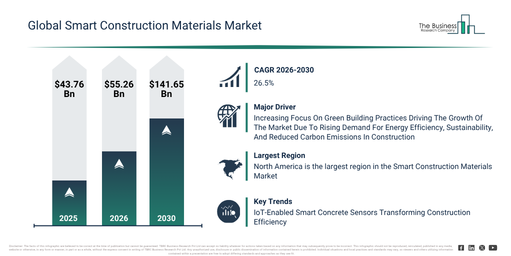
The smart construction materials market has seen substantial expansion in recent years. This market is projected to increase from $43.76 billion in 2025 to $55.26 billion in 2026, registering a compound annual growth rate (CAGR) of 26.3%. The historical growth of this market can be attributed to factors like the increasing demand for sustainable building solutions, the adoption of conventional high-performance concrete, the expansion of residential and commercial construction activities, a rising awareness of energy efficiency, and the introduction of functional coatings in building materials.
The smart construction materials market is projected to experience rapid expansion over the coming years. Its valuation is set to reach $141.65 billion by 2030, exhibiting a compound annual growth rate (CAGR) of 26.5%. This anticipated expansion during the forecast period is propelled by factors such as the increasing uptake of electrochromic and photochromic glass, a surging need for self-sensing and light-emitting concrete, the proliferation of smart infrastructure initiatives, an elevated emphasis on carbon-sequestering and environmentally friendly materials, and the increasing incorporation of IoT-enabled environmental sensing systems. Key developments expected within this period encompass a rise in the adoption of self-healing and self-cleaning materials, a heightened demand for energy-efficient smart facades, the expanding integration of structural health monitoring systems, the proliferation of acoustic and vibration control solutions, and an increased focus on enhancing safety, fire resistance, and overall durability.
Get A Free Sample Report With In-Depth Market Insights:
Smart Construction Materials Market Demand Drivers Opening New Revenue Streams
The growing emphasis on green building methodologies is projected to drive the expansion of the smart construction materials market moving forward. These green building practices involve strategies for designing and constructing buildings to minimize environmental impact, improve energy efficiency, and encourage the sustainable use of resources throughout a building’s lifecycle. The proliferation of green building practices is fueled by increasing environmental concerns and the necessity to reduce carbon emissions and energy consumption within the construction industry. Smart construction materials support green building initiatives by enabling energy efficiency, self-healing capabilities, thermal regulation, and reduced material waste, thereby enhancing overall building performance and sustainability. For instance, in February 2024, according to the US Green Building Council, a US-based non-profit organization that promotes eco-friendly building and developed the Leadership in Energy and Environmental Design (LEED) certification system, in 2023, LEED certifications increased by 9% compared to the previous year, along with 21 additional certifications for single-family homes. Additionally, new LEED project registrations rose by 51%, indicating substantial growth. Therefore, the heightened focus on green building practices is propelling the growth of the smart construction materials market.
Smart Construction Materials Market Segment Landscape And Growth Outlook
The smart construction materials market covered in this report is segmented –
1) By Material: Coatings, Concrete, Glass
2) By Function: Chromoactive Materials, Electrochromic Materials, Electrorheological Fluids, Magnetostrictive Materials, Piezoelectric Materials
3) By Application: Structural Health Monitoring, Energy Efficiency, Durability Enhancement, Safety And Fire Resistance, Smart Facades, Acoustic And Vibration Control, Environmental Sensing
4) By End Use Industry: Residential, Commercial, Industrial, Infrastructure
Subsegments:
1) By Coatings: Self-Healing Coatings, Self-Cleaning Coatings, Thermal Insulating Coatings, Anti-Corrosion Coatings, Photochromic Coatings
2) By Concrete: Self-Healing Concrete, Self-Sensing Concrete, Light-Emitting Concrete, High-Performance Concrete, Carbon-Sequestering Concrete
3) By Glass: Electrochromic Glass, Thermochromic Glass, Photochromic Glass, Self-Cleaning Glass, Low-Emissivity Glass
Smart Construction Materials Market Trends Powering Strategic Industry Growth
Leading firms within the smart construction materials market are prioritizing the incorporation of Internet of Things (IoT) technologies into construction components, including IoT-enabled smart concrete sensors. This initiative aims to address the growing need for live construction oversight, enhanced structural integrity, and project administration guided by data. These IoT-powered smart concrete sensors are wireless devices integrated directly into concrete or affixed to rebar, consistently tracking parameters like temperature, humidity, and the progression of strength throughout the curing phase. Illustrating this trend, in January 2023, Giatec Scientific Inc., a Canada-based innovator in construction testing, unveiled SmartRock Pro. This advanced, self-calibrating wireless concrete sensor is engineered for continuous strength assessment in building endeavors. The sensor is directly embedded into concrete and linked to reinforcement bars, autonomously gauging temperature and maturity to estimate compressive strength, thereby eliminating the need for manual calibration. Utilizing sophisticated sensing methods and wireless communication, it transmits live data to mobile and cloud platforms. This capability enables contractors to oversee curing progress from a distance and mitigate delays typically associated with conventional break tests. Ultimately, this technology contributes to saving construction time, diminishing material waste, and boosting overall project efficiency by furnishing precise data across the entire lifespan of the concrete.
Smart Construction Materials Market Competitive Landscape: Which Companies Lead The Industry?
Major companies operating in the smart construction materials market are BASF SE, Saint-Gobain S.A., Dow Inc., LafargeHolcim Ltd., 3M Company, Johnson Controls International, The Sherwin-Williams Company, PPG Industries Inc., Evonik Industries AG, Skanska AB, Covestro AG, Sika AG, DuPont de Nemours Inc., Kingspan Group, RPM International Inc., Huntsman Corporation, Nippon Sheet Glass Co. Ltd., Rockwool A/S, USG Corporation, GCP Applied Technologies, Aerogel Technologies LLC.
View The Full Smart Construction Materials Market Report:
Smart Construction Materials Market Regional Breakdown: Where Is Demand Concentrated?
North America was the largest region in the smart construction materials market in 2025. Asia-Pacific is expected to be the fastest-growing region in the forecast period. The regions covered in the smart construction materials market report are Asia-Pacific, South East Asia, Western Europe, Eastern Europe, North America, South America, Middle East, Africa.
Reach Out To Our Team:
The Business Research Company: https://www.thebusinessresearchcompany.com/
Americas: +1 310-496-7795
Asia: +44 7882 955267 & +91 8897263534
Europe: +44 7882 955267
Email us at: marketing@tbrc.info
Follow us on:
LinkedIn: https://in.linkedin.com/company/the-business-research-company
YouTube: https://www.youtube.com/channel/UC24_fI0rV8cR5DxlCpgmyFQ
Global Market Model: https://www.thebusinessresearchcompany.com/global-market-model

Wasay has over a decade of experience in market research, data modelling, and analytics, with prior experience at GlobalData and Decision Tree Consulting Services. At The Business Research Company , he leads research operations across syndicated studies, customized consulting engagements, and the Global Market Model platform. His professional experience includes supporting organizations such as Boston Consulting Group, KPMG, and Ernst & Young. Wasay holds a degree in Electronics and Communications Engineering, postgraduate management qualifications from International Management Institute Belgium and Indian School of Business and Entrepreneurship, and completed the Integrated Program in Business Analytics from Indian Institute of Management Indore.