With a focus on actionable insights and strategic value, The Business Research Company’s 2026 market reports include market attractiveness scoring, total addressable market sizing, company benchmarking matrices, interactive Excel dashboards, deeper supply chain intelligence, emerging startup tracking, and granular product-level insights.
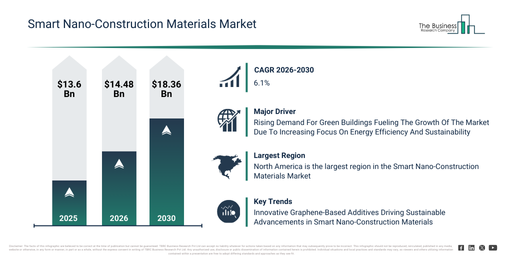
Smart Nano-Construction Materials Market Size Forecast Points To $18.36 Billion In Revenue By 2030
The smart nano-construction materials market has seen robust growth over recent years. It will grow from $13.6 billion in 2025 to $14.48 billion in 2026 at a compound annual growth rate (CAGR) of 6.4%. Historically, this expansion was driven by factors such as intensified research and development efforts in nanotechnology, a heightened need for energy-efficient building solutions, the uptake of high-strength nano concrete, an increasing emphasis on durable and self-healing materials, and the proliferation of smart building initiatives.
The smart nano-construction materials market is projected to experience substantial expansion in the coming years, reaching $18.36 billion by 2030, driven by a compound annual growth rate (CAGR) of 6.1%. This anticipated growth is primarily fueled by factors such as the increasing deployment of AI-enabled nano material monitoring, a surge in the adoption of adaptive and self-sensing materials, the broadening of eco-friendly nano construction solutions, advancements in automated nano material fabrication, and the expanding integration of smart coatings and glass technologies. Key developments during this forecast period are expected to involve the integration of AI-based nano material monitoring, the uptake of smart nano concrete and coating solutions, the implementation of IoT-enabled structural health systems, a rise in automated nano material production, and the creation of energy-efficient nano construction solutions.
Get A Free Smart Nano-Construction Materials Market Sample Covering Drivers, Trends And Key Players:
Smart Nano-Construction Materials Market Driver Analysis: Key Factor Supporting Revenue Growth
An anticipated increase in green building demand is set to boost the expansion of the smart nano-construction materials market. These environmentally conscious structures minimize ecological footprints by efficiently managing energy, water, and various materials from conception to end-of-life. Increased environmental consciousness, particularly concerning energy conservation and lowering carbon emissions through sustainable building methods, fuels the emergence of green buildings. Critical to green building initiatives, smart nano-construction materials enhance energy performance, structural integrity, and overall environmental durability. Their cutting-edge attributes include superior insulation capabilities, inherent self-cleaning functions, and reduced material usage, contributing to more sustainable building practices. Illustratively, data from July 2024 by the Green Building Council, a US-based non-profit organization, reported that more than 46,000 residential projects obtained LEED green building certification, indicating nearly a 5% rise in new registrations compared to 2023. Consequently, the escalating need for green buildings directly propels the expansion of the smart nano-construction materials market.
Smart Nano-Construction Materials Market Segmentation Framework: Major Segments At A Glance
The smart nano-construction materials market covered in this report is segmented –
1) By Material Type: Smart Nano Concrete, Smart Nano Coatings, Smart Nano Glass, Other Material Types
2) By Technology: Active Smart Materials, Passive Smart Materials
3) By Application: Structural Applications, Non-Structural Applications, Monitoring Systems
4) By Distribution Channel: Direct, Indirect
5) By End-Use: Commercial Buildings, Residential Buildings, Infrastructure, Industrial
Subsegments:
1) By Smart Nano Concrete: Self-Healing Concrete, High-Strength Concrete, Lightweight Concrete, Fiber-Reinforced Concrete
2) By Smart Nano Coatings: Anti-Corrosion Coatings, Self-Cleaning Coatings, Thermal Insulation Coatings, Fire-Resistant Coatings
3) By Smart Nano Glass: Energy-Efficient Glass, Self-Cleaning Glass, Impact-Resistant Glass, Electrochromic Glass
4) By Other Material Types: Nano-Insulation Materials, Nano-Additives, Nano-Fibers, Nano-Plastics
Latest Smart Nano-Construction Materials Market Developments And Emerging Trends
Leading firms within the smart nano-construction materials market are concentrating on creating cutting-edge solutions, including graphene admixtures, to enhance concrete performance and bolster sustainability efforts in the construction sector. These graphene admixtures are sophisticated additive materials that integrate graphene, which is a singular layer of carbon atoms arranged in a hexagonal lattice, into conventional building materials like concrete, cement, or mortar to elevate their performance characteristics. For example, in August 2024, Gerdau Graphene, a Brazil-based manufacturer of graphene-based products, introduced NanoCONS. This new line of graphene admixtures for concrete aims to transform concrete performance by boosting its compressive and tensile strength, concurrently reducing cement usage. The NanoCONS product range employs functionalized graphene additives, which improve the concrete’s microstructure, resulting in better water resistance, less cracking, and a longer structural lifespan. This advancement aligns with worldwide initiatives to foster more eco-efficient construction practices, particularly within the framework of smart cities and sustainable infrastructure developments.
Which Companies Are Shaping The Smart Nano-Construction Materials Market?
Major companies operating in the smart nano-construction materials market are BASF SE, Saint-Gobain, The Sherwin-Williams Company, Evonik Industries AG, PPG Industries Inc., DuPont de Nemours Inc., Arkema Group, AkzoNobel N.V., Huntsman Corporation, OCSiAl, American Elements, Zyvex Technologies, Nasiol India Coating, Aerogel Technologies LLC, Advanced Nanotech Lab, Aalberts Surface Technologies, AdNano Technologies Pvt Ltd, Nanospan India Pvt Ltd, Nanocrete Technologies OPC Private Limited, Xiamen SRS Trading Co. Ltd., Foshan New Fashion Building Material Co. Ltd., Xiamen Hongzhanxing Co. Ltd.
Dive Deeper Into The Smart Nano-Construction Materials Market With The Full Report:
Smart Nano-Construction Materials Market Regional Distribution: Where Is Revenue Concentrated?
North America was the largest region in the smart nano-construction materials market in 2025. Asia-Pacific is expected to be the fastest-growing region in the forecast period. The regions covered in the smart nano-construction materials market report are Asia-Pacific, South East Asia, Western Europe, Eastern Europe, North America, South America, Middle East, Africa.
Reach Out To Our Team:
The Business Research Company: https://www.thebusinessresearchcompany.com/
Americas: +1 310-496-7795
Asia: +44 7882 955267 & +91 8897263534
Europe: +44 7882 955267
Email us at: marketing@tbrc.info
Follow us on:
LinkedIn: https://in.linkedin.com/company/the-business-research-company
YouTube: https://www.youtube.com/channel/UC24_fI0rV8cR5DxlCpgmyFQ
Global Market Model: https://www.thebusinessresearchcompany.com/global-market-model

Wasay has over a decade of experience in market research, data modelling, and analytics, with prior experience at GlobalData and Decision Tree Consulting Services. At The Business Research Company , he leads research operations across syndicated studies, customized consulting engagements, and the Global Market Model platform. His professional experience includes supporting organizations such as Boston Consulting Group, KPMG, and Ernst & Young. Wasay holds a degree in Electronics and Communications Engineering, postgraduate management qualifications from International Management Institute Belgium and Indian School of Business and Entrepreneurship, and completed the Integrated Program in Business Analytics from Indian Institute of Management Indore.