
Featuring market attractiveness scoring, total addressable market sizing, company benchmarking matrices, interactive Excel dashboards, deeper supply chain intelligence, emerging startup tracking, and granular product-level insights, The Business Research Company’s 2026 market reports are built to deliver research that is both more actionable and more strategically valuable.
Urban Infrastructure Market Value Growth And Long-Term Outlook
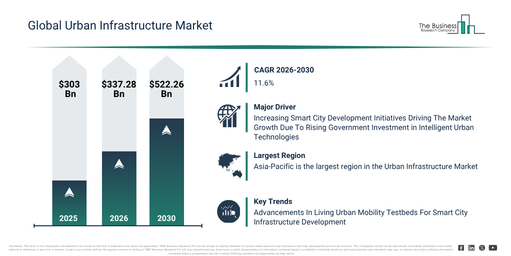
The urban infrastructure market has experienced swift expansion in recent years. Forecasts indicate it will expand from $303 billion in 2025 to $337.28 billion in 2026, exhibiting a compound annual growth rate (CAGR) of 11.3%. Historically, this expansion can be linked to factors such as accelerated urbanization and city development, an increase in public infrastructure investment, a growing need for effective transportation networks, higher energy consumption along with power grid development, and the establishment of improved water supply and sanitation amenities.
The urban infrastructure market size is projected to experience rapid expansion in the coming years. It is forecast to grow to $522.26 billion by 2030 at a compound annual growth rate (CAGR) of 11.6%. This projected growth is driven by the increasing implementation of smart city initiatives, the rising integration of renewable energy into urban frameworks, the growing deployment of IoT-enabled urban management systems, the broadening of high-speed communication networks, and a strong emphasis on sustainable and climate-resilient urban planning. Key trends during this period encompass increasing investment in public-private partnership infrastructure projects, a rising adoption of smart urban transportation solutions, a heightened focus on water and wastewater management systems, the expansion of communication and data center infrastructure, and a growing priority on resilient and disaster-ready social infrastructure.
Get A Free Sample Report With In-Depth Market Insights:
Urban Infrastructure Market Industry Drivers: What’s Behind The Revenue Growth?
The expanding scope of smart city development initiatives is anticipated to fuel the growth of the urban infrastructure market. These initiatives encompass government-led programs and investments that integrate digital technologies, including IoT, AI, and interconnected systems, into urban infrastructure to elevate the efficiency, safety, and sustainability of city services. The increasing momentum in smart city development, bolstered by strong government policy support and significant public funding, is propelling the extensive adoption of advanced smart community technologies. Urban infrastructure plays a pivotal role in fostering smart city development by facilitating efficient transportation, reliable utilities, and digital connectivity, thereby underpinning smart technologies that enhance resource management, quality of life, and environmental sustainability. For instance, in January 2024, the Institute of the Americas, a US-based non-profit organization, indicated that global spending on smart city initiatives in 2023 was expected to exceed $190 billion. Therefore, the proliferation of smart city development initiatives is a key driver for the growth of the urban infrastructure market.
Urban Infrastructure Market Segment Performance And Emerging Opportunities
The urban infrastructure market covered in this report is segmented –
1) By Infrastructure Type: Transportation Infrastructure, Energy Infrastructure, Water And Wastewater Infrastructure, Communication Infrastructure, Social Infrastructure
2) By Deployment Model: Public Infrastructure Projects, Public-Private Partnership Projects, Private Infrastructure Projects
3) By Application: Transport, Cargo, Urban, Tourism, Defense
4) By End Use: Residential, Commercial, Industrial
Subsegments:
1) By Transportation Infrastructure: Road And Highway Infrastructure, Urban Rail Transit Infrastructure, Airport Infrastructure, Seaport And Inland Port Infrastructure, Public Bus And Transit Terminal Infrastructure
2) By Energy Infrastructure: Electric Power Generation Infrastructure, Electric Power Transmission Infrastructure, Electric Power Distribution Infrastructure, Natural Gas Pipeline Infrastructure, Renewable Energy Generation Infrastructure
3) By Water And Wastewater Infrastructure: Drinking Water Supply Infrastructure, Water Treatment Plant Infrastructure, Wastewater Treatment Plant Infrastructure, Stormwater Drainage Infrastructure, Sewage Collection And Conveyance Infrastructure
4) By Communication Infrastructure: Telecommunication Network Infrastructure, Fiber Optic Communication Infrastructure, Mobile Network Tower Infrastructure, Satellite Communication Ground Infrastructure, Data Center And Cloud Communication Infrastructure
5) By Social Infrastructure: Healthcare Facility Infrastructure, Educational Institution Infrastructure, Public Safety And Emergency Service Infrastructure, Government Administrative Building Infrastructure, Public Recreation And Community Facility Infrastructure
#Urban Infrastructure Market Growth Trends: What’s Shaping The Future Outlook?
Major companies operating in the urban infrastructure market are focusing on developing advancements in smart city infrastructure technologies, such as living urban mobility testbeds, to enable real-time experimentation, data-driven traffic management, and integrated transportation solutions that enhance urban efficiency, sustainability, and commuter experience. Living urban mobility testbeds empower developers, researchers, and city planners to evaluate how vehicles, infrastructure, and residents interact through connected data systems, advanced sensors, and coordinated traffic management technologies. For instance, in September 2025, Toyota Motor Corporation, a Japan-based automotive and mobility technology company, launched Woven City, a fully connected prototype urban environment designed as a real-world testing platform for future mobility and smart infrastructure. The city incorporates a three-type road network separating pedestrians, personal mobility devices, and vehicles, an underground logistics corridor for autonomous delivery, and multifunctional smart poles equipped with sensors and cameras that support infrastructure monitoring and traffic coordination.
Urban Infrastructure Market Company Landscape And Competitive Strategy
Major companies operating in the urban infrastructure market are China State Construction Engineering Corporation Limited, China Communications Construction Company Limited, Power Construction Corporation of China Limited, Vinci S.A., Bouygues Construction S.A., Samsung C&T Corporation, HOCHTIEF Aktiengesellschaft, Larsen & Toubro Limited, Hyundai Engineering & Construction Co. Ltd., STRABAG SE, Kiewit Corporation, Bechtel Corporation, Skanska AB, Fluor Corporation, AECOM, Jacobs Solutions Inc., Balfour Beatty plc, Ferrovial SE, Acciona S.A., Webuild S.p.A., Hindustan Construction Company Limited, GMR Group, Ghella S.p.A., Gülermak Agir Sanayi Insaat ve Taahhüt A.S.
View The Full Urban Infrastructure Market Report:
Urban Infrastructure Market Largest Region: Which Geography Holds The Biggest Share?
Asia-Pacific was the largest region in the urban infrastructure market in 2025. Asia-Pacific is expected to be the fastest-growing region in the forecast period. The regions covered in the urban infrastructure market report are Asia-Pacific, South East Asia, Western Europe, Eastern Europe, North America, South America, Middle East, Africa.
Reach Out To Our Team:
The Business Research Company: https://www.thebusinessresearchcompany.com/
Americas: +1 310-496-7795
Asia: +44 7882 955267 & +91 8897263534
Europe: +44 7882 955267
Email us at: marketing@tbrc.info
Follow us on:
LinkedIn: https://in.linkedin.com/company/the-business-research-company
YouTube: https://www.youtube.com/channel/UC24_fI0rV8cR5DxlCpgmyFQ
Global Market Model: https://www.thebusinessresearchcompany.com/global-market-model

Wasay has over a decade of experience in market research, data modelling, and analytics, with prior experience at GlobalData and Decision Tree Consulting Services. At The Business Research Company , he leads research operations across syndicated studies, customized consulting engagements, and the Global Market Model platform. His professional experience includes supporting organizations such as Boston Consulting Group, KPMG, and Ernst & Young. Wasay holds a degree in Electronics and Communications Engineering, postgraduate management qualifications from International Management Institute Belgium and Indian School of Business and Entrepreneurship, and completed the Integrated Program in Business Analytics from Indian Institute of Management Indore.