The Business Research Company’s 2026 market reports are designed to deliver research that is more actionable and strategically valuable. Key offerings include market attractiveness scoring, total addressable market sizing, company benchmarking matrices, interactive Excel dashboards, deeper supply chain intelligence, emerging startup tracking, and granular product-level insights.
Residential Low Slope Roofing Market Historical Growth Vs. Forecast Growth: How Do The Numbers Compare?
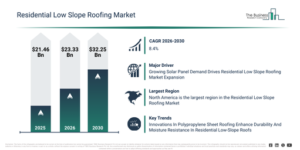
The residential low slope roofing market size has experienced significant growth in recent years. Looking ahead, this market is projected to expand from $21.46 billion in 2025 to $23.33 billion in 2026, achieving a compound annual growth rate (CAGR) of 8.7%. Factors contributing to this growth during the historic period include the increasing adoption of low slope roofing, the rising use of energy-efficient materials, expansion in residential construction, a growing focus on roof durability, and the rising popularity of green roofs.
The residential low slope roofing market is projected to witness significant expansion in the upcoming years. Its valuation is forecast to reach $32.25 billion by 2030, exhibiting a compound annual growth rate (CAGR) of 8.4%. This anticipated growth is driven by factors such as the increasing implementation of automated installation systems, the deployment of IoT-enabled monitoring solutions, the integration of AI-based maintenance strategies, the development of sustainable roofing options, and the broader use of synthetic and composite materials. Notable trends during this period include the adoption of energy-efficient low slope roofing materials, the introduction of smart roof monitoring systems, the incorporation of AI for maintenance and inspection, the expansion of IoT-enabled residential roofing platforms, and advancements in automated installation techniques.
Start With A Free Sample Of The Residential Low Slope Roofing Market Research Report:
The Leading Growth Driver In The Residential Low Slope Roofing Market Explained
The increasing demand for solar panels is projected to propel the growth of the residential low-slope roofing market in the future. Solar panels are pieces of equipment that transform sunlight into electricity through photovoltaic technology. This rising demand for solar panels is driven by the necessity for renewable energy sources and supportive government regulations. Residential low-slope roofs offer a relatively flat surface, enabling solar panels to be positioned and angled optimally for maximum sunlight capture. These low-slope roofs also provide safer and easier access for workers, making the installation of solar panels less risky and more efficient. For instance, in May 2025, according to SolarPower Europe, a Belgium-based non-profit government agency, global solar PV installations reached a new milestone in 2024, hitting 597 GW, representing a 33% growth compared to 2023. Therefore, the expanding demand for solar panels is a key driver for the residential low-slope roofing market.
Key Segments Shaping The Residential Low Slope Roofing Market Landscape
The residential low slope roofing market covered in this report is segmented –
1) By Type: Ethylene Propylene Diene Monomer (EPDM) Roofing, Thermoplastic Olefin (TPO) Roofing, Polyvinyl Chloride (PVC) Roofing, Modified Bitumen Roofing, Other Types
2) By Roofing Material: Bituminous Roofing, Metal Roofing, Tile Roofing, Other Roofing Materials
3) By Application: Commercial, Residential, Industrial
Subsegments:
1) By Ethylene Propylene Diene Monomer (EPDM) Roofing: Fully Adhered EPDM Roofing, Ballasted EPDM Roofing, Mechanically Attached EPDM Roofing
2) By Thermoplastic Olefin (TPO) Roofing: Single-Ply TPO Membranes, Mechanically Fastened TPO Roofing, Fully Adhered TPO Roofing, Ballasted TPO Roofing
3) By Polyvinyl Chloride (PVC) Roofing: Single-Ply PVC Membranes, Mechanically Fastened PVC Roofing, Fully Adhered PVC Roofing, Reinforced vs. Non-Reinforced PVC
4) By Modified Bitumen Roofing: APP (Atactic Polypropylene) Modified Bitumen, SBS (Styrene-Butadiene-Styrene) Modified Bitumen, Self-Adhering Modified Bitumen Systems, Torch-Applied Modified Bitumen Systems
5) By Other Types: Spray Polyurethane Foam (SPF) Roofing, Built-Up Roofing (BUR), Green Roof Systems (Vegetative Roofs), Liquid Applied Roofing Systems
Residential Low Slope Roofing Market Trend Spotlight: Key Shifts Shaping Future Demand
Leading firms within the residential low-slope roofing market are creating polypropylene sheet roofing to enhance durability, moisture resistance, and ease of installation. This type of roofing is a lightweight, thermoplastic material offering robust defense against water, air, and weather damage, while also being straightforward to manage and put in place on low-slope and flat roof surfaces. For instance, in August 2025, Polyglass U.S.A., Inc., a US-based manufacturer of bitumen roofing and waterproofing membranes, launched PolyVap SA S. The product functions as both an air barrier and a vapor barrier, incorporating a high-strength polypropylene sheet with an aggressive acrylic-based adhesive on its underside. It is suitable for deployment as a temporary roofing system for a duration of up to 180 days prior to the final roof assembly. PolyVap SA S exhibits complete impermeability to air, moisture, and water, and its self-adhering connection offers strong wind uplift resistance. This innovation highlights the market’s dedication to developing roofing solutions that are durable, weather-resistant, and easy to apply, thereby addressing the increasing need for efficient and long-lasting low-slope residential roofing systems.
Residential Low Slope Roofing Market Competitive Analysis: Who Are The Main Competitors?
Major companies operating in the residential low slope roofing market are BASF SE, Sika AG, Owens Corning, Kingspan Group plc, Carlisle Construction Materials LLC, Johns Manville Inc., BMI Group Limited, CertainTeed Corporation, CentiMark Corporation, GAF Materials Corporation, Atlas Roofing Corporation, IKO Industries Ltd, The Garland Company Inc., TAMKO Building Products LLC, American Hydrotech Inc., GenFlex Roofing Systems LLC, Polyglass USA Inc, Malarkey Roofing Products Co., ATAS International Inc, ARAC Roof It Forward Inc., Hopkins Roofing LLC, Kemper System Inc., Mule-Hide Products Co Inc., Strategic Building Products LLC
Find The Complete Residential Low Slope Roofing Market Outlook In The Full Report:
Mapping The Residential Low Slope Roofing Market: Regional Leadership And Global Reach
North America was the largest region in the residential low slope roofing market in 2025. North America is expected to be the fastest-growing region in the forecast period. The regions covered in the residential low slope roofing market report are Asia-Pacific, South East Asia, Western Europe, Eastern Europe, North America, South America, Middle East, Africa.
Reach Out To Our Team:
The Business Research Company: https://www.thebusinessresearchcompany.com/
Americas: +1 310-496-7795
Asia: +44 7882 955267 & +91 8897263534
Europe: +44 7882 955267
Email us at: marketing@tbrc.info
Follow us on:
LinkedIn: https://in.linkedin.com/company/the-business-research-company
YouTube: https://www.youtube.com/channel/UC24_fI0rV8cR5DxlCpgmyFQ
Global Market Model: https://www.thebusinessresearchcompany.com/global-market-model

Wasay has over a decade of experience in market research, data modelling, and analytics, with prior experience at GlobalData and Decision Tree Consulting Services. At The Business Research Company , he leads research operations across syndicated studies, customized consulting engagements, and the Global Market Model platform. His professional experience includes supporting organizations such as Boston Consulting Group, KPMG, and Ernst & Young. Wasay holds a degree in Electronics and Communications Engineering, postgraduate management qualifications from International Management Institute Belgium and Indian School of Business and Entrepreneurship, and completed the Integrated Program in Business Analytics from Indian Institute of Management Indore.