Built to provide research that’s more actionable and strategically valuable, The Business Research Company’s 2026 market reports include market attractiveness analysis, total addressable market sizing, company benchmarking matrices, interactive Excel dashboards, broader supply chain intelligence, emerging startup tracking, and in-depth product insights.
3D Stacking Market Size Outlook: How Quickly Will Revenue Expand Through 2030?
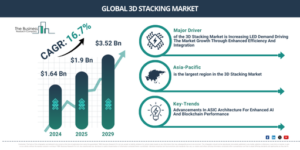
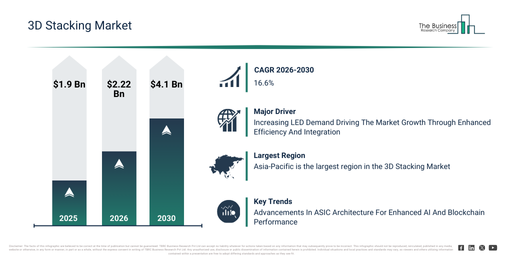
The 3D stacking market has seen rapid expansion in recent years. Its valuation is anticipated to climb from $1.9 billion in 2025 to $2.22 billion in 2026, registering a compound annual growth rate (CAGR) of 16.7%. Historically, this growth can be attributed to advancements in semiconductor lithography, an increasing need for high-performance computing, the expansion of consumer electronics, enhancements in interconnect technologies, and rising research and development investments in chip design.
The 3D stacking market is anticipated to undergo significant expansion in the upcoming years. Its valuation is projected to reach $4.1 billion by 2030, demonstrating a compound annual growth rate (CAGR) of 16.6%. This growth during the forecast period is fueled by the expansion of AI workloads, the adoption of advanced memory technologies, the proliferation of autonomous systems, increasing demand for wearable and smart devices, and advancements in 3D hybrid bonding. Key trends expected over this period encompass 3D stacking for high-performance computing, advanced memory integration, energy-efficient semiconductor design, miniaturization of consumer electronics, and low-latency interconnect technologies.
Get A Free Sample Report With In-Depth Market Insights:
3D Stacking Market Development Factors: What’s Supporting Demand?
The increasing demand for LEDs is expected to propel the growth of the 3D stacking market going forward. LEDs, which are light-emitting diodes, are semiconductor devices that emit light when an electric current passes through them. The demand for these devices is growing due to their superior energy efficiency, extended lifespan, and environmental benefits compared to traditional lighting. 3D stacking further enhances LED performance by facilitating higher integration density, improving thermal management, reducing power consumption, and boosting optical efficiency, rendering it crucial for advanced lighting, display, and miniaturized electronic applications. For instance, in July 2023, the International Energy Agency, a France-based autonomous intergovernmental organization, noted that the efficiency of new LEDs is consistently improving, expected to reach approximately 140 lm/W by 2030, which is around 30% higher than the 2022 average, to align with the Net Zero Scenario. Therefore, the escalating demand for LEDs is driving the growth of the 3D stacking market.
3D Stacking Market Segment Analysis And Revenue Potential
The 3D stacking market covered in this report is segmented –
1) By Device Type: Logic Integrated Circuits (ICs), Imaging And Optoelectronics, Memory Devices, Micro-Electro-Mechanical Systems (MEMS) Or Sensors, LEDs, Other Device Types
2) By Method: Die-To-Die, Die-To-Wafer, Wafer-To-Wafer, Chip-To-Chip, Chip-To-Wafer
3) By Interconnecting Technology: 3D Hybrid Bonding, 3D Through-Silicon Via (TSV), Monolithic 3D Integration
4) By End User: Consumer Electronics, Medical Devices Or Healthcare, Manufacturing, Communications, Automotive, Other End Users
Subsegments:
1) By Logic Integrated Circuits (ICs): Processors, Field-Programmable Gate Arrays (FPGAs), Application-Specific Integrated Circuits (ASICs), System-on-Chip (SoC)
2) By Imaging and Optoelectronics: CMOS Image Sensors, Infrared Sensors, Photodetectors, Optical Transceivers
3) By Memory Devices: Dynamic Random-Access Memory (DRAM), High-Bandwidth Memory (HBM), 3D NAND Flash, Resistive RAM (ReRAM)
4) By Micro-Electro-Mechanical Systems (MEMS) or Sensors: Accelerometers, Gyroscopes, Pressure Sensors, RF MEMS
5) By LEDs: Micro-LEDs, Mini-LEDs, Organic LEDs (OLEDs), Infrared LEDs
6) By Other Device Types: Radio Frequency (RF) Devices, Power Management ICs (PMICs), Analog And Mixed-Signal ICs, Photonic ICs
3D Stacking Market Transformation Trends: What Innovations Are Driving Change?
Leading companies in the 3D stacking market are concentrating on technological advancements, such as 3D stacked application-specific integrated circuit (ASIC) architecture, to improve power efficiency and high-bandwidth 3D memory integration. This architecture involves the vertical integration of multiple ASIC layers, interconnected through-silicon vias (TSVs) or other methods, which enhances performance, increases density, and reduces power consumption compared to traditional two-dimensional (2D) designs. For instance, in December 2024, Nano Labs Ltd., a China-based integrated circuit design company, launched the FPU3.0, an ASIC architecture specifically engineered to boost artificial intelligence (AI) inference and blockchain performance. Through the use of advanced 3D DRAM stacking technology, the FPU3.0 achieves a fivefold increase in power efficiency when compared to its predecessor, the FPU2.0. This sets a new benchmark for high-performance, energy-efficient ASICs. This significant development showcases the company’s strong commitment to research and development in cutting-edge technologies, aiming to drive innovation and promote the wider adoption of AI and cryptocurrency applications.
3D Stacking Market Key Players Shaping Industry Direction
Major companies operating in the 3D stacking market are Samsung Electronics Co. Ltd., Sony Group Corporation, Taiwan Semiconductor Manufacturing Company Ltd., Intel Corporation, International Business Machines Corporation, Qualcomm Technologies Inc., Broadcom Inc., Micron Technology Inc., Advanced Micro Devices Inc., ASML Holding N.V., ASE Technology Holding Co. Ltd., Toshiba Corporation, Texas Instruments Incorporated, Western Digital Technologies Inc., Infineon Technologies AG, Renesas Electronics Corporation, United Microelectronics Corporation, GlobalFoundries Inc., Amkor Technology Inc., JCET Group, Entegris Inc., Imec, Xperi Inc., Nano Labs Ltd., 3D Plus, Tezzaron.
View The Full 3D Stacking Market Report:
3D Stacking Market Regional Analysis: Which Geography Leads On Revenue?
Asia-Pacific was the largest region in the 3D stacking market in 2025. Asia-Pacific is expected to be the fastest-growing region in the forecast period. The regions covered in the 3D stacking market report are Asia-Pacific, South East Asia, Western Europe, Eastern Europe, North America, South America, Middle East, Africa.
Reach Out To Our Team:
The Business Research Company: https://www.thebusinessresearchcompany.com/
Americas: +1 310-496-7795
Asia: +44 7882 955267 & +91 8897263534
Europe: +44 7882 955267
Email us at: marketing@tbrc.info
Follow us on:
LinkedIn: https://in.linkedin.com/company/the-business-research-company
YouTube: https://www.youtube.com/channel/UC24_fI0rV8cR5DxlCpgmyFQ
Global Market Model: https://www.thebusinessresearchcompany.com/global-market-model

Wasay has over a decade of experience in market research, data modelling, and analytics, with prior experience at GlobalData and Decision Tree Consulting Services. At The Business Research Company , he leads research operations across syndicated studies, customized consulting engagements, and the Global Market Model platform. His professional experience includes supporting organizations such as Boston Consulting Group, KPMG, and Ernst & Young. Wasay holds a degree in Electronics and Communications Engineering, postgraduate management qualifications from International Management Institute Belgium and Indian School of Business and Entrepreneurship, and completed the Integrated Program in Business Analytics from Indian Institute of Management Indore.