With a focus on actionable insights and strategic value, The Business Research Company’s 2026 market reports include market attractiveness scoring, total addressable market sizing, company benchmarking matrices, interactive Excel dashboards, deeper supply chain intelligence, emerging startup tracking, and granular product-level insights.
5G Base Station Dielectric Filter Market Size Snapshot: 2026 Valuation, 2030 Projection And Key Growth Factors
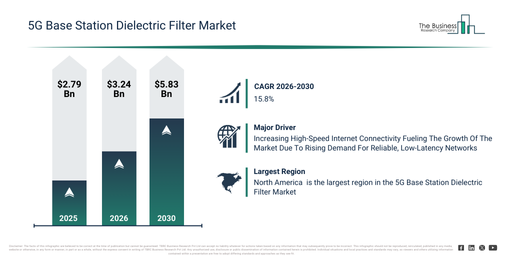
The market for 5G base station dielectric filters has seen rapid expansion in recent years. This market is projected to expand from $2.79 billion in 2025 to $3.24 billion in 2026, demonstrating a compound annual growth rate (CAGR) of 16.1%. Historically, this growth was fueled by factors such as the increasing demand for mobile broadband, the rollout of 4G and initial 5G networks, increased investments in telecommunications infrastructure, the embrace of ceramic and dielectric materials, and the escalating interference in congested frequency bands.
The 5G base station dielectric filter market size is expected to experience substantial growth in the coming years. It is projected to reach $5.83 billion in 2030, growing at a compound annual growth rate (CAGR) of 15.8%. This expansion during the forecast period is driven by factors such as the deployment of mmwave 5G networks, the increasing prevalence of private 5G networks, growing IoT device connectivity, the broadening of smart city projects, and the adoption of energy-efficient telecom components. Prominent trends for the forecast period include optimizing 5G networks, the development of low insertion loss components, the use of high selectivity filters, advancements in temperature-stable RF components, and enhancements in spectrum efficiency.
Get A No-Cost Sample Of The 5G Base Station Dielectric Filter Market Study:
Major Factor Fueling The 5G Base Station Dielectric Filter Market Through 2030
The increasing high-speed internet connectivity is expected to propel the growth of the 5G base station dielectric filter market going forward. This high-speed wireless connectivity facilitates the rapid and reliable transmission of substantial data volumes over wireless networks, enabling seamless communication, real-time applications, and enhanced user experiences across various regions. The heightened demand for high-speed wireless connectivity stems from the swift expansion of data-intensive applications, such as video streaming and internet of things (IoT) devices, which necessitate fast, dependable, and low-latency network performance in both urban and rural areas. High-speed wireless connectivity improves 5G base station dielectric filters by allowing for quicker and more reliable signal transmission. These filters minimize interference by screening out unwanted frequencies, thereby boosting network efficiency and overall communication quality. For instance, in 2023, according to the International Telecommunication Union, a Switzerland-based specialized agency of the United Nations, the number of internet users increased from 5.1 billion (64% penetration) in 2022 to 5.4 billion (67% penetration). Therefore, the rising high-speed internet connectivity is a key driver for the 5G base station dielectric filter market. The growing expansion of smart cities is expected to propel the growth of the 5G base station dielectric filter market going forward. Smart cities are urban areas that utilize digital technologies, data, and smart infrastructure to enhance the quality of life, improve service efficiency, and promote sustainability. The increasing emphasis on smart cities is a result of rapid urbanization, as cities seek innovative solutions to effectively manage infrastructure, resources, and population growth. 5G base station dielectric filters support smart cities by ensuring clear and stable signal transmission, which enables seamless connectivity for internet of things (IoT) devices and urban infrastructure. They reduce network interference by filtering unwanted frequencies, thereby enhancing the efficiency and reliability of smart city applications. For instance, in April 2025, the International Institute for Management Development (IMD), a Switzerland-based business school, assessed 146 cities in its Smart City Index 2025, indicating an expansion in the study’s global city coverage. Therefore, the growing expansion of smart cities is driving the growth of the 5G base station dielectric filter market.
5G Base Station Dielectric Filter Market Segment Landscape: Main Categories And Subcategories Covered
The 5G base station dielectric filter market covered in this report is segmented –
1) By Type of Filter: Band Pass Filter, Low Pass Filter, High Pass Filter, Notch Filter
2) By Product Type: Ceramic Filters, Cavity Filters, Dielectric Resonator Filters, Other Product Types
3) By Material Used: Ceramic, Polytetrafluoroethylene (PTFE), Plastic, Metal
4) By Application Area: Telecom Infrastructure, Smart Cities, Internet of Things (IoT), Public Safety Communications, Private Networks
5) By End User Industry: Telecommunications, Automotive, Healthcare, Manufacturing, Transportation and Logistics
Subsegments:
1) By Band Pass Filter: Narrow Band Pass Filter, Wide Band Pass Filter, Dual Band Pass Filter, Tunable Band Pass Filter
2) By Low Pass Filter: Standard Low Pass Filter, Tunable Low Pass Filter, Elliptic Low Pass Filter, Butterworth Low Pass Filter
3) By High Pass Filter: Standard High Pass Filter, Tunable High Pass Filter, Elliptic High Pass Filter, Chebyshev High Pass Filter
4) By Notch Filter: Single Notch Filter, Dual Notch Filter, Tunable Notch Filter, High-Q Notch Filter
5G Base Station Dielectric Filter Market Leading Players And Key Industry Participants In 2026
Major companies operating in the 5G base station dielectric filter market are Huawei Technologies Co. Ltd., Ube Electronics Ltd., Broadcom Inc., TDK Corporation, Kyocera Corporation, Murata Manufacturing Co. Ltd., Skyworks Solutions Inc., Suzhou Dongshan Precision Manufacturing Co. Ltd., Qorvo Inc., Rohde & Schwarz GmbH & Co. KG, Partron Co. Ltd., Fenghua Advanced Technology Holding Co. Ltd., Wuhan Fingu Electronic Technology Co. Ltd., Taoglas Group Holdings Limited, Tongyu Communication Inc., Samsung Electronics Co. Ltd., Tatfook Technology Co. Ltd., Beijing BDStar Navigation Co. Ltd., MCV Technologies Inc. (MCV Microwave), CaiQin Technology Co. Ltd.
Check Out The Full 5G Base Station Dielectric Filter Market Report 2026:
5G Base Station Dielectric Filter Market By Geography: Revenue Leaders Among Global Regions
North America was the largest region in the 5G base station dielectric filter market in 2025. Asia-Pacific is expected to be the fastest-growing region in the forecast period. The regions covered in the 5G base station dielectric filter market report are Asia-Pacific, South East Asia, Western Europe, Eastern Europe, North America, South America, Middle East, Africa.
Reach Out To Our Team:
The Business Research Company: https://www.thebusinessresearchcompany.com/
Americas: +1 310-496-7795
Asia: +44 7882 955267 & +91 8897263534
Europe: +44 7882 955267
Email us at: marketing@tbrc.info
Follow us on:
LinkedIn: https://in.linkedin.com/company/the-business-research-company
YouTube: https://www.youtube.com/channel/UC24_fI0rV8cR5DxlCpgmyFQ
Global Market Model: https://www.thebusinessresearchcompany.com/global-market-model

Wasay has over a decade of experience in market research, data modelling, and analytics, with prior experience at GlobalData and Decision Tree Consulting Services. At The Business Research Company , he leads research operations across syndicated studies, customized consulting engagements, and the Global Market Model platform. His professional experience includes supporting organizations such as Boston Consulting Group, KPMG, and Ernst & Young. Wasay holds a degree in Electronics and Communications Engineering, postgraduate management qualifications from International Management Institute Belgium and Indian School of Business and Entrepreneurship, and completed the Integrated Program in Business Analytics from Indian Institute of Management Indore.