With a focus on actionable insights and strategic value, The Business Research Company’s 2026 market reports include market attractiveness scoring, total addressable market sizing, company benchmarking matrices, interactive Excel dashboards, deeper supply chain intelligence, emerging startup tracking, and granular product-level insights.
Thermal Management For Fifth Generation (5G) Market Size Analysis: Historical Growth And Future Revenue Projections
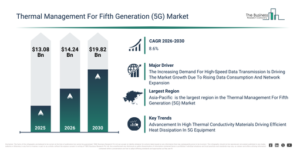
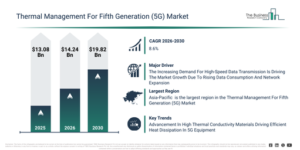
Recent years have witnessed substantial growth in the market size for thermal management for fifth generation (5g). This market is projected to expand from $13.08 billion in 2025 to $14.24 billion in 2026, exhibiting a compound annual growth rate (CAGR) of 8.9%. Historically, this expansion has been driven by factors such as the rapid deployment of 5g infrastructure, increasing data traffic demand, heightened power density in network equipment, greater mobile device usage, and advancements in semiconductor fabrication.
The thermal management for fifth generation (5g) market is projected to experience robust expansion over the coming years. This sector is anticipated to reach a valuation of $19.82 billion by 2030, demonstrating a compound annual growth rate (CAGR) of 8.6%. Key drivers contributing to this anticipated growth include the rollout of standalone 5G networks, the proliferation of edge computing, the increasing deployment of small cells, a growing need for energy-efficient network infrastructure, and innovations in thermal interface materials. Prominent developments expected throughout this period encompass the incorporation of advanced thermal materials, the emergence of compact and lightweight cooling designs, the integration of hybrid cooling systems, the implementation of real-time thermal monitoring solutions, and enhanced approaches for high-density component heat dissipation.
Preview The Thermal Management For Fifth Generation (5G) Market Report With A Free Sample:
Thermal Management For Fifth Generation (5G) Market Drivers: What Is Fueling Demand Through 2030?
The escalating requirement for high-speed data transmission is anticipated to fuel the expansion of thermal management solutions within the 5G market. High-speed data transmission refers to the rapid transfer of substantial data volumes across communication networks, which is vital for applications like streaming, gaming, and cloud computing. This increasing demand stems from the proliferation of data-intensive applications and services that necessitate faster and more dependable network connections to function effectively. Thermal management for 5G ensures optimal cooling and temperature regulation of 5G network equipment, thereby preventing overheating, maintaining consistent performance, and enabling reliable high-speed data transmission for data-intensive applications and seamless connectivity across densely populated networks. For example, in April 2024, the International Telecommunication Union (ITU), a Switzerland-based United Nations agency, stated that global mobile broadband traffic reached 1 zettabyte for the first time in 2023 and is projected to increase to 1.3 zettabytes in 2024. Simultaneously, fixed broadband traffic is expected to grow from 5.1 to 6 zettabytes during the same period. Hence, the rising need for high-speed data transmission is a significant factor driving the growth of thermal management for the fifth-generation (5G) market.
Thermal Management For Fifth Generation (5G) Market Segmentation Analysis: Core Categories And Subcategories
The thermal management for fifth generation (5g) market covered in this report is segmented –
1) By Solution Type: Materials, Hardware Systems, Services
2) By Cooling Method: Passive, Active (Air), Hybrid
3) By Application: Fifth Generation (5G) Infrastructure, Fifth Generation (5G) Devices, Power And Supporting Systems
Subsegments:
1) By Materials: Thermal Interface Materials, Adhesives, Graphite, Graphene, Ceramics, Die Attach
2) By Hardware Systems: Heat Sinks, Vapor Chambers, Heat Pipes, Fans, Liquid Cooling, Immersion Cooling
3) By Services: Thermal Monitoring, Thermal Control, Thermal Design, Thermal Integration
Which Trends Will Define The Thermal Management For Fifth Generation (5G) Market Through 2030?
Major companies involved in thermal management for the 5G market are focused on developing advanced products, such as high thermal conductivity materials, to effectively dissipate heat and enable the high-speed operation of 5G equipment. High thermal conductivity materials are substances capable of transferring heat rapidly and efficiently, which helps in dissipating excess heat from electronic components, thereby ensuring reliable performance and extended lifespans for devices. For example, in June 2025, U-MAP Co., Ltd., a Japan-based technology firm that specializes in high-efficiency materials, launched Thermalnite. This high thermal conductivity fibrous ceramic material is engineered to significantly improve heat dissipation, enhance mechanical strength, and meet the thermal management needs of advanced electronics, including 5G equipment. It allows manufacturers to sustain high device performance while preventing overheating, even in compact and high-power 5G modules. Incorporating minimal amounts of Thermalnite into composite materials can enhance thermal conductivity by up to tenfold, all while maintaining flexibility and minimizing added weight. This advancement opens up innovative applications in structural design, injection moulding, and other manufacturing processes, establishing it as a strategic solution for next-generation telecommunications infrastructure.
Thermal Management For Fifth Generation (5G) Market Major Companies And Industry Participants
Major companies operating in the thermal management for fifth generation (5g) market are The Dow Chemical Company, Honeywell International Inc., 3M Company, Henkel AG & Co. KGaA, Parker-Hannifin Corporation, TDK Corporation, Kyocera Corporation, Delta Electronics Inc., Vertiv Holdings Co., H.B. Fuller Company, Boyd Corporation, Autoneum Holding AG, Syensqo, Mersen SA, Momentive Performance Materials Inc., Malico Inc., Zaward Corporation, Advanced Thermal Solutions Inc., Advanced Cooling Technologies Inc., European Thermodynamics Ltd.
Buy The Full Thermal Management For Fifth Generation (5G) Global Market Report 2026:
Thermal Management For Fifth Generation (5G) Market Geographic Analysis: Which Region Accounts For The Biggest Share?
Asia-Pacific was the largest region in the thermal management for fifth generation (5G) market in 2025. North America is expected to be the fastest-growing region in the forecast period. The regions covered in the thermal management for fifth generation (5g) market report are Asia-Pacific, South East Asia, Western Europe, Eastern Europe, North America, South America, Middle East, Africa.
Reach Out To Our Team:
The Business Research Company: https://www.thebusinessresearchcompany.com/
Americas: +1 310-496-7795
Asia: +44 7882 955267 & +91 8897263534
Europe: +44 7882 955267
Email us at: marketing@tbrc.info
Follow us on:
LinkedIn: https://in.linkedin.com/company/the-business-research-company
YouTube: https://www.youtube.com/channel/UC24_fI0rV8cR5DxlCpgmyFQ
Global Market Model: https://www.thebusinessresearchcompany.com/global-market-model

Wasay has over a decade of experience in market research, data modelling, and analytics, with prior experience at GlobalData and Decision Tree Consulting Services. At The Business Research Company , he leads research operations across syndicated studies, customized consulting engagements, and the Global Market Model platform. His professional experience includes supporting organizations such as Boston Consulting Group, KPMG, and Ernst & Young. Wasay holds a degree in Electronics and Communications Engineering, postgraduate management qualifications from International Management Institute Belgium and Indian School of Business and Entrepreneurship, and completed the Integrated Program in Business Analytics from Indian Institute of Management Indore.