Designed to make market research more actionable and strategically valuable, The Business Research Company’s 2026 market reports feature market attractiveness scoring, total addressable market sizing, company benchmarking matrices, interactive Excel dashboards, deeper supply chain intelligence, emerging startup tracking, and granular product-level insights.
How Big Is The Advanced Carbon Dioxide (CO2) Sensors Market In 2026, And How Fast Will It Grow?
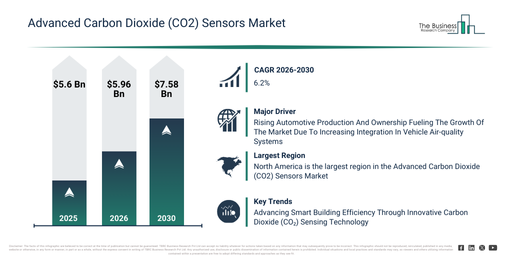
The market for advanced carbon dioxide (co2) sensors has experienced robust growth over the past few years. This market is projected to expand from $5.6 billion in 2025 to reach $5.96 billion by 2026, demonstrating a compound annual growth rate (CAGR) of 6.5%. Historically, this expansion has been driven by factors such as increased consciousness regarding indoor air quality, initial integration into HVAC systems, advancements in NDIR sensor technologies, demands for industrial process optimization, and the expansion of building automation initiatives.
The market for advanced carbon dioxide (co2) sensors is projected to experience substantial expansion over the coming years. This sector is anticipated to reach $7.58 billion in 2030, demonstrating a compound annual growth rate (CAGR) of 6.2%. This growth during the projection period stems from various factors, including increased usage in smart homes and commercial properties, a rising need for wireless and retrofit sensing options, seamless integration with IoT and cloud infrastructures, more stringent safety and emission guidelines, and broadening applications across healthcare and consumer electronics. Significant trends expected in the forecast period encompass the integration of co2 sensors with HVAC and building automation systems, the widespread uptake of wireless and retrofit co2 sensor solutions, the implementation of real-time monitoring for optimizing industrial processes, the development of high-accuracy multi-pass optical sensing technologies, and their application in smart homes and for safety and fire detection.
Download A Free Advanced Carbon Dioxide (CO2) Sensors Market Sample Report With Size And Forecast Data:
Advanced Carbon Dioxide (CO2) Sensors Market Growth Driver: The Key Factor Behind Rising Demand
The expansion in automotive manufacturing and vehicle ownership is anticipated to fuel the growth of the advanced carbon dioxide (CO2) sensors market moving forward. Automobiles are motor vehicles designed for road transport, encompassing passenger cars and light commercial vehicles used for transporting people or goods. The increasing count of automobiles is attributed to a resurgence in registrations and an augmentation in the on-road vehicle stock in 2023 compared with 2022. As more vehicles become operational, automakers and tier-1 suppliers incorporate advanced CO2 sensors into cabin air-quality modules to manage fresh-air intake, alleviate CO2 buildup and drowsiness, and satisfy comfort and safety specifications, thereby increasing sensor units per vehicle. For instance, in May 2024, GOV.UK, a UK-based executive agency, reported 41.2 million licensed vehicles in the United Kingdom, a 1% increase from the end of 2022, demonstrating an annual rise in the vehicle fleet. Hence, the escalating automotive production and ownership are driving the advanced carbon dioxide (CO2) sensors market.
Advanced Carbon Dioxide (CO2) Sensors Market Segmentation: Key Segments And Subsegments Covered
The advanced carbon dioxide (co2) sensors market covered in this report is segmented –
1) By Product: Non-Dispersive Infrared (NDIR) Advanced Carbon Dioxide (CO2) Sensors, Chemical Advanced Carbon Dioxide (CO2) Sensors
2) By Sensor Fitting: Retrofit, Wall Mount
3) By Connectivity: Wired Carbon Dioxide (CO2) Sensors, Wireless Carbon Dioxide (CO2) Sensors
4) By Application: Heating, Ventilation, And Air Conditioning (HVAC) Systems, Smart Homes And Buildings, Safety And Fire Detection, Industrial Processes, Quality Control, Other Applications
5) By End-Use Industry: Healthcare, Petrochemical, Building Automation, Automotive, Consumer Electronics, Other End-Users
Subsegments:
1) By Non-Dispersive Infrared (NDIR) Advanced Carbon Dioxide (CO2) Sensors: Single Beam Single Wavelength, Single Beam Dual Wavelength, Dual Beam Reference Configuration, Long Optical Path Multi Pass, Short Optical Path Compact Module, Thermopile Detector Based Module, Pyroelectric Detector Based Module
2) By Chemical Advanced Carbon Dioxide (CO2) Sensors, By Type: Colorimetric Dye Based Optical Sensor, Metal Oxide Semiconductor Chemiresistive Sensor, Ion Selective Field Effect Transistor With Bicarbonate Membrane, Polymer Nanocomposite Chemiresistive Sensor, Metal Organic Framework Sorption Sensor, Severinghaus Electrode Sensor
Advanced Carbon Dioxide (CO2) Sensors Market Trends: Key Developments Shaping 2026 And Beyond
Companies operating in the advanced carbon dioxide (CO2) sensors market are concentrating on technological breakthroughs, such as photoacoustic spectroscopy, to improve sensor precision, reduce their size and expense, and enable efficient implementation in heating, ventilation, and air conditioning; the internet of things; and building automation systems. Photoacoustic spectroscopy (PAS) is a sensing and measurement approach where a gas or material absorbs light, leading to localized heating and pressure changes that produce sound waves. These sound waves are then detected by sensitive microphones to accurately determine the concentration of specific gases, like carbon dioxide (CO2). For example, in November 2024, Infineon, a Germany-based semiconductor company, introduced the XENSIV PAS CO2 5V sensor, an advanced photoacoustic spectroscopy-based product designed for smart buildings to continuously monitor indoor air quality and optimize heating, ventilation, and air conditioning energy use, offering precise, reliable, and energy-efficient climate control while supporting decarbonization efforts.
Leading Companies Operating In The Advanced Carbon Dioxide (CO2) Sensors Market
Major companies operating in the advanced carbon dioxide (co2) sensors market are Siemens AG, Asahi Kasei Corporation, Infineon Technologies AG, Murata Manufacturing Co. Ltd., Vaisala Oyj, Sensirion AG, KMC Controls Inc., Winson, Building Automation Products Inc. (BAPI), AZoSensors.com, COMET SYSTEM s.r.o., Ahlborn Mess- und Regelungstechnik GmbH (ALMEMO), Digital Control Systems Inc., smartGAS Mikrosensorik GmbH, Sable Systems International, CO2meter.com, ELT Sensor Co. Ltd., PP Systems Inc., Cubic Sensor and Instrument Co. Ltd., BlueSens Gas Sensor GmbH.
Access The Full Advanced Carbon Dioxide (CO2) Sensors Market Research Report:
Advanced Carbon Dioxide (CO2) Sensors Market Regional Analysis: Largest Region And Key Geographies Covered
North America was the largest region in the advanced carbon dioxide (CO2) sensors market in 2025. Asia-Pacific is expected to be the fastest-growing region in the forecast period. The regions covered in the advanced carbon dioxide (co2) sensors market report are Asia-Pacific, South East Asia, Western Europe, Eastern Europe, North America, South America, Middle East, Africa.
Reach Out To Our Team:
The Business Research Company: https://www.thebusinessresearchcompany.com/
Americas: +1 310-496-7795
Asia: +44 7882 955267 & +91 8897263534
Europe: +44 7882 955267
Email us at: marketing@tbrc.info
Follow us on:
LinkedIn: https://in.linkedin.com/company/the-business-research-company
YouTube: https://www.youtube.com/channel/UC24_fI0rV8cR5DxlCpgmyFQ
Global Market Model: https://www.thebusinessresearchcompany.com/global-market-model

Wasay has over a decade of experience in market research, data modelling, and analytics, with prior experience at GlobalData and Decision Tree Consulting Services. At The Business Research Company , he leads research operations across syndicated studies, customized consulting engagements, and the Global Market Model platform. His professional experience includes supporting organizations such as Boston Consulting Group, KPMG, and Ernst & Young. Wasay holds a degree in Electronics and Communications Engineering, postgraduate management qualifications from International Management Institute Belgium and Indian School of Business and Entrepreneurship, and completed the Integrated Program in Business Analytics from Indian Institute of Management Indore.