Featuring market attractiveness scoring, total addressable market sizing, company benchmarking matrices, interactive Excel dashboards, deeper supply chain intelligence, emerging startup tracking, and granular product-level insights, The Business Research Company’s 2026 market reports are built to deliver research that is both more actionable and more strategically valuable.
Assembly Market Size Forecast: How Big Could The Market Get By 2030?
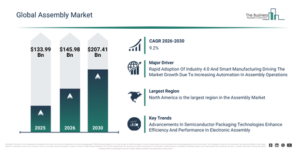
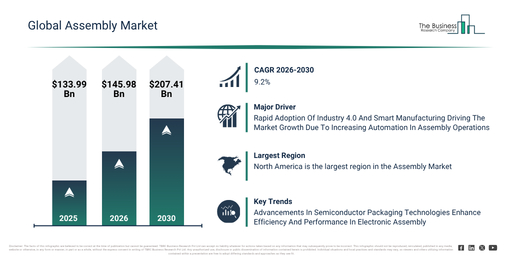
The assembly market has demonstrated substantial growth in recent years. Looking ahead, its expansion is projected from $133.99 billion in 2025 to $145.98 billion in 2026, exhibiting a compound annual growth rate (CAGR) of 8.9%. This historical growth was influenced by factors such as low integration density packaging demand, the reliance on manual assembly processes, the limited adoption of advanced packaging, a rise in consumer electronics demand, and an early dependence on outsourced semiconductor assembly.
The assembly market is anticipated to experience substantial expansion over the coming years. It is projected to reach $207.41 billion by 2030, demonstrating a compound annual growth rate (CAGR) of 9.2%. This growth during the forecast period can be linked to several factors, including the pressure for miniaturization in electronics, the rapid adoption of chiplet architectures, a growing need for high-performance computing chips, the expansion of electronics in electric and autonomous vehicles, and the increasing requirement for highly reliable advanced packaging solutions. Key trends for the forecast period encompass the miniaturization of advanced semiconductor packaging alongside high-density interconnects, the embrace of heterogeneous integration and chiplet-based designs, hurdles related to thermal and power management in advanced IC assembly, a transition towards wafer-level and 2.5D/3D integrated packaging technologies, and a heightened emphasis on reliability testing and failure analysis within semiconductor assembly processes.
Get A Free Sample Report With In-Depth Market Insights:
Assembly Market Growth Catalysts And Demand Drivers
The widespread implementation of Industry 4.0 and smart manufacturing is anticipated to significantly boost the expansion of the assembly market moving ahead. Industry 4.0 encompasses the incorporation of sophisticated digital technologies, including artificial intelligence, the Industrial Internet of Things (IIoT), robotics, and real-time data analytics, into industrial and manufacturing operations. This increasing embrace of Industry 4.0 and smart manufacturing is primarily fueled by manufacturers’ urgent requirement to tackle labor deficits and improve operational effectiveness, given that businesses across various industries are substantially investing in automated systems to sustain productivity and their position in the global market. The emergence of smart manufacturing directly stimulates the demand for assembly, since automated robotic setups and intelligent assembly lines are taking over manual operations, thus necessitating advanced assembly components, high-precision tools, and integrated digital frameworks. As an illustration, figures from April 2024, provided by the International Federation of Robotics (IFR) – a Germany-based body representing robotics trade associations and manufacturers in over 20 countries – show that total industrial robot installations by U.S. manufacturers climbed from 39,600 units in 2022 to 44,303 units in 2023, indicating an increase of 4,703 units. Consequently, the swift uptake of Industry 4.0 and smart manufacturing is propelling the expansion of the assembly market.
Assembly Market Segment Analysis Spotlighting Growth Areas
The assembly market covered in this report is segmented –
1) By Component: Hardware, Software, Services
2) By Equipment Type: Die Bonders Or Die Attach Equipment, Wire Bonders, Flip-Chip Attach Systems, Encapsulation And Molding Machines, Inspection And Metrology Tools, Automation And Handling Systems
3) By Packaging Type: Traditional Packaging (Wire Bond, Leadframe), Advanced Packaging (Flip-Chip, Wafer-Level Packaging (WLP), 2.5D/3D Stacking), System-In-Package (SiP), Chip-on-Board (CoB) Or Chip-on-Flex (CoF)
4) By Application: Consumer Electronics, Automotive Electronics, Industrial Electronics and Automation, Computing And Data Centers, Healthcare And Medical Devices, Aerospace And Defense
5) By End-User: Integrated Device Manufacturers, Foundries, Contract Manufacturers
Subsegments:
1) By Hardware: Wafer Handling Equipment, Die Bonding Equipment, Wire Bonding Equipment, Flip Chip Bonding Equipment, Encapsulation Equipment, Soldering Equipment, Inspection And Testing Equipment, Laser Dicing Equipment, Material Handling Systems, Packaging Equipment
2) By Software: Design And Simulation Software, Process Control Software, Manufacturing Execution Software, Quality Control Software, Equipment Monitoring Software, Production Planning Software, Data Analysis Software, Automation Control Software
3) By Services: Installation Services, Maintenance And Repair Services, Calibration Services, Technical Support Services, Training Services, Consulting Services, System Integration Services, Upgradation Services
Assembly Market Trends Shaping Long-Term Demand
Leading companies in the assembly market are prioritizing the development of sophisticated solutions, such as advanced semiconductor packaging technologies, to enhance thermal attributes, reduce physical dimensions, and improve overall device resilience. High-performance semiconductor packaging solutions are designed to integrate and safeguard semiconductor components while simultaneously boosting their operational speed, efficiency, thermal regulation, and miniaturization for cutting-edge computing applications. For example, in December 2025, Suchi Semicon, an India-based outsourced semiconductor assembly and test (OSAT) organization, introduced advanced QFN and power packaging offerings tailored to support high-performance and energy-efficient electronic systems. These offerings aim to satisfy the rising demand for compact, highly dependable components across various industries like automotive, consumer electronics, and industrial systems, concurrently improving manufacturing effectiveness and heat management within semiconductor assembly processes.
Assembly Market Competitive Overview And Top Companies
Major companies operating in the assembly market are Kaijo Corporation, Nordson Corporation, ASMPT Limited, DISCO Corporation, Kulicke and Soffa Industries Inc, BE Semiconductor Industries NV, I-PEX Inc, TOWA Corporation, Hanmi Semiconductor Co Ltd, Shinkawa Ltd, SPEL Semiconductor Limited, Tokyo Seimitsu Co Ltd, FiconTEC Service GmbH, Advanced Engineering Corporation, West Bond Inc, Micro Assembly Technologies Ltd, Dr Tresky AG, Musashi Engineering Inc, Bondtec Semiconductor GmbH, DIAS Automation Asia Co Ltd
View The Full Assembly Market Report:
Assembly Market Leading Geography: Which Region Contributes The Most Revenue?
North America was the largest region in the assembly market in 2025. Asia-Pacific is expected to be the fastest-growing region in the forecast period. The regions covered in the assembly market report are Asia-Pacific, South East Asia, Western Europe, Eastern Europe, North America, South America, Middle East, Africa.
Reach Out To Our Team:
The Business Research Company: https://www.thebusinessresearchcompany.com/
Americas: +1 310-496-7795
Asia: +44 7882 955267 & +91 8897263534
Europe: +44 7882 955267
Email us at: marketing@tbrc.info
Follow us on:
LinkedIn: https://in.linkedin.com/company/the-business-research-company
YouTube: https://www.youtube.com/channel/UC24_fI0rV8cR5DxlCpgmyFQ
Global Market Model: https://www.thebusinessresearchcompany.com/global-market-model

Wasay has over a decade of experience in market research, data modelling, and analytics, with prior experience at GlobalData and Decision Tree Consulting Services. At The Business Research Company , he leads research operations across syndicated studies, customized consulting engagements, and the Global Market Model platform. His professional experience includes supporting organizations such as Boston Consulting Group, KPMG, and Ernst & Young. Wasay holds a degree in Electronics and Communications Engineering, postgraduate management qualifications from International Management Institute Belgium and Indian School of Business and Entrepreneurship, and completed the Integrated Program in Business Analytics from Indian Institute of Management Indore.