
Backed by market attractiveness analysis, total addressable market sizing, company benchmarking matrices, interactive Excel dashboards, wider supply chain intelligence, emerging startup coverage, and detailed product-level insights, The Business Research Company’s 2026 market reports are designed to offer research that is more actionable and strategically valuable than ever.
Auto Integrated Circuit (IC) Market Expansion Outlook: What Revenue Opportunities Are Ahead?
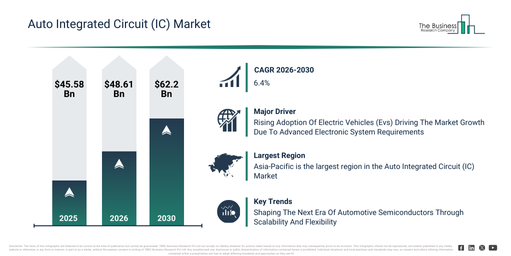
The auto integrated circuit (ic) market size has experienced robust expansion in recent years. It is projected to increase from $45.58 billion in 2025 to $48.61 billion in 2026, exhibiting a compound annual growth rate (CAGR) of 6.7%. This historic growth was primarily driven by the escalating demand for automotive electronics, the enhanced adoption of engine management systems, a surge in vehicle production within emerging markets, continuous improvements in sensor technologies, and the early integration of microcontrollers in passenger vehicles.
The auto integrated circuit (IC) market size is projected to experience substantial growth in the coming years. It is forecast to expand to $62.2 billion by 2030, achieving a compound annual growth rate (CAGR) of 6.4%. This expansion during the forecast period can be attributed to advancements in autonomous driving technologies, the increasing adoption of electric vehicles, a heightened demand for smart vehicle systems, the integration of AI into automotive electronics, and the development of next-generation battery management ICs. Significant trends for this period include enhanced automotive safety systems, energy-efficient automotive electronics, advanced vehicle connectivity solutions, smart sensor integration, and adaptive power management systems.
Get A Free Sample Report With In-Depth Market Insights:
Auto Integrated Circuit (IC) Market Growth Drivers: What’s Behind The Acceleration?
The increasing embrace of electric vehicles (EVs) is anticipated to drive the expansion of the auto integrated circuit (IC) market in the future. EVs are vehicles that operate on electric motors, drawing power from rechargeable battery packs, in contrast to conventional internal combustion engines. The take-up of electric vehicles is consistently increasing, spurred by heightened environmental consciousness, which encourages both individuals and governments to cut carbon emissions and address climate change. This surge in EV adoption fuels the need for auto integrated circuits, due to the necessity for advanced electronic systems within these vehicles for functions like battery management, power conversion, motor control, and sophisticated driver assistance. For example, data from January 2025 by Cox Automotive Inc., a US-based software development company, indicates that 2023 sales were revised upwards to 1,212,758 units, marking a 49% rise from 2022. By 2024, sales continued to climb, reaching 1,301,411 units, which was a 7.3% increase and accounted for 8.1% of total sales, an improvement from the 7.8% share observed in 2023. Consequently, the expanding embrace of electric vehicles is a key factor propelling the growth of the auto integrated circuit market.
Auto Integrated Circuit (IC) Market Breakdown By Product Type And Application
The auto integrated circuit (ic) market covered in this report is segmented –
1) By Product Type: Microcontrollers, Power Amplifiers, Sensor Integrated Circuits (ICs), Battery Management Integrated Circuits (ICs), Analog Integrated Circuits (ICs)
2) By Technology Type: Analog Technology, Digital Technology, Mixed-Signal Technology, Embedded Technology, Discrete Technologies
3) By Vehicle Type: Passenger Vehicles, Commercial Vehicles, Electric Vehicles (EVs), Hybrid Electric Vehicles (HEVs), Luxury Vehicles
4) By Sales Channel: Original Equipment Manufacturers (OEMS), Aftermarket, Distributors, Online Retail, Direct Sales
5) By Application: Advance Driver Assistance System, In-Vehicle Networking, Engine Management, Transmission Control System, Other Applications
Subsegments:
1) By Microcontrollers: 8-Bit Microcontrollers, 16-Bit Microcontrollers, 32-Bit Microcontrollers, Automotive Grade Microcontrollers
2) By Power Amplifiers: Audio Power Amplifiers, Radio Frequency Power Amplifiers, Switching Power Amplifiers, Linear Power Amplifiers
3) By Sensor Integrated Circuits: Temperature Sensor Integrated Circuits, Pressure Sensor Integrated Circuits, Proximity Sensor Integrated Circuits, Accelerometer Sensor Integrated Circuits
4) By Battery Management Integrated Circuits: Charging Management Integrated Circuits, Discharging Management Integrated Circuits, Cell Balancing Integrated Circuits, Protection Integrated Circuits
5) By Analog Integrated Circuits: Operational Amplifier Integrated Circuits, Voltage Regulator Integrated Circuits, Comparator Integrated Circuits, Analog Signal Processing Integrated Circuits
Auto Integrated Circuit (IC) Market Trends: What’s Defining The Industry’s Next Phase?
Leading companies in the auto integrated circuit (IC) market are increasingly utilizing innovative technologies like chiplet technology to enhance performance, scalability, and design flexibility. Chiplet technology represents a semiconductor design approach where a system-on-chip (SoC) is constructed from multiple smaller chip modules (chiplets) instead of a single large monolithic die, thereby improving performance, scalability, manufacturing yield, and design versatility while simultaneously reducing costs. For instance, in November 2024, Renesas Electronics Corporation, a Japan-based semiconductor manufacturing firm, unveiled the R-Car X5H, which is the industry’s first automotive multi-domain SoC built using 3-nanometer process technology. This new SoC incorporates advanced AI acceleration, robust GPU performance, mixed-criticality processing, and chiplet extension capabilities to support applications in ADAS, infotainment, and gateway systems, empowering automakers to develop scalable and future-proof software-defined vehicles. The adoption of chiplet extensions via the Universal Chiplet Interconnect Express (UCIe) standard allows customers to seamlessly integrate additional NPUs, GPUs, or other specialized components, offering significant flexibility for next-generation vehicle architectures.
Auto Integrated Circuit (IC) Market Company Landscape And Competitive Strategy
Major companies operating in the auto integrated circuit (ic) market are Samsung Electronics Co. Ltd., Robert Bosch GmbH, Qualcomm Incorporated, Toshiba Electronic Devices & Storage Corporation, Texas Instruments Incorporated, STMicroelectronics N.V., Micron Technology Inc., Kyocera Corporation, NXP Semiconductors N.V., Analog Devices Inc., Renesas Electronics Corporation, Microchip Technology Incorporated, ON Semiconductor Corporation, Vishay Intertechnology Inc., ROHM Co. Ltd., Nexperia B.V., Littelfuse Inc., Wolfspeed Inc., Silicon Labs Inc., ABLIC Inc.
View The Full Auto Integrated Circuit (IC) Market Report:
Auto Integrated Circuit (IC) Market Top Region: Where Does Most Revenue Come From?
Asia-Pacific was the largest region in the auto integrated circuit (IC) market in 2025. Asia-Pacific is expected to be the fastest-growing region in the forecast period. The regions covered in the auto integrated circuit (ic) market report are Asia-Pacific, South East Asia, Western Europe, Eastern Europe, North America, South America, Middle East, Africa.
Reach Out To Our Team:
The Business Research Company: https://www.thebusinessresearchcompany.com/
Americas: +1 310-496-7795
Asia: +44 7882 955267 & +91 8897263534
Europe: +44 7882 955267
Email us at: marketing@tbrc.info
Follow us on:
LinkedIn: https://in.linkedin.com/company/the-business-research-company
YouTube: https://www.youtube.com/channel/UC24_fI0rV8cR5DxlCpgmyFQ
Global Market Model: https://www.thebusinessresearchcompany.com/global-market-model

Wasay has over a decade of experience in market research, data modelling, and analytics, with prior experience at GlobalData and Decision Tree Consulting Services. At The Business Research Company , he leads research operations across syndicated studies, customized consulting engagements, and the Global Market Model platform. His professional experience includes supporting organizations such as Boston Consulting Group, KPMG, and Ernst & Young. Wasay holds a degree in Electronics and Communications Engineering, postgraduate management qualifications from International Management Institute Belgium and Indian School of Business and Entrepreneurship, and completed the Integrated Program in Business Analytics from Indian Institute of Management Indore.