Backed by market attractiveness analysis, total addressable market sizing, company benchmarking matrices, interactive Excel dashboards, wider supply chain intelligence, emerging startup coverage, and detailed product-level insights, The Business Research Company’s 2026 market reports are designed to offer research that is more actionable and strategically valuable than ever.
Automotive Acoustic Materials Market Size, Value And Growth Trajectory Through 2030
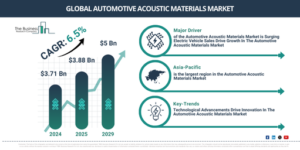
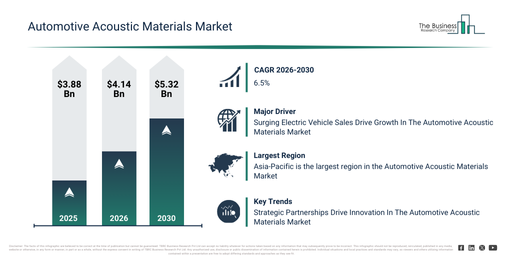
The automotive acoustic materials market size has experienced robust growth in recent years. It is projected to expand from $3.88 billion in 2025 to $4.14 billion in 2026, demonstrating a compound annual growth rate (CAGR) of 6.6%. This historical expansion can be attributed to factors such as the increased utilization of conventional NVH materials, a reliance on mechanical insulation, the growth in passenger car applications, early adoption within commercial vehicles, and the increasing demand for in-cabin noise control.
The automotive acoustic materials market is projected to experience substantial expansion in the coming years. Its valuation is anticipated to reach $5.32 billion by 2030, exhibiting a compound annual growth rate (CAGR) of 6.5%. This anticipated growth is driven by factors such as the rising use of AI-integrated acoustic systems, advancements in sustainable and lightweight material development, the broadening of electric vehicle NVH solutions, incorporation with intelligent vehicle monitoring systems, and the expanding luxury and premium vehicle sectors. Key developments expected during this period involve the embrace of AI-driven NVH solutions, the widespread use of smart acoustic materials, the integration of IoT-enabled noise observation, the spread of lightweight soundproofing technologies, and the introduction of automated in-car acoustic management.
Get A Free Sample Report With In-Depth Market Insights:
Automotive Acoustic Materials Market Growth Backed By Core Demand Fundamentals
The expansion of the automotive acoustic materials market is anticipated to be significantly boosted by the growing sales of electric vehicles moving forward. Electric vehicles (EVs) are defined as automobiles that operate on electric motors, drawing power from rechargeable batteries, in contrast to traditional internal combustion engines. The increasing embrace of electric vehicles stems from heightened environmental awareness, given that EVs produce no tailpipe emissions, thereby contributing to lower air pollution and a reduced carbon footprint compared to conventional gasoline vehicles. Within these vehicles, automotive acoustic materials play a crucial role in mitigating interior noise through soundproofing and sound absorption techniques. This trend is underscored by recent data; for instance, a report from January 2024 by Kelley Blue Book, a US-based automotive firm, revealed that 2023 saw an unprecedented 1.2 million car purchasers in the United States opting for electric vehicles. This constituted 7.6% of the overall U.S. vehicle market, a notable increase from 5.9% in 2022. Consequently, the escalating demand for electric vehicles is a key driver for the expansion of the automotive acoustic materials market.
Automotive Acoustic Materials Market Segment Landscape: Which Areas Lead Development?
The automotive acoustic materials market covered in this report is segmented –
1) By Material Type: Acrylonitrile Butadiene Styrene (ABS), Fiberglass, Polyvinyl Chloride (PVC), Polyurethane (PU) Foam, Polypropylene, Textiles
2) By Component: Arch Liner, Dash, Fender and Floor Insulator, Door, Head & Bonnet Liner, Engine Cover, Trunk Trim, Parcel Tray, Other Components
3) By Vehicle Type: Passenger Cars, LCV, HCV
4) By Application: Underbody and Engine Bay Acoustics, Interior Cabin Acoustics, Exterior Acoustics, Trunk Panel Acoustics
Subsegments:
1) By Acrylonitrile Butadiene Styrene (ABS): ABS Sheets, ABS Foam
2) By Fiberglass: Fiberglass Mats, Fiberglass Panels
3) By Polyvinyl Chloride (PVC): Rigid PVC Sheets, Flexible PVC Sheets
4) By Polyurethane (PU) Foam: Rigid PU Foam, Flexible PU Foam
5) By Polypropylene: Polypropylene Sheets, Polypropylene Foam
6) By Textiles: Non-woven Textiles, Woven Textiles, Composite Textiles
Automotive Acoustic Materials Market Growth Trends Reshaping The Competitive Landscape
Leading companies in automotive acoustic materials are adopting strategic collaboration strategies to offer comprehensive and integrated solutions. These partnerships involve businesses leveraging each other’s strengths and resources to achieve shared benefits and success. For example, in July 2024, the manufacturing firm Brose introduced an acoustic vehicle alerting system. This system is designed to improve the safety of electric and hybrid vehicles, which are generally quieter than their internal combustion engine equivalents. It produces audible warnings at low speeds to notify pedestrians and other road users of the vehicle’s presence, thereby decreasing the likelihood of accidents caused by the absence of sound. AVAS is a mandatory requirement in many areas to ensure adherence to safety regulations, especially as the automotive industry moves towards electrification. The system can create distinct sound designs across a broad frequency range, customized for different driving scenarios, to enhance auditory recognition and vehicle identification.
Automotive Acoustic Materials Market Industry Leaders And Competitive Landscape
Major companies operating in the automotive acoustic materials market are Dow Chemical Company, 3M Acoustic Solutions, BASF SE, Covestro AG, Henkel Adhesives Technologies India Private Limited, LyondellBasell Industries Holdings B.V., Sumitomo Riko Co. Ltd., Sika AG, Huntsman International LLC, Johns Manville, Harman International, UFP Technologies Inc., Nihon Tokushu Toryo Co. Ltd., Owens Corning, DuPont Automotive, ThyssenKrupp Automotive AG, Alps Automotive Inc., American Showa Inc., ShanghAI Energy New Materials Technology Co. Ltd., Cangzhou Mingzhu Plastic Co., Teijin Limited, Nitto Denko Corporation
View The Full Automotive Acoustic Materials Market Report:
Automotive Acoustic Materials Market Geographic Landscape: Which Region Leads Industry Growth?
Asia-Pacific was the largest region in the automotive acoustic materials market share in 2025. The regions covered in the automotive acoustic materials market report are Asia-Pacific, South East Asia, Western Europe, Eastern Europe, North America, South America, Middle East, Africa.
Reach Out To Our Team:
The Business Research Company: https://www.thebusinessresearchcompany.com/
Americas: +1 310-496-7795
Asia: +44 7882 955267 & +91 8897263534
Europe: +44 7882 955267
Email us at: marketing@tbrc.info
Follow us on:
LinkedIn: https://in.linkedin.com/company/the-business-research-company
YouTube: https://www.youtube.com/channel/UC24_fI0rV8cR5DxlCpgmyFQ
Global Market Model: https://www.thebusinessresearchcompany.com/global-market-model

Wasay has over a decade of experience in market research, data modelling, and analytics, with prior experience at GlobalData and Decision Tree Consulting Services. At The Business Research Company , he leads research operations across syndicated studies, customized consulting engagements, and the Global Market Model platform. His professional experience includes supporting organizations such as Boston Consulting Group, KPMG, and Ernst & Young. Wasay holds a degree in Electronics and Communications Engineering, postgraduate management qualifications from International Management Institute Belgium and Indian School of Business and Entrepreneurship, and completed the Integrated Program in Business Analytics from Indian Institute of Management Indore.